The Taos Hum: My Investigation into the Sound That Has No Single Source
Some residents of Taos, New Mexico, describe a low sound that seems to arrive after midnight: not loud enough to point toward, not stable enough to record on command, but persistent enough to rearrange a night. I opened the file expecting one hidden machine. I closed it convinced that the real mystery is more complicated—and more human.
- Location: Taos and the high desert of northern New Mexico.
- Claim: A portion of listeners report a low, persistent hum or rumble, often more noticeable indoors or late at night.
- Common explanations: industrial vibration, traffic, atmospheric sound carrying, room resonance, tinnitus, and differences in low-frequency hearing.
- My result: none of those explanations is ridiculous; the mistake is demanding that one explanation fit every witness and every night.
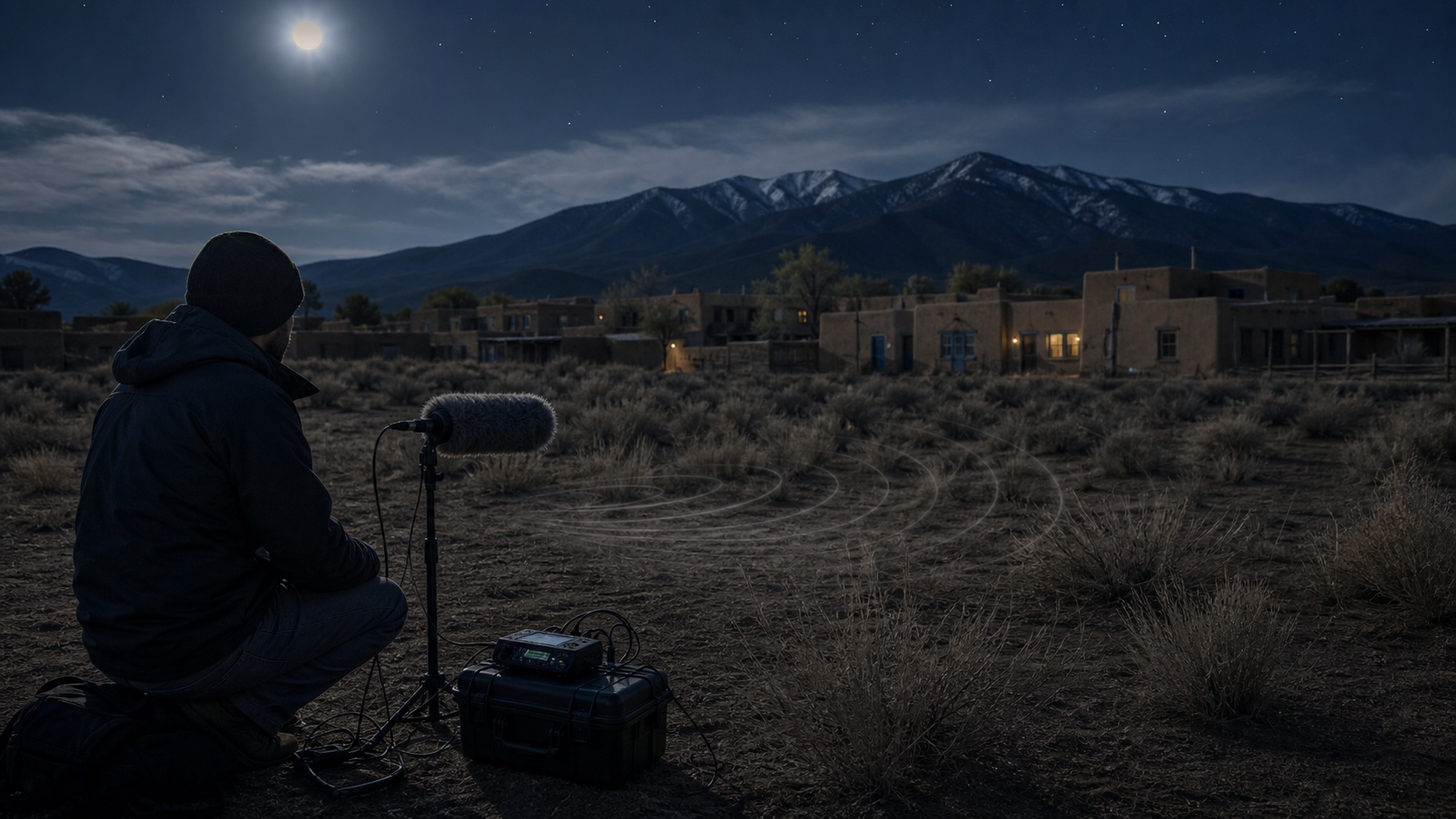
Night field setup: a recorder and directional microphone wait for a sound that will not hold still.
1. The silence that was not silent
I began with a discipline that mystery stories often abandon too early: I separated the experience from the explanation. A person can honestly hear a troubling hum without the hum being a secret transmitter, a buried engine, or a message from somewhere beyond the town limits. The testimony is the starting point. The theory is a later and much more fragile construction.
The Taos Hum became widely known in the early 1990s, when local accounts of a low-frequency sound started attracting national attention. Reports varied. Some people described a diesel-like throb; others heard a distant electrical drone, a pressure in the ears, or a vibration that seemed to exist more in the room than in the air. Many residents heard nothing at all. That last fact is not an embarrassment to the case. It is one of the clues that matters most.
When I read the accounts side by side, I stopped treating the word hum as if it named a single object. It is a witness word, the way “glow” or “smell of smoke” can be witness words. It describes an encounter before it identifies a cause. My investigation therefore started with an unfashionable question: what conditions allow a low sound to become impossible to ignore for one person and nonexistent for another?
2. What the first scene looks like
Taos is a difficult place in which to make a sound behave simply. The town sits in high desert country, with adobe walls, open ground, mountain weather, scattered mechanical sources, wide temperature swings, and long quiet intervals. Quiet is not the absence of sound. Quiet is the condition in which small sounds stop being masked by larger ones. A refrigerator compressor, a distant road, a pump, a ventilation unit, wind against a roofline—any of these can become much more apparent when the ordinary daytime blanket of voices and traffic falls away.
But the setting offered a second complication. Low-frequency energy does not announce itself like a ringing telephone. It can travel in awkward paths, fade at one wall, strengthen at another, and arrive as vibration rather than a clean audible tone. A listener may walk ten steps and decide the noise has vanished, only to find it waiting in a bedroom at three in the morning. That behavior sounds theatrical until you remember that rooms, ducts, windows, furniture, and even the shape of a valley can change how low sound is felt.
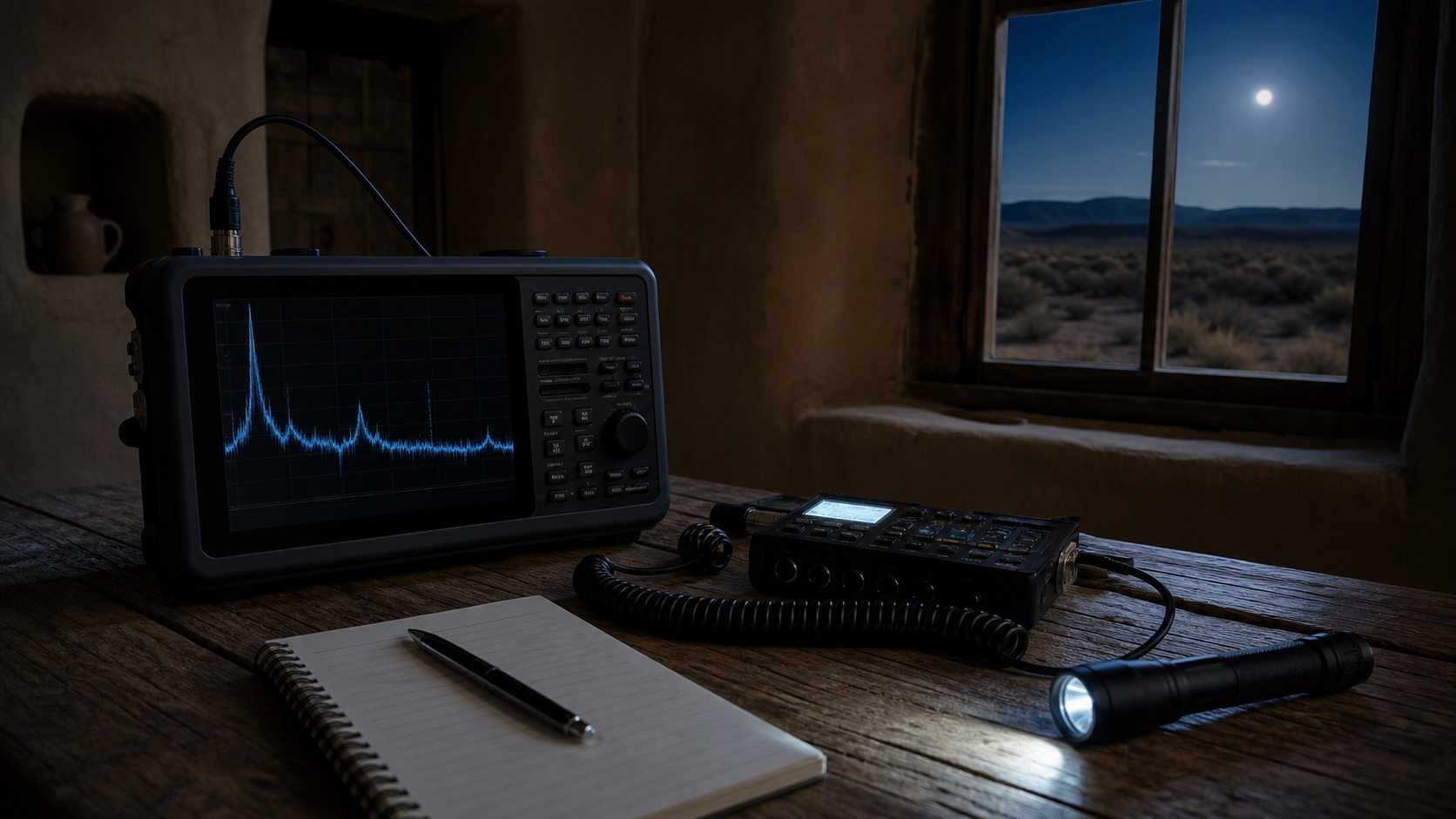
Field instruments can detect pressure changes; they cannot, by themselves, describe every listener’s experience.
That is why a recorder on a desk cannot settle the whole case by itself. A microphone measures pressure variation; a listener reports an experience shaped by hearing, body, attention, fatigue, expectation, and the acoustics of the room. I do not say that to dismiss the witnesses. I say it because a useful investigation has to protect them from a false choice: either the machine captures the sound perfectly or the person is imagining it. Reality is kinder, and stranger, than that.
3. I tested the “hidden machine” theory first
The mechanical explanation is the obvious suspect. A steady industrial source can produce a low tone. Fans, compressors, pumps, transformers, motors, grain equipment, cooling systems, and highway traffic all make energy that may be felt more than heard at a distance. Some of these sources cycle. Some wake up only under certain load conditions. Some transmit vibration through structures rather than through open air. If I had found one device that ran on the same schedule, pointed in the same direction, and explained the same cluster of reports, the case would have ended here.
It did not. The strongest version of the machine theory breaks under its own ambition. It can explain a local report beautifully, but it cannot easily explain why descriptions vary from street to street, why a listener might hear it inside one house and not outside, or why others in the same room may hear nothing. A machine can be part of a Taos Hum episode. It is a weak candidate for the entire Taos Hum story.
I imagined the inspection the way an investigator should: not with one dramatic midnight visit, but with a ledger. What was running? Where was it located? What frequency or vibration was present? What changed when equipment was switched off? Did the sound coincide with traffic, wind, temperature, or a building system? Without that log, “there must be a factory somewhere” is not a finding. It is a flashlight pointed into fog.
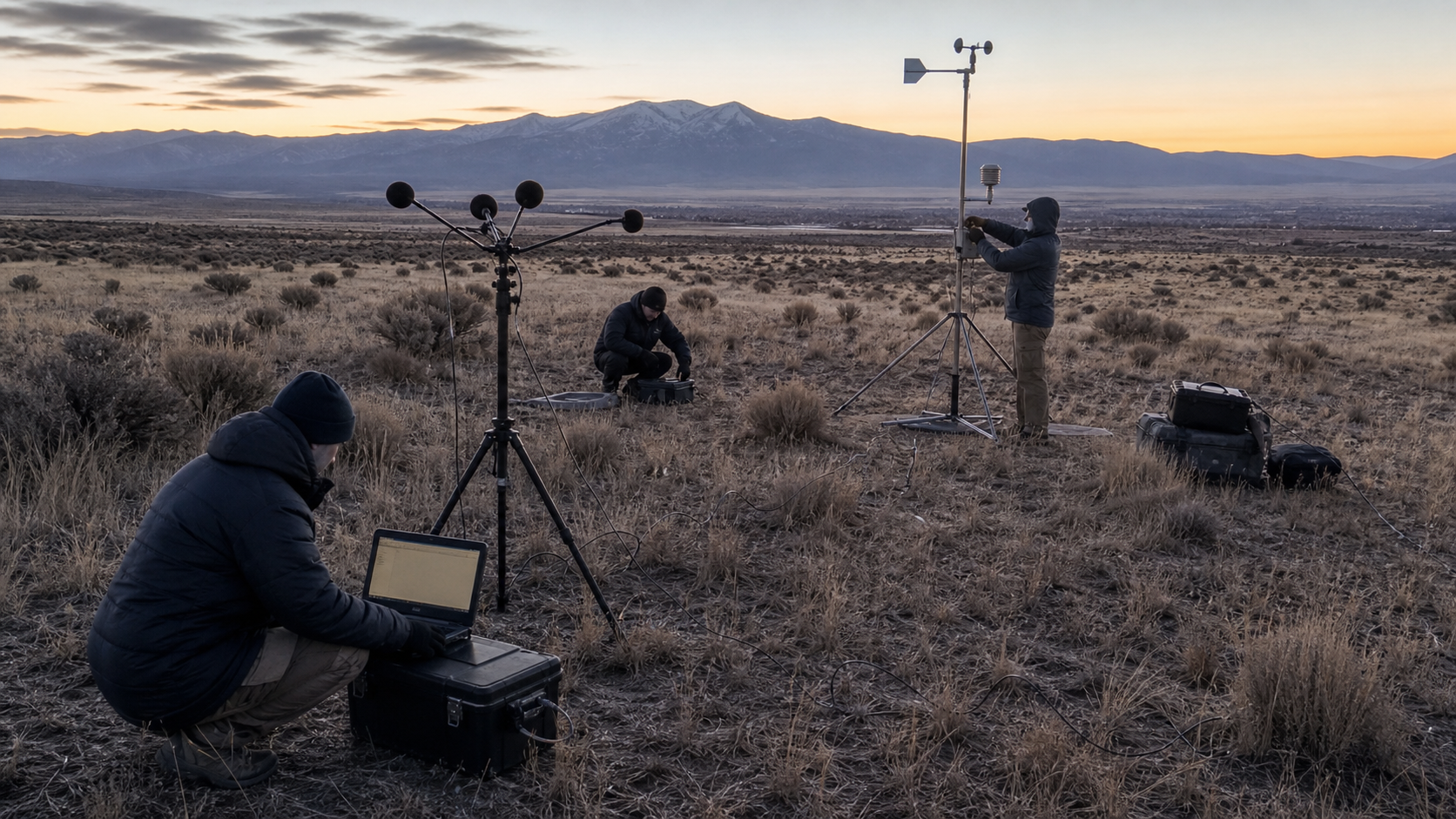
A portable microphone array tests direction, timing, and variation across open desert ground.
The same caution applies to electrical explanations. The human mind likes a hum that has wires attached to it. It feels tidy. Yet transformers and power equipment do not operate as a universal answer key. A specific electrical source must leave specific traces: location, timing, direction, and a reproducible change when conditions change. In the reports I examined, the details refused to line up that cleanly. The more I forced them toward one machine, the more evidence I had to leave behind.
4. The room became a suspect
The next clue was the indoor emphasis. Many hum reports—not only from Taos—become sharper in bedrooms, basements, or quiet rooms late at night. At first that seems backwards. Why would a sound be stronger behind walls? The answer is that the room does not merely receive sound. It selects it. A space can reinforce certain low frequencies, mute others, and make a distant vibration feel intimate. A loose window frame, an air return, a hollow wall, or a standing wardrobe can become an accidental instrument.
I pictured the case as a three-part chain: a source, a path, and a receiver. The source might be a vehicle, an appliance, wind, or some other ordinary energy. The path might be open air, soil, a building frame, or a duct. The receiver might be a microphone, a room, an inner ear, or a tired person lying awake in a very quiet house. Remove any one link and the experience changes. This is why the same town can produce such incompatible testimony without any witness being dishonest.
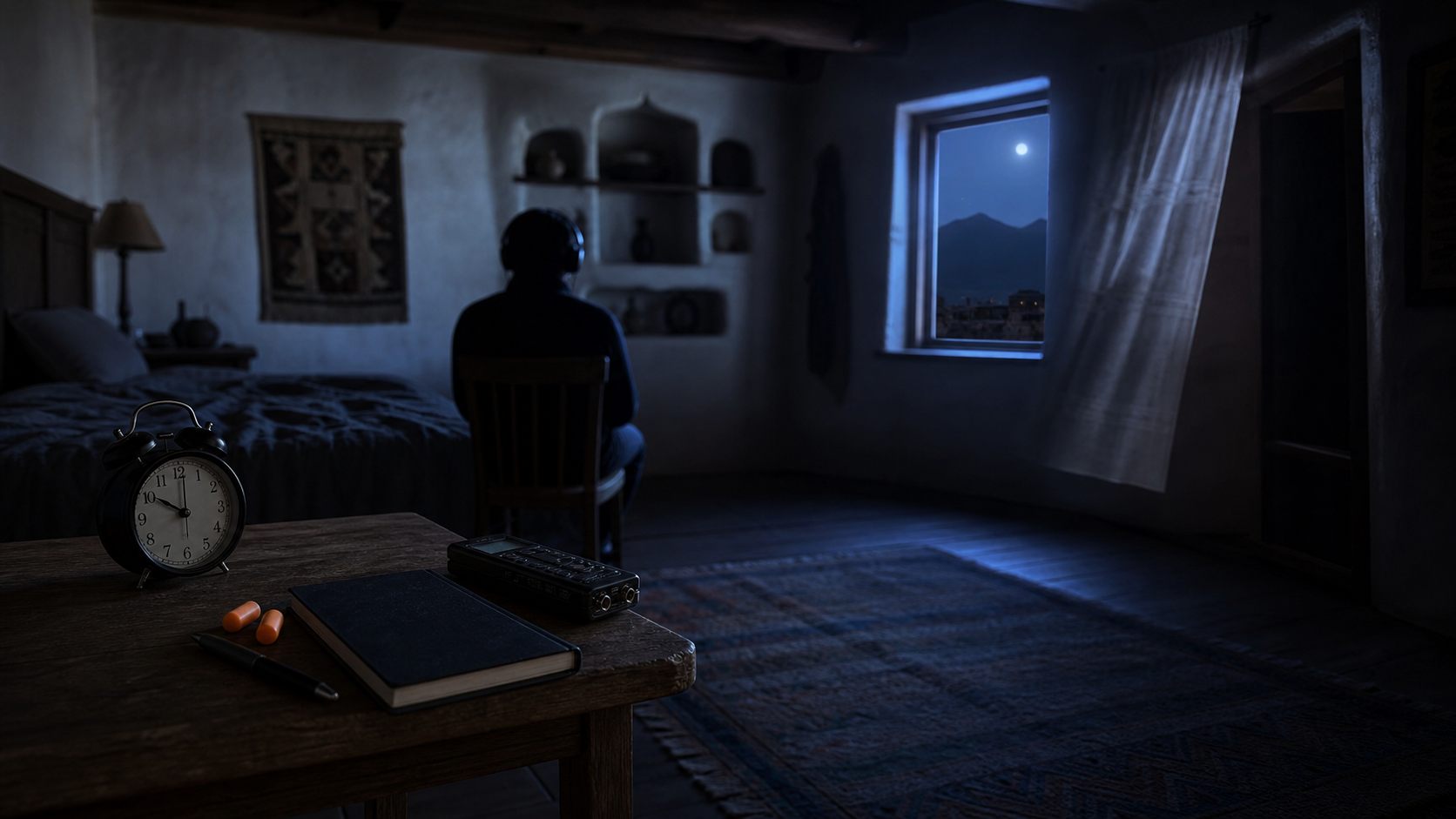
The bedroom is not neutral: quiet and room resonance can make a small low tone inescapable.
Night adds its own pressure. Not magic—pressure in the ordinary sense. A sleeping house contains fewer competing sounds. Attention narrows. A small irregularity becomes a pattern, and a pattern becomes a thing with a personality. Once a listener has spent three bad nights searching for the next appearance, the body begins to listen before the sound arrives. That anticipation is real and exhausting. It can also make a weak acoustic event feel stronger. Again, the point is not that the event is invented. The point is that the listener is part of the measurement.
5. The body was not an afterthought
At this stage I had to confront the explanation people often use too carelessly: tinnitus. Tinnitus is not a synonym for “you are mistaken.” It is a genuine auditory perception that can take many forms, including low tones, ringing, hiss, pulsation, or rumble. It may fluctuate with stress, sleep, illness, medication, noise exposure, and posture. A person can also have a tinnitus-like perception while an actual environmental sound is present. The two ideas are not enemies; they can overlap.
This overlap is what makes the Hum such an instructive mystery. If a microphone does not reveal a clean shared tone, that does not automatically prove an internal cause. If multiple people report a sound, that does not automatically prove a single external device. Evidence must be time-linked. Did a listener’s perception change when the room changed? When they traveled? When equipment stopped? When sleep improved? When background masking sound was introduced? Those questions are less romantic than a secret bunker, but they are the questions that have a chance of producing an honest answer.
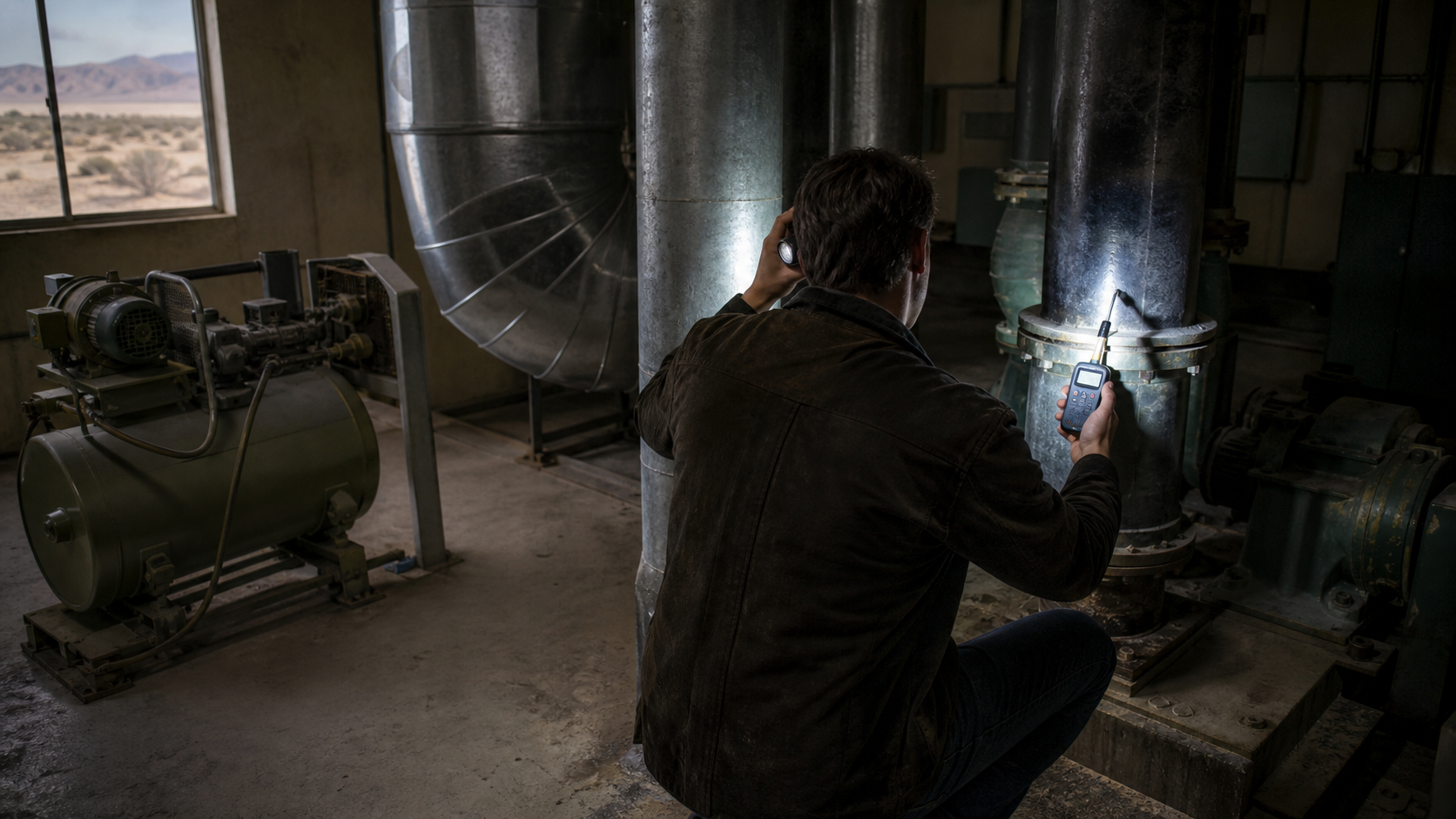
Mechanical systems are suspects only when their timing and sound signature can be tested.
I would not turn a mystery blog into a diagnosis. A persistent new sound in one ear, a sound that pulses with a heartbeat, or a noise accompanied by dizziness or sudden hearing change belongs with a qualified clinician, not a comment thread. In the Taos file, that boundary matters because it keeps a search for an environmental source from becoming a reason to ignore a person’s health.
6. The desert and the weather offered another route
The high desert changes character after sunset. Temperature layers form. Wind moves above the ground while a yard may seem still. Distant traffic or machinery can travel in ways that feel impossible to the person hearing them. The landscape can bend a sound’s story without creating a new sound from nothing. An inversion, a valley, a hard ground surface, or a line of buildings can help a low component arrive with unusual clarity.
This route was appealing because it explains the intermittent quality. A source may be ordinary, but the delivery system is temporary. Tonight the air carries it; tomorrow the air does not. One neighborhood catches the low edge of the sound; another is in a quiet pocket. That is a much better fit for a report that appears and disappears than a permanently buried oscillator running beneath an entire region.
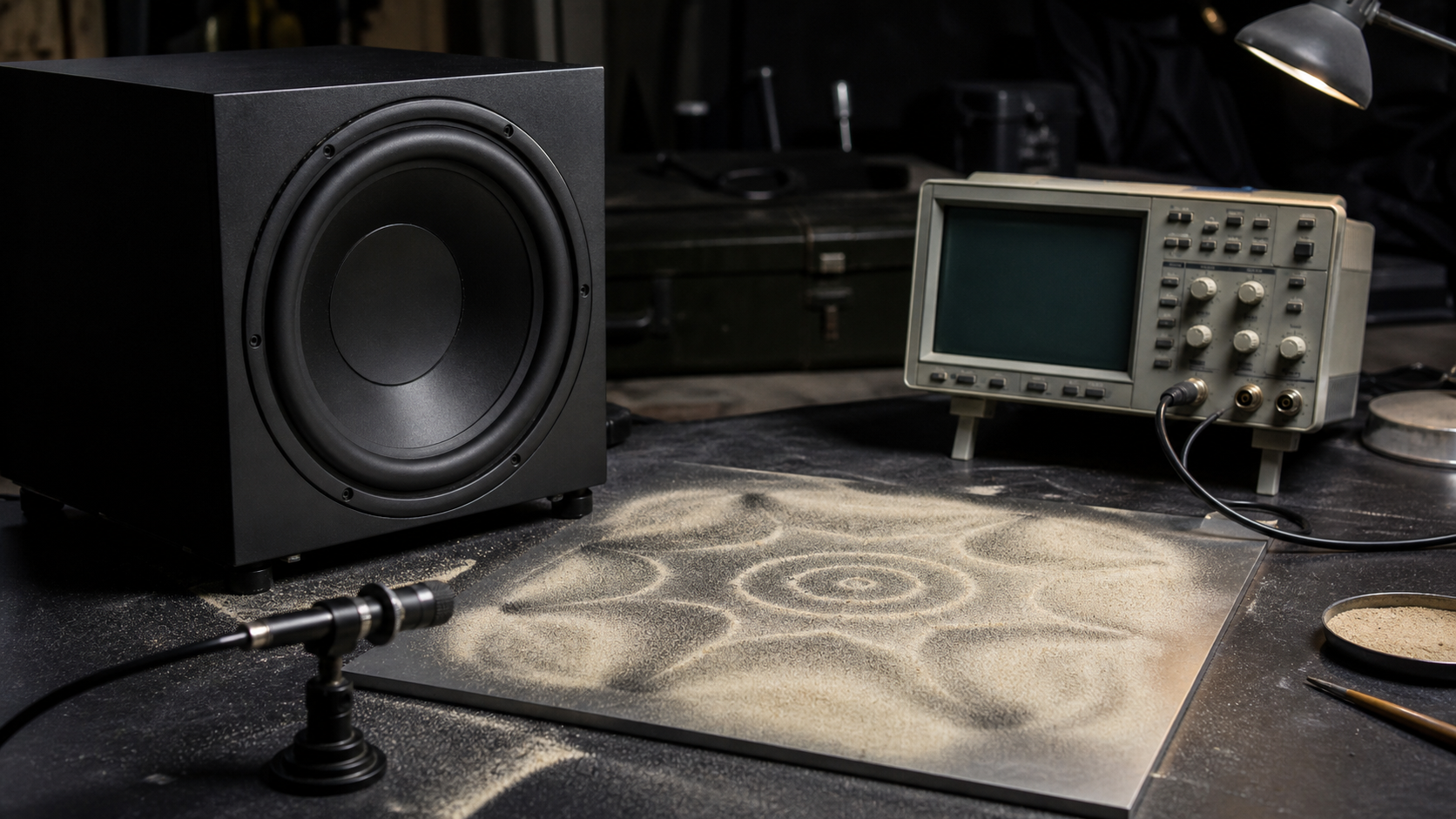
A simple vibration experiment: low energy can become visible when a surface responds.
Still, weather is not a magic permission slip either. I rejected any explanation that relied on the phrase “atmospheric conditions” without measurements. An actual investigation would log wind, temperature, pressure, time, location, and indoor versus outdoor levels, then compare recordings made on a night when the Hum was reported with a night when it was absent. If conditions repeat, confidence grows. If they do not, the hypothesis stays a sketch.
7. What vibration taught me
Low-frequency sound has a habit of crossing the border between hearing and feeling. A person may sense a pressure in the head, a flutter in a window, a pulse in a chair, or an unease that seems larger than the sound itself. That does not mean the sensation is supernatural. It means our vocabulary is too small. We often use “noise” for a phenomenon that has parts in the ear, the floor, the chest, the room, and the imagination at once.
A simple vibration experiment makes the point. Place sand on a surface, introduce a controlled low-frequency vibration, and the grains begin to sort themselves into patterns. Nothing mysterious has happened; energy has found the surfaces and frequencies to which they respond. A house can do a quieter version of this. One pane rattles. One vent pulses. One bedframe seems to carry a sound that is inaudible near the front door. The effect feels personal because the room has made it personal.
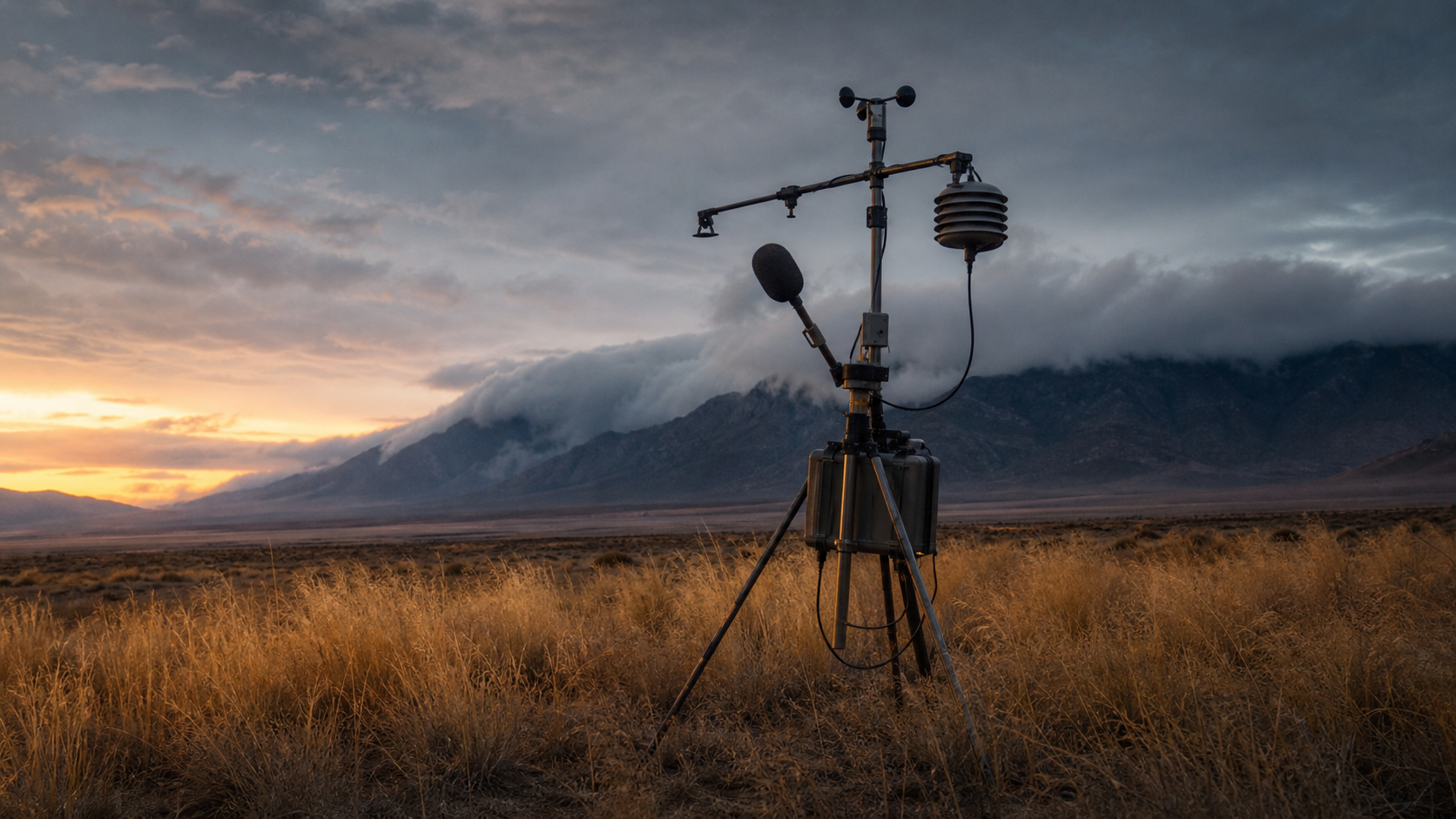
Weather and terrain may change the route a distant sound takes.
That image changed my reading of the reports. Instead of asking, “Where is the giant sound?” I asked, “Which small signals might be amplified here, tonight, for this listener?” It is a less satisfying question if you want a single villain. It is a far more satisfying one if you care about why people actually lose sleep.
8. Why the conspiracy answer failed my test
Every famous unexplained sound attracts a hidden-project theory. The suggestion is understandable: a low hum feels technical, invisible, and difficult to locate. But a theory should become more demanding as it becomes more dramatic. A covert device supposedly affecting a whole town would need more than unsettling testimony. It would need a stable signature, a defensible physical mechanism, a location, a power source, and a reason the effect changes so much from person to person.
I found no reason to invent that machinery. The conspiracy answer consumes the ambiguity rather than explaining it. It treats inconsistent reports as proof that the project is clever, and it treats missing measurements as proof that the project is secret. That is not investigation. It is a theory that can never lose, which is another way of saying it cannot truly win.

A log, a compass, and time stamps are better evidence than a theory chosen too early.
The same rule ruled out the extraterrestrial version. Mystery deserves more respect than a reflexive alien label. A good case is not made smaller by ordinary mechanisms; it is made sharper. There is still drama in the possibility that a place, a body, a building, and a changing atmosphere can combine to create an experience so persistent that it becomes local legend.
9. My reconstruction
Here is the reconstruction I can defend. “The Taos Hum” is probably not one sound with one origin. It is a name placed over several kinds of low-frequency experience. On some nights, a distant mechanical or traffic source may be carried unusually well. In some rooms, the building may reinforce the low component until it seems to come from inside the walls. For some listeners, a hearing-related perception may be part of the event; for others, it may not. Sleep loss and vigilance can intensify the burden without manufacturing the original trigger.
This reconstruction is not a retreat into vagueness. It makes predictions. If it is right, carefully logged reports should cluster around particular rooms, weather patterns, operating schedules, or individual hearing circumstances more often than around one universal direction or frequency. Some cases will yield a mechanical answer. Some will yield a room-acoustics answer. Some will remain uncertain because the event did not occur during measurement. And a few will be about a listener whose experience requires medical rather than environmental follow-up.
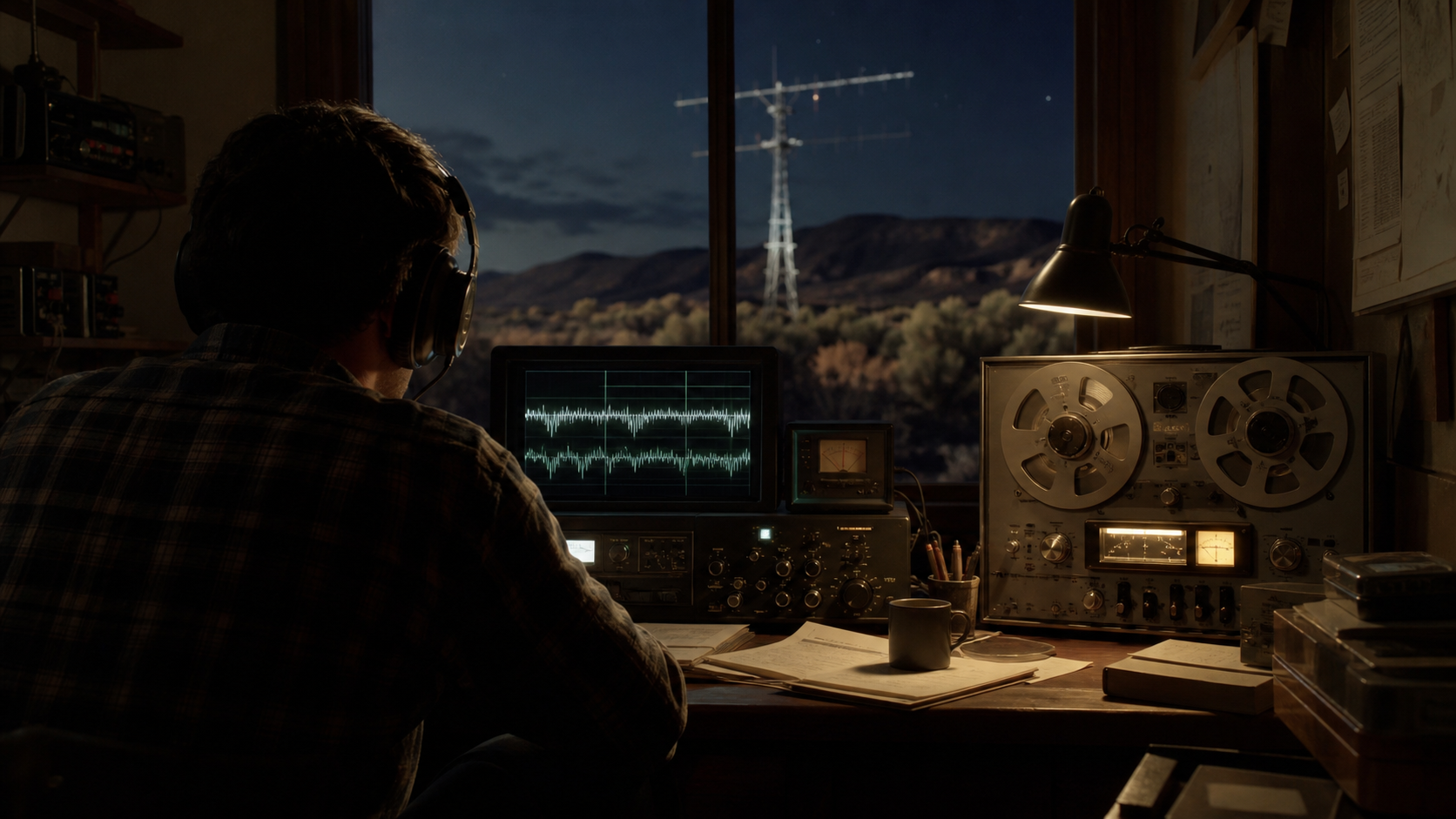
Monitoring equipment turns the mystery into questions that can be repeated and checked.
I also think the accounts contain a social clue. Once a town has a name for a difficult sensation, the name gives residents a way to compare it. That can be useful; it can turn an isolated bad night into a report worth investigating. It can also merge different experiences under one label. The legend grows because the label is memorable, not necessarily because the cause is singular.
10. Verdict: unresolved, but not empty
My conclusion is not that the Taos Hum is solved. My conclusion is that it has been asked the wrong question. There is no good evidence that one secret object is producing a uniform signal for the whole town. There is very good reason to believe that low-frequency sound, building resonance, weather, hearing, and attention can produce a family of experiences that feel remarkably similar from the inside.
That leaves the mystery intact in the way I prefer: not as a blank space waiting for fantasy, but as a real boundary between what people report and what our instruments, rooms, bodies, and assumptions are able to separate. The sound may have no single source. The investigation still has a shape.

The investigation ends at dawn without a dramatic culprit—but with a better map of the problem.
Case note for future investigations
If this file were reopened, I would start with a notebook rather than a conclusion. Record the exact time, the room, whether windows are open, which appliances are running, wind and weather, whether others hear it, and whether the sensation changes outdoors. A short recording is useful, but a comparison log is better. The aim is not to prove a favorite theory. It is to give the sound enough context that it can finally be questioned properly.
The Taos Hum remains worth reading about because it refuses to behave like a neat puzzle. It is an acoustic mystery, an environmental mystery, and sometimes a personal mystery. I came looking for the machine behind the curtain. I left with a more unsettling answer: sometimes the curtain, the room, the air, and the listener are all part of the mechanism.
Research note: This is an interpretive investigation based on publicly reported accounts of the Taos Hum and established principles of low-frequency sound, room resonance, and hearing perception. It does not claim a new field measurement or a single verified cause.