Yonaguni Monument: Ruined Architecture or Fractured Sandstone?
Terraces, steps, walls, and a broad platform seem to rise from the seabed near Yonaguni. I investigated whether those words describe construction—or the way fractured sandstone looks when currents remove its softer edges.
- Setting
- Underwater off the south coast of Yonaguni Island, Japan
- Period
- Publicized after discovery by divers in the 1980s; geological formation much older
- Core question
- Is the formation primarily natural bedrock, modified terrain, or the remains of a constructed monument?
- Case status
- Most geological interpretations favor a natural formation; archaeological modification is unproven.
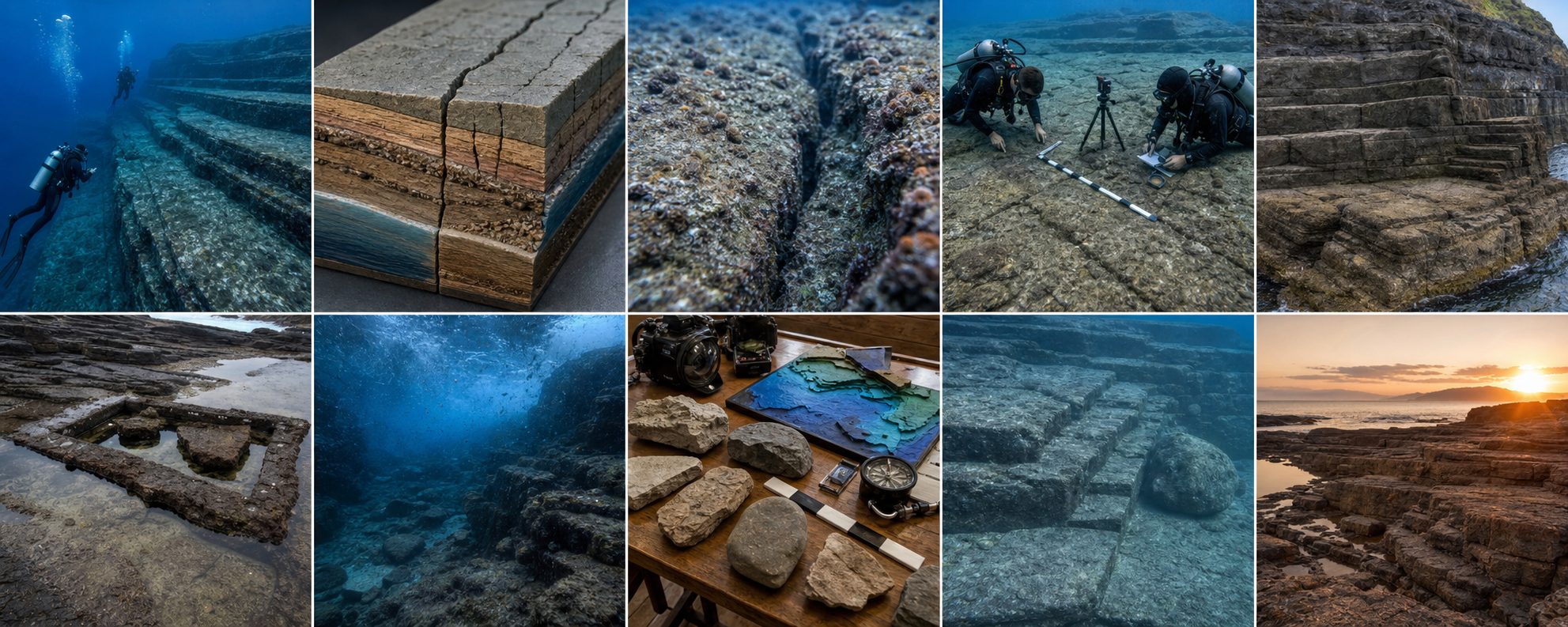
The scene at the center of Yonaguni Monument: Ruined Architecture or Fractured Sandstone?, reconstructed without adding a culprit.
1. The file I opened
The first page of this case looked orderly; the second page made that order collapse. Geometry is not exclusive to architecture. Layered sedimentary rock breaks along planes, joints intersect at angles, and wave energy enlarges those weaknesses into steps and channels.
I rebuilt the chronology before I allowed myself to name a suspect cause. That decision mattered because this mystery has accumulated explanations faster than it has accumulated reliable evidence. A vivid retelling can preserve the emotional truth of an event while quietly altering dates, distances, weather, witnesses, or the meaning of an object. I therefore refused to reward a detail simply because it was memorable.
The central experience in this case is a large submerged sandstone formation with flat terraces, straight fractures, angular corners, and pillar-like remnants. That description is deliberately narrower than the legend. It gives me something that can be tested without pretending that the cause was already known. I wanted to know which parts of the story remain standing after the famous labels are removed.
Geography is evidence: distance, access, and environment constrain every explanation.
2. What I can actually establish
The following points form the hard frame of the investigation. They are not equally complete, but each is more useful than a dramatic claim detached from time and place.
- The feature is connected to underlying bedrock rather than being a freestanding assembled structure.
- Regional sandstone and mudstone exhibit bedding planes and jointing capable of producing blocky forms.
- Strong currents and wave action affect the exposed seafloor.
- Claims of roads, carvings, faces, and tool marks are disputed and often rely on suggestive photographs.
- Lower sea levels during the last glacial period exposed areas now submerged, but exposure alone does not establish construction.
Read together, these facts do not deliver a solution. They define the boundaries within which a solution must fit. That distinction is important. A mystery becomes easier to manipulate when the absence of an answer is treated as permission to add new facts. I used absence only as absence.
I also kept provenance in view. A contemporary log, physical measurement, dated photograph, or preserved artifact deserves more weight than a recollection recorded decades later. That does not make later witnesses dishonest. It recognizes that memory is reconstructive and that public stories teach people how an event is supposed to be remembered.
The artifact or observation that keeps the case from becoming a simple story.
3. The contradictions that shaped the case
Every durable mystery contains at least one mismatch between what should have happened and what the record shows. In this file, the most important tensions are these:
- Some surfaces appear strikingly regular, yet no mortar, fitted masonry, or construction debris defines architecture.
- Possible human modification is difficult to separate from natural fracture and modern visual expectation.
- Sea-level chronology allows ancient exposure but would require extraordinary cultural evidence for a monumental city.
I did not try to dissolve these contradictions immediately. I placed them beside one another and asked whether they could arise from incomplete observation, ordinary physical processes, documentary loss, deliberate deception, or a mixture of causes. The order matters. Extraordinary explanations should not receive a head start merely because ordinary evidence is incomplete.
A reconstruction of how investigators could test the surviving record.
4. Evidence under pressure
1. Bedrock continuity
Continuous geological layers through the formation favor erosion of native rock over assembled blocks.
I treated this item as a constraint rather than a decoration. If a proposed answer cannot account for detailed structural mapping of bedding and joints, it does not survive the file merely because it sounds dramatic. The value of this clue lies in what it rules out as much as in what it appears to support.
2. Fracture geometry
Orthogonal joints and horizontal beds create steps, corners, and terraces naturally.
I treated this item as a constraint rather than a decoration. If a proposed answer cannot account for comparison with emerged coastal outcrops of the same formation, it does not survive the file merely because it sounds dramatic. The value of this clue lies in what it rules out as much as in what it appears to support.
3. Surface marks
Grooves and holes may arise from erosion, boring organisms, anchors, or human activity.
I treated this item as a constraint rather than a decoration. If a proposed answer cannot account for microscopy and context distinguishing tool marks from natural weathering, it does not survive the file merely because it sounds dramatic. The value of this clue lies in what it rules out as much as in what it appears to support.
4. Cultural material
A constructed site should produce artifacts, occupation evidence, worked stone waste, or repeated design logic.
I treated this item as a constraint rather than a decoration. If a proposed answer cannot account for controlled archaeological survey of sediments and sheltered zones, it does not survive the file merely because it sounds dramatic. The value of this clue lies in what it rules out as much as in what it appears to support.
The leading explanation gains strength only where it matches the documented conditions.
5. Building the hypothesis table
I ranked explanations by coverage, not excitement. Coverage means that an explanation accounts for the reliable observations, fits the known environment, and does not require invisible actors whenever it encounters a difficulty. I also asked whether the idea makes a prediction that another investigator could check.
Hypothesis 1: Natural jointed sandstone landform
Why it remains plausible: Bedrock connection, regional geology, and erosion explain major geometry without added assumptions.
Where it fails: Selected local features may still have been modified by people.
My test was simple: the hypothesis had to explain the strongest evidence without asking the weakest evidence to carry the entire case. On that standard, this explanation is the leading explanation.
Hypothesis 2: Natural formation used or altered by humans
Why it remains plausible: Periods of lower sea level and nearby human presence make limited modification conceivable.
Where it fails: Secure tool marks, artifacts, and dates have not demonstrated such use.
My test was simple: the hypothesis had to explain the strongest evidence without asking the weakest evidence to carry the entire case. On that standard, this explanation is possible but unproven.
Hypothesis 3: Constructed lost-city monument
Why it remains plausible: Terrace-like views resemble monumental architecture.
Where it fails: The formation lacks an archaeological construction system and requires a culture unsupported by regional evidence.
My test was simple: the hypothesis had to explain the strongest evidence without asking the weakest evidence to carry the entire case. On that standard, this explanation is unsupported.
The strongest alternative explains part of the case, but not all of it.
6. The chronology test
Chronology is where many elegant theories fail. A cause must exist before its effect, a witness must be able to occupy the claimed location, and a later interpretation cannot be smuggled backward as if it were contemporary knowledge. In this case, the useful sequence begins with deposition, lithification, jointing, and uplift of sedimentary rock. It then passes through subaerial and marine erosion enlarging fractures while sea levels changed. and ends, for now, with modern diving, selective photography, and interpretation as ruins.
This order changed my reading. The famous version tends to compress separate moments into one continuous scene. Once the intervals are restored, some apparently impossible features become ordinary gaps in observation. Other features become more troubling because the time available for them narrows. A timeline does not solve the mystery, but it prevents the mystery from solving itself through careless narration.
I would want every future claim attached to a date, an observer, a location, and a method of recording. Without those four elements, a new claim may be interesting, but it cannot safely move the verdict.
Environment can transform an ordinary source before it reaches a witness or instrument.
7. The geography and environment test
The setting is not background scenery. strong currents, wave energy, layered sandstone, biological erosion, and limited underwater visibility emphasize edges and conceal geological continuity. Any explanation that ignores those conditions is incomplete before it begins. Distance can distort scale; terrain can hide a source; water can move objects; temperature can change sound; geology can imitate architecture; and human structures can amplify small physical effects.
I reconstructed the scene as a chain of source, path, receiver, and record. The source is whatever produced the event. The path is the environment through which it traveled. The receiver is a person or instrument. The record is what survived. An error or transformation at any link can make the final story look more mysterious than the original event.
This framework also protects the witness. It does not force a choice between “the witness was perfectly accurate” and “the witness imagined everything.” A person may faithfully report an experience while misjudging its distance, size, cause, or duration. That is not failure; it is the normal condition of observation under uncertainty.
A case becomes clearer when evidence, memory, and later retelling are separated.
8. How the legend changed the evidence
Images are often framed with architectural labels before scale and bedrock are shown. Once a ledge is called a staircase, every crack acquires intention.
Once a case becomes famous, each retelling selects the details that best support the identity of the story. A ghost-ship story keeps the untouched meal and forgets the maintenance problem. A lights story remembers impossible motion and forgets viewing angle. An ancient-technology story magnifies resemblance while shrinking archaeological context. The pattern is consistent: the legend is not necessarily false, but it is edited.
My task was to reverse that editing. I restored mundane details because mundane details are often causal. Weather, bureaucracy, equipment failure, translation, publicity, and the simple loss of records can create an empty space large enough for a myth to occupy. The resulting explanation may remain uncertain, but it becomes honest uncertainty.
The decisive comparison is between what was recorded and what the legend later added.
9. My reconstruction
The monument is a natural sandstone outcrop shaped along bedding and joint planes, then submerged and further eroded. Humans may have visited or altered limited surfaces when exposed, but no city-scale construction is established.
This reconstruction does not require every report to have the same cause. That is one of the most important conclusions in the file. A named mystery can become a container for several events: a real physical trigger, an observer’s interpretation, later documentary errors, and cultural expectations. Treating the container as a single mechanism often creates the very contradiction investigators then struggle to solve.
I therefore assign confidence in layers. I have high confidence in the documented core, moderate confidence in the environmental or historical mechanism described above, and low confidence in any claim that depends on a detail appearing only in late retellings. This hierarchy leaves room for correction without making every possibility equally likely.
The file closes with a graded verdict rather than a manufactured certainty.
10. Verdict
Yonaguni is primarily a dramatic natural formation, with limited ancient human modification still a testable but unsupported possibility.
Detailed public geological mapping and targeted archaeological sampling remain less complete than the publicity surrounding the site.
What would move the case forward
The next useful step is to publish full 3D photogrammetry, structural geology, comparative coastal outcrops, sediment sampling, and blinded tool-mark analysis. That work should be documented before a preferred interpretation is chosen. Negative results matter as much as positive ones because they narrow the space in which the explanation can hide.
If no new evidence appears, the responsible outcome is not to manufacture closure. It is to preserve a graded conclusion: what happened, what probably happened, what might have happened, and what the surviving record can no longer tell us. A mystery is not diminished by those distinctions. It becomes legible.
The formation is not less remarkable when geology becomes the architect. It is a record of rock breaking according to rules that happen to resemble our own.
Case audit
| Question | My assessment |
|---|---|
| Is the reported core real? | Yes. A documented event or artifact exists beneath the later legend. |
| Is one cause sufficient? | Possibly, but the surviving record does not justify forcing every detail into one mechanism. |
| What most distorts the story? | Later retelling, missing context, and the unequal survival of evidence. |
| Current confidence | Moderate on the documented core; lower on the final causal reconstruction. |
Research note: This article is an interpretive investigation based on the surviving historical or scientific record. It distinguishes documented facts from inference and does not claim new field measurements, private evidence, or a final solution where the record does not support one.