The Bloop: How an Ocean Mystery Became the Sound of Moving Ice
The signal was loud, low, and heard across enormous distances. For years it seemed to demand a living source of impossible size. I followed its acoustic shape south, toward ice breaking under continental stress.
- Setting
- The Pacific hydrophone network with likely origin in the Southern Ocean
- Period
- Recorded in 1997; later compared with Antarctic ice sounds
- Core question
- What produced the powerful low-frequency signal nicknamed the Bloop?
- Case status
- Strongly identified with icequake or iceberg-fracture processes.
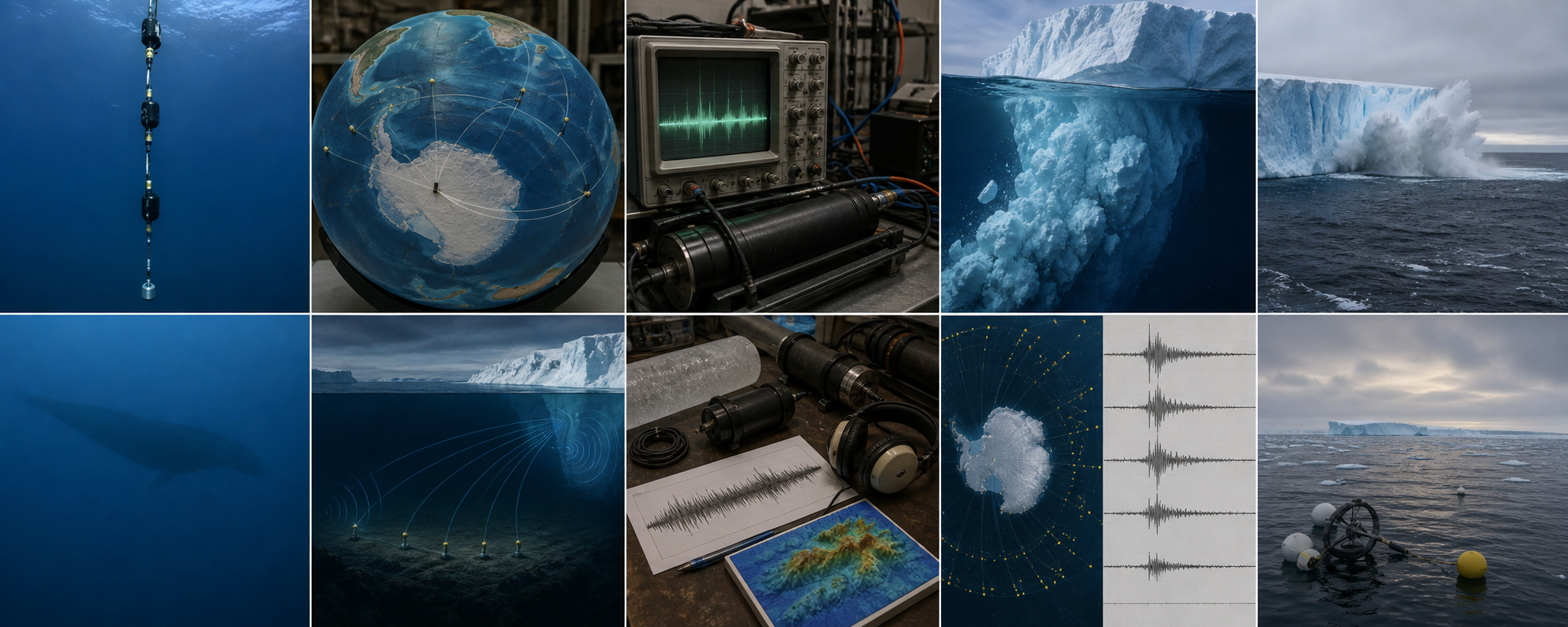
The scene at the center of The Bloop: How an Ocean Mystery Became the Sound of Moving Ice, reconstructed without adding a culprit.
1. The file I opened
I began this file by removing every explanation from the table and leaving only the scene. A sound can be biological without belonging to an animal, and mechanical without belonging to a machine. The Bloop’s identity became clearer when analysts expanded the comparison library beyond whales and ships.
I separated observation, memory, later retelling, and modern interpretation into different columns. That decision mattered because this mystery has accumulated explanations faster than it has accumulated reliable evidence. A vivid retelling can preserve the emotional truth of an event while quietly altering dates, distances, weather, witnesses, or the meaning of an object. I therefore refused to reward a detail simply because it was memorable.
The central experience in this case is a powerful ultra-low-frequency underwater sound detected by widely separated hydrophones. That description is deliberately narrower than the legend. It gives me something that can be tested without pretending that the cause was already known. I wanted to know which parts of the story remain standing after the famous labels are removed.
Geography is evidence: distance, access, and environment constrain every explanation.
2. What I can actually establish
The following points form the hard frame of the investigation. They are not equally complete, but each is more useful than a dramatic claim detached from time and place.
- The signal was recorded in 1997 by hydrophones used for long-range ocean monitoring.
- Its frequency and amplitude were accelerated or shifted for public listening, affecting popular perception.
- Early uncertainty generated comparisons with biological calls.
- Later recordings of Antarctic ice cracking, calving, and grounding produced similar acoustic signatures.
- NOAA explanations associate the Bloop with large ice-related events rather than an unknown animal.
Read together, these facts do not deliver a solution. They define the boundaries within which a solution must fit. That distinction is important. A mystery becomes easier to manipulate when the absence of an answer is treated as permission to add new facts. I used absence only as absence.
I also kept provenance in view. A contemporary log, physical measurement, dated photograph, or preserved artifact deserves more weight than a recollection recorded decades later. That does not make later witnesses dishonest. It recognizes that memory is reconstructive and that public stories teach people how an event is supposed to be remembered.
The artifact or observation that keeps the case from becoming a simple story.
3. The contradictions that shaped the case
Every durable mystery contains at least one mismatch between what should have happened and what the record shows. In this file, the most important tensions are these:
- The sound’s immense propagation suggested a huge source but not necessarily a huge organism.
- Public playback makes the event seem short and creature-like after time and frequency transformation.
- A remote source area limited immediate visual confirmation.
I did not try to dissolve these contradictions immediately. I placed them beside one another and asked whether they could arise from incomplete observation, ordinary physical processes, documentary loss, deliberate deception, or a mixture of causes. The order matters. Extraordinary explanations should not receive a head start merely because ordinary evidence is incomplete.
A reconstruction of how investigators could test the surviving record.
4. Evidence under pressure
1. Hydrophone arrival pattern
Detection across stations constrains direction and demonstrates efficient low-frequency propagation.
I treated this item as a constraint rather than a decoration. If a proposed answer cannot account for whether travel times fit a Southern Ocean source, it does not survive the file merely because it sounds dramatic. The value of this clue lies in what it rules out as much as in what it appears to support.
2. Spectral shape
The frequency sweep and broadband structure can be compared with whales, ships, earthquakes, and ice.
I treated this item as a constraint rather than a decoration. If a proposed answer cannot account for which source class reproduces the signal envelope, it does not survive the file merely because it sounds dramatic. The value of this clue lies in what it rules out as much as in what it appears to support.
3. Icequake analogs
Later Antarctic recordings supplied close matches from fracturing and moving ice.
I treated this item as a constraint rather than a decoration. If a proposed answer cannot account for whether event scale and source location are physically consistent, it does not survive the file merely because it sounds dramatic. The value of this clue lies in what it rules out as much as in what it appears to support.
4. Playback transformation
Public audio presentations alter duration and pitch to enter human hearing.
I treated this item as a constraint rather than a decoration. If a proposed answer cannot account for how the unmodified signal differs from the familiar clip, it does not survive the file merely because it sounds dramatic. The value of this clue lies in what it rules out as much as in what it appears to support.
The leading explanation gains strength only where it matches the documented conditions.
5. Building the hypothesis table
I ranked explanations by coverage, not excitement. Coverage means that an explanation accounts for the reliable observations, fits the known environment, and does not require invisible actors whenever it encounters a difficulty. I also asked whether the idea makes a prediction that another investigator could check.
Hypothesis 1: Large ice fracture or grounding event
Why it remains plausible: Location, power, spectrum, and later analog recordings align with ice-generated sound.
Where it fails: The exact individual iceberg or fracture was not visually identified.
My test was simple: the hypothesis had to explain the strongest evidence without asking the weakest evidence to carry the entire case. On that standard, this explanation is the accepted and strongly supported explanation.
Hypothesis 2: Unknown marine animal
Why it remains plausible: Some biological calls travel far and exhibit frequency change.
Where it fails: Required scale, signal structure, and ice analogs make an organism unnecessary.
My test was simple: the hypothesis had to explain the strongest evidence without asking the weakest evidence to carry the entire case. On that standard, this explanation is a memorable early speculation, now weak.
Hypothesis 3: Secret technology or underwater explosion
Why it remains plausible: Hydrophone networks detect human activity and explosions.
Where it fails: The acoustic signature and geographic context fit ice better, with no corroborating operational evidence.
My test was simple: the hypothesis had to explain the strongest evidence without asking the weakest evidence to carry the entire case. On that standard, this explanation is unsupported.
The strongest alternative explains part of the case, but not all of it.
6. The chronology test
Chronology is where many elegant theories fail. A cause must exist before its effect, a witness must be able to occupy the claimed location, and a later interpretation cannot be smuggled backward as if it were contemporary knowledge. In this case, the useful sequence begins with the 1997 detection by separated hydrophone stations. It then passes through public release and speculation before a mature ice-sound comparison set existed. and ends, for now, with recognition that major icequakes produce closely related signals.
This order changed my reading. The famous version tends to compress separate moments into one continuous scene. Once the intervals are restored, some apparently impossible features become ordinary gaps in observation. Other features become more troubling because the time available for them narrows. A timeline does not solve the mystery, but it prevents the mystery from solving itself through careless narration.
I would want every future claim attached to a date, an observer, a location, and a method of recording. Without those four elements, a new claim may be interesting, but it cannot safely move the verdict.
Environment can transform an ordinary source before it reaches a witness or instrument.
7. The geography and environment test
The setting is not background scenery. the ocean sound channel carries low-frequency energy over vast distances, while Antarctic ice generates powerful complex acoustic events beyond visual range. Any explanation that ignores those conditions is incomplete before it begins. Distance can distort scale; terrain can hide a source; water can move objects; temperature can change sound; geology can imitate architecture; and human structures can amplify small physical effects.
I reconstructed the scene as a chain of source, path, receiver, and record. The source is whatever produced the event. The path is the environment through which it traveled. The receiver is a person or instrument. The record is what survived. An error or transformation at any link can make the final story look more mysterious than the original event.
This framework also protects the witness. It does not force a choice between “the witness was perfectly accurate” and “the witness imagined everything.” A person may faithfully report an experience while misjudging its distance, size, cause, or duration. That is not failure; it is the normal condition of observation under uncertainty.
A case becomes clearer when evidence, memory, and later retelling are separated.
8. How the legend changed the evidence
The transformed audio clip encouraged listeners to imagine a single vocal creature. The original data belong to geophysics and long-distance propagation.
Once a case becomes famous, each retelling selects the details that best support the identity of the story. A ghost-ship story keeps the untouched meal and forgets the maintenance problem. A lights story remembers impossible motion and forgets viewing angle. An ancient-technology story magnifies resemblance while shrinking archaeological context. The pattern is consistent: the legend is not necessarily false, but it is edited.
My task was to reverse that editing. I restored mundane details because mundane details are often causal. Weather, bureaucracy, equipment failure, translation, publicity, and the simple loss of records can create an empty space large enough for a myth to occupy. The resulting explanation may remain uncertain, but it becomes honest uncertainty.
The decisive comparison is between what was recorded and what the legend later added.
9. My reconstruction
A large Antarctic ice mass fractured, calved, or grounded, releasing low-frequency energy into the ocean. The sound channel delivered it to distant hydrophones, and altered public playback made the event resemble a call.
This reconstruction does not require every report to have the same cause. That is one of the most important conclusions in the file. A named mystery can become a container for several events: a real physical trigger, an observer’s interpretation, later documentary errors, and cultural expectations. Treating the container as a single mechanism often creates the very contradiction investigators then struggle to solve.
I therefore assign confidence in layers. I have high confidence in the documented core, moderate confidence in the environmental or historical mechanism described above, and low confidence in any claim that depends on a detail appearing only in late retellings. This hierarchy leaves room for correction without making every possibility equally likely.
The file closes with a graded verdict rather than a manufactured certainty.
10. Verdict
The Bloop is a solved acoustic mystery: moving and fracturing ice is the best-supported source.
The precise ice feature responsible cannot be identified confidently from the surviving public record.
What would move the case forward
The next useful step is to compare archived waveforms with satellite ice positions, seismic data, and modern classified ice-event libraries. That work should be documented before a preferred interpretation is chosen. Negative results matter as much as positive ones because they narrow the space in which the explanation can hide.
If no new evidence appears, the responsible outcome is not to manufacture closure. It is to preserve a graded conclusion: what happened, what probably happened, what might have happened, and what the surviving record can no longer tell us. A mystery is not diminished by those distinctions. It becomes legible.
The answer was enormous, alive only in the geological sense, and already moving at the edge of a warming world.
Case audit
| Question | My assessment |
|---|---|
| Is the reported core real? | Yes. The hydrophone signal is a genuine recorded event. |
| Is one cause sufficient? | A large ice event is sufficient for the signal class. |
| What most distorts the story? | Frequency-shifted public audio and the appeal of a giant unknown animal. |
| Current confidence | High on an ice source; lower on the exact fracture or iceberg. |
Research note: This article is an interpretive investigation based on the surviving historical or scientific record. It distinguishes documented facts from inference and does not claim new field measurements, private evidence, or a final solution where the record does not support one.