Symbols and Traces · Unsolved Case
A clue-led reconstruction · Documented fact, deduction and uncertainty kept separate · Updated August 2026
At about 4:30 a.m. on June 3, 2011, Lauren Spierer reached the intersection of 11th Street and College Avenue in Bloomington, Indiana. The city around her was not empty. Apartments, streets and businesses had produced fragments of a visible night. Then, within a few blocks of home, the verified record stopped.
The disappearance feels modern enough that a camera, phone or access log should settle it. Instead, the surviving material behaves like a row of lamps ending before the last doorway. The case is not short of movement before 4:30. It is short of one reliable observation after it.
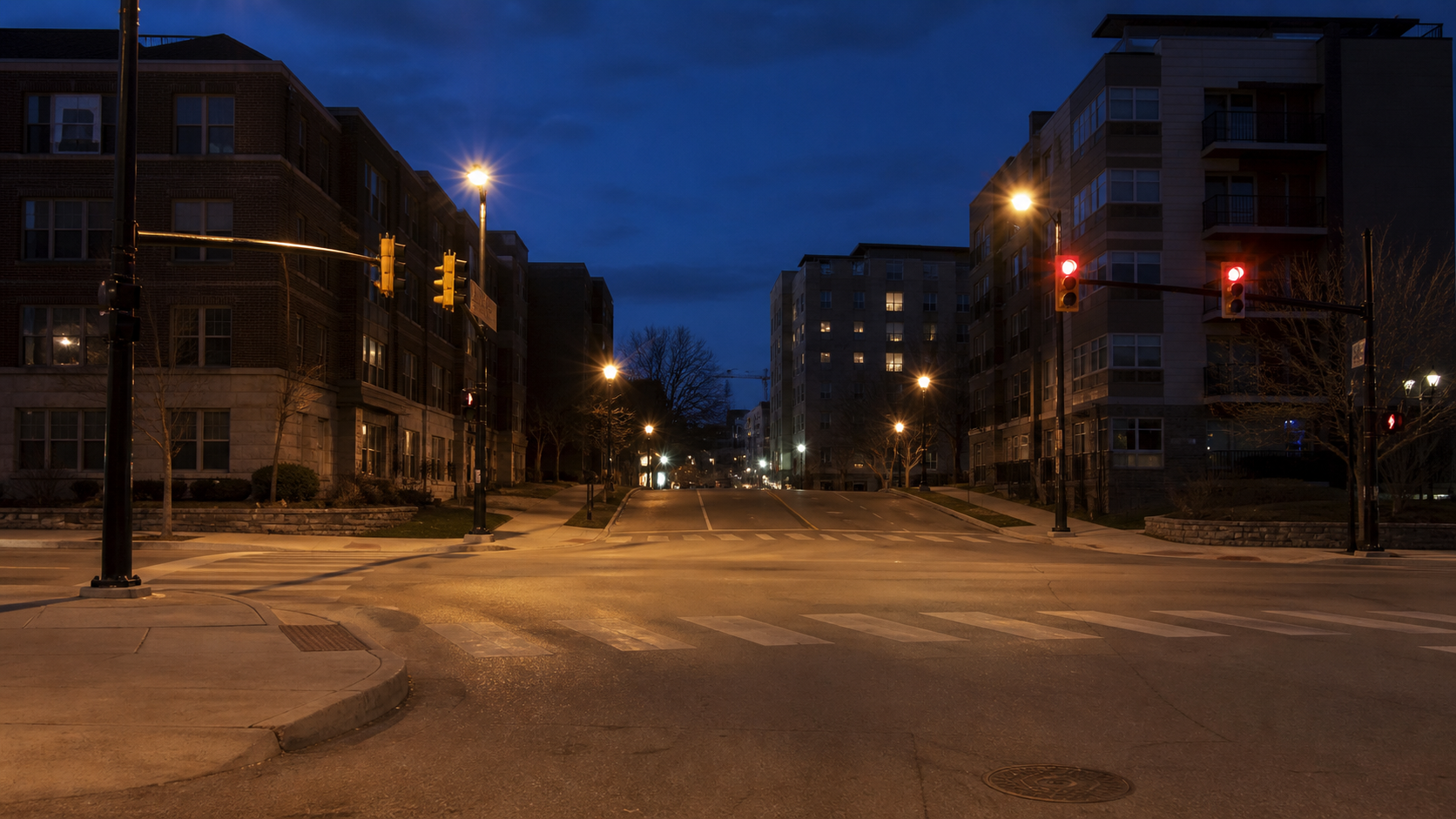
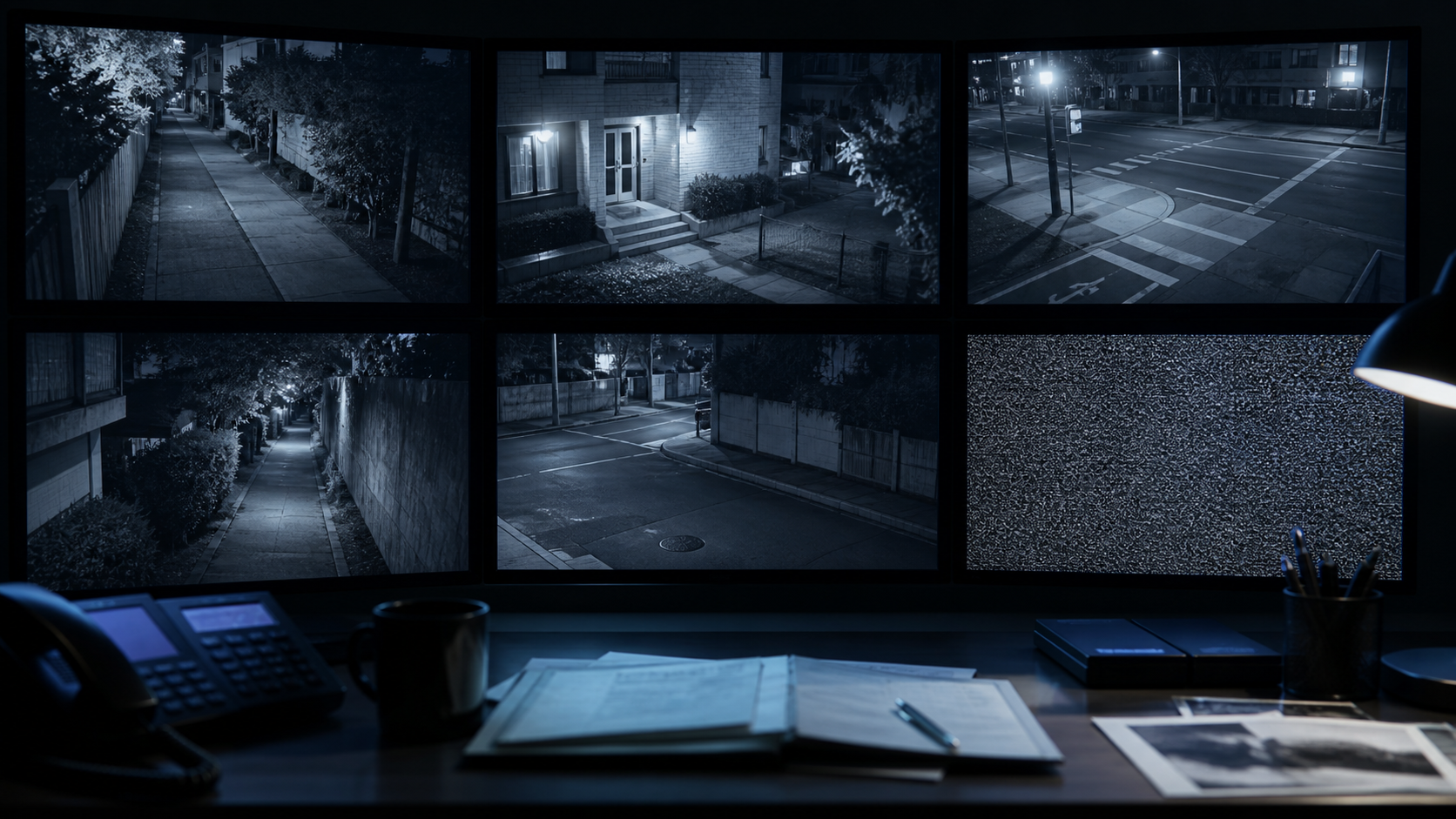
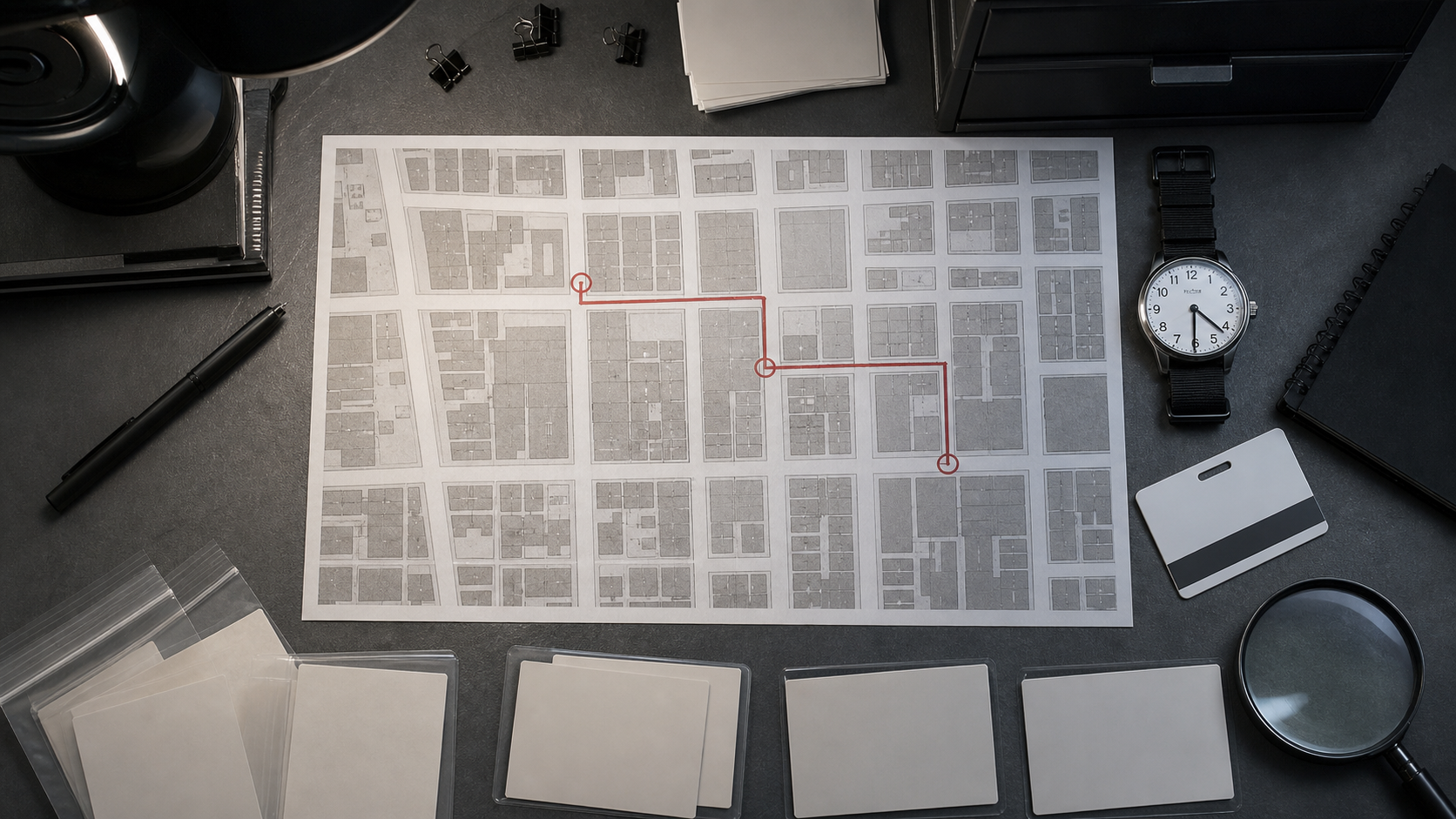
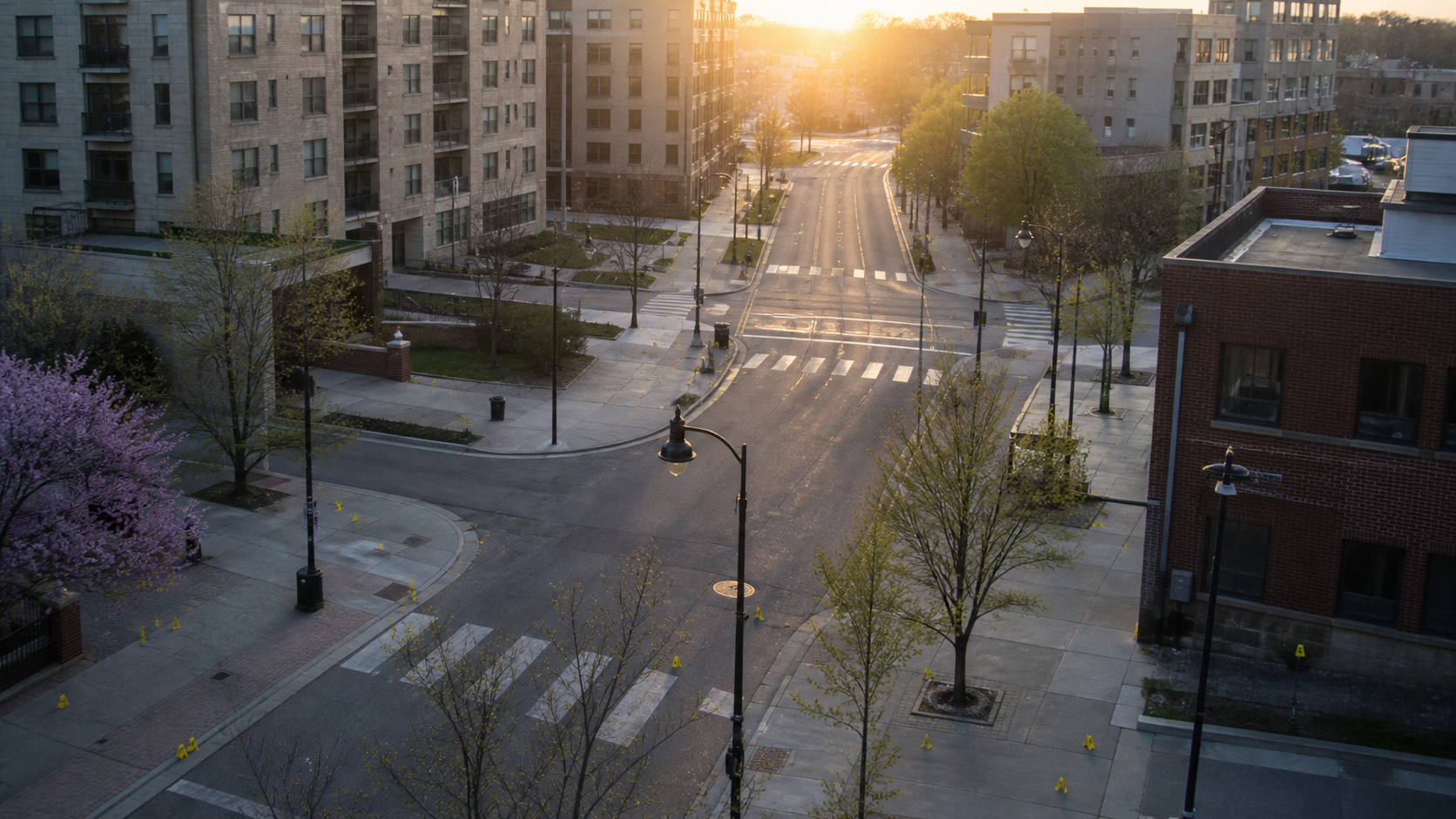
Editorial images in this article are symbolic reconstructions. They do not depict Lauren Spierer, her companions, actual surveillance footage or recovered evidence.
The central riddle: How did a person cross a busy student district, pass through several documented locations, and then vanish during the shortest and least recorded part of the route?
Why this case still matters
Lauren's case tests a common belief about the digital era: that urban movement automatically creates a complete trail. Cameras record angles, not whole streets. Phones create data only when powered, connected or used. Witnesses remember moments, not continuous chains.
Fifteen years after the disappearance, Bloomington police said in 2026 that the investigation remained very active and that tips continued to arrive. That status is important. Public theories may harden with repetition, but investigators still require evidence capable of surviving verification rather than a story that merely fills the final blank.
Case at a glance
| Date | June 3, 2011 |
|---|---|
| Last reported time | About 4:30 a.m. |
| Last reported place | 11th Street and College Avenue, Bloomington, Indiana |
| Missing | Lauren E. Spierer, 20 |
| Investigating agency | Bloomington Police Department, with partner agencies |
| Status | Active unresolved missing-person investigation |
1. The last confirmed sequence
Lauren, an Indiana University student, spent the early morning moving through a bar and downtown apartment area. Official and court records establish a night involving several locations and companions, but the public timeline must not turn every reported minute into an equally reliable fact.
The strongest final anchor is the reported sighting near 11th Street and College Avenue at about 4:30 a.m. From there, the apparent distance to her apartment was short. A short distance reduces the number of ordinary turns available, but it can increase uncertainty when no single camera covers the entire path.
Lauren was reported missing later that day. Searches, interviews and reviews of surveillance material followed. The large response proves that investigators gathered substantial information; it does not mean the final four-block interval was ever continuously observed.
2. What the evidence fixes
The case has a defined urban corridor and a late-night time frame. It also has multiple people who saw Lauren before the trail ended. Those facts make it possible to test statements against one another, camera times, building access and travel durations.
A federal appeals-court opinion arising from a civil lawsuit records that Lauren left a classmate's apartment and disappeared after a night of heavy drinking. The court document is not a criminal finding about what happened next. It is useful because it separates legally established background from the unresolved disappearance.
Indiana's current missing-person bulletin continues to list Lauren under the Bloomington Police Department. In 2026 police again asked for information, no matter how small. No publicly identified person has been charged with causing her disappearance.
3. Where the investigation loses continuity
The first gap is camera coverage. A person can appear at one doorway and fail to appear at the expected next angle without proving which alternate route was taken. Missing footage is absence of observation, not observation of absence.
The second gap is condition and memory. Witnesses in the early morning may have imperfect time estimates, and Lauren's own condition may have affected pace, direction or decisions. Those factors widen possibilities, but they do not prove an accident, concealment or attack.
The third gap is transport. A vehicle could move someone beyond the search corridor quickly, yet a vehicle theory needs a specific car, time and access point. A walking theory needs a route and destination. An indoor-event theory needs evidence that she entered a place from which she was never seen leaving.
4. Theories under the lamp
An accidental medical crisis followed by concealment
This model is often repeated because it can incorporate Lauren's condition and the late hour. It still requires people with motive and opportunity to conceal the event, plus a transport and disposal chain that left no verified trace.
An opportunistic offender intercepted the final walk
The short unobserved corridor gives this theory a window. It needs a vehicle or person placed there by independent evidence, not simply the general possibility that a stranger could be present.
Lauren reached another indoor location
A doorway outside the known sequence could explain why street cameras lost her. The theory must identify that location and reconcile it with access records, witnesses and later searches.
The decisive event involved someone already in the timeline
Familiar access can reduce the need for a random encounter. But proximity and inconsistent memory are not themselves proof. A viable accusation would require physical, digital or testimonial evidence linking a named person to the disappearance after the last sighting.
5. What could move the case
- A preserved device, account or provider record that extends the timeline beyond 4:30 a.m.
- Previously unrecovered private video from the final corridor or an intersecting road.
- A witness who can identify a specific vehicle, doorway or person with a verifiable time.
- A disclosure containing nonpublic details that investigators can test against retained evidence.
- Recovered remains or property with a reliable location and forensic chain.
Finding
Detective's reading: this is not a case in which the whole night vanished. Most of it survived in fragments. The decisive task is to connect the last verified fragment to a specific exit from the downtown grid.
The temptation is to make the final gap dramatic because it is empty. A disciplined reconstruction does the opposite. It measures the gap, marks which observations are independent, and refuses to turn a missing camera angle into a verdict about the people who stood nearest to it.
Sources and further reading
'Unsolved case' 카테고리의 다른 글
| Hachioji Supermarket Murders: The Cashbox Left Behind (0) | 2026.08.25 |
|---|---|
| Wanda Beach Murders: The Timeline Buried in the Dunes (0) | 2026.08.25 |
| Brianna Maitland: The Car at the Abandoned Barn (0) | 2026.08.25 |
| The Springfield Three: The House That Kept Everything but Its Peopl (0) | 2026.08.25 |
| The Alphabet Murders: A Pattern More Famous Than the Evidence (0) | 2026.08.24 |