Glasgow, Scotland | 1968–1969 | Current through August 2026
The most famous man in this case may be the least securely established fact in it. “Bible John” has a nickname, a face and a personality, yet all three were assembled after the last of three women was killed. I reopened the file by taking that figure apart: first the three deaths, then the taxi journey, then the links that turned separate investigations into a series.
Patricia Docker, Jemima McDonald and Helen Puttock were young mothers who went dancing in Glasgow and did not return to their children. Their deaths deserve precision because the story built around them has often preferred atmosphere to proof. A biblical quotation became a name. A witness description became an instantly recognisable face. Similarities became a single offender. Then every man who resembled the drawing was invited into the legend.
My method is deliberately less dramatic. I treat each death as its own file and mark every bridge between files by strength. A shared detail can support linkage without proving it. A witness can accurately remember a taxi conversation without establishing what happened on two earlier nights. A DNA comparison can clear one man without identifying another. This is not scepticism for its own sake; it is the only way to keep the conclusions proportional to the surviving record.
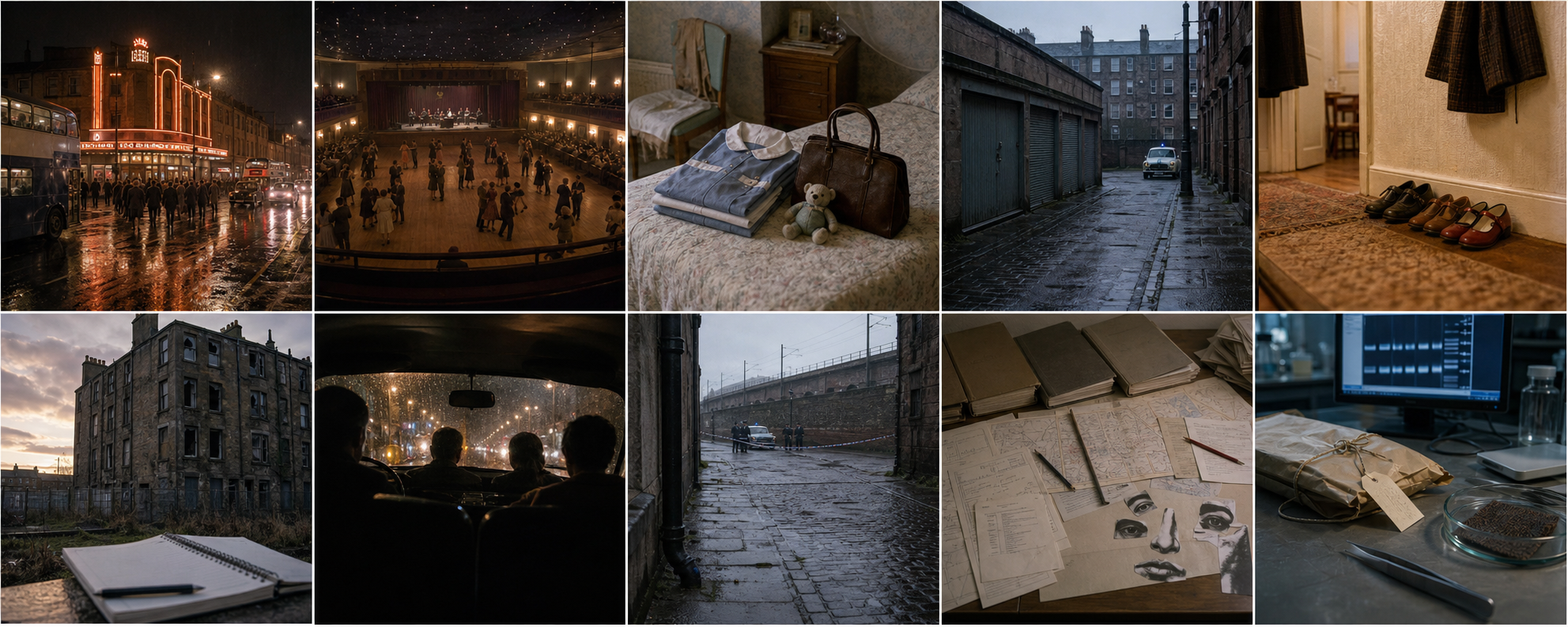
The ballroom before it became a crime-scene adjective
The Barrowland Ballroom opened beside the Barras market in Glasgow’s East End in 1934 and survived fire, reconstruction and changing music. Its sprung floor, starry ceiling and large crowds made it a social institution. On Thursday “over-25s” nights, adults who had jobs, marriages, separations and children could dance in the same ordinary way younger Glaswegians did elsewhere. Later coverage often treated attendance as evidence about a woman’s character. It was evidence only of where she chose to spend an evening.
That distinction matters because the ballroom carries different evidential weight in the three files. Jemima was a regular and was seen there on the relevant night. Helen went with her sister and met two men there. Patricia told her family she was going to the Majestic Ballroom; later accounts connect her to Barrowland, but the public record never established that route with the confidence of the other two. The phrase “three women murdered after leaving Barrowland” is compact, memorable and potentially too certain at its first step.
The venue also shaped the pool of possible witnesses. A crowded dance floor produces many brief observations and few sustained ones. Partners changed, music limited conversation, alcohol could be consumed in nearby bars, closing time released a stream of people into streets, buses and taxis, and a well-dressed stranger did not automatically look out of place. The same environment that allowed an offender to make contact also made retrospective identification unusually difficult.
Once newspapers printed a face and a nickname, memory no longer operated in a neutral city. People began comparing men they knew with the published image. Officers watched dance halls for someone who resembled it. The public learned what the wanted man was supposed to look like before many later recollections were recorded. The ballroom had become both a source of evidence and a machine for contaminating it.
File 1: Patricia Docker and the missing first route
Patricia Docker was twenty-five, an auxiliary nurse at Glasgow’s Victoria Infirmary and the mother of a young son. She was separated from her husband, who served in the RAF, and was living with her parents in Langside. On the evening of 22 February 1968, she went out dancing. She told her parents she intended to visit the Majestic. What happened between that departure and the following morning has never been reconstructed securely in public.
On 23 February, Patricia was found in a lane behind Carmichael Place in Battlefield, only streets from home. She had been beaten and strangled. Her clothing and handbag were absent; reports state that some personal property was later recovered from water. These facts establish violence, movement of possessions and a location close to the end of her expected journey. They do not establish the dance hall she actually attended, the person she left with, the transport she used or whether the missing property was taken for concealment, robbery or both.
The early investigation lost time to uncertainty about her evening. If witnesses were sought first at the Majestic while she had visited another venue, the strongest memories were already aging. If she did remain at the Majestic, the later Barrowland link may have redirected attention away from the correct crowd. Either possibility weakens a clean three-case narrative. Patricia’s file should not be forced to supply an answer that its timeline cannot.
Her case is also materially different. Clothing and the apparent ligature were removed from the immediate scene, unlike important elements described in the later files. An offender can change behaviour, especially over eighteen months, so difference does not disprove linkage. But it must count against a confident conclusion. My first ledger therefore marks Patricia as possibly linked, not as the automatic first act of an established series.
File 2: Jemima McDonald and the first visible pattern
Jemima McDonald was thirty-two and the mother of three children. She lived in Bridgeton, within walking distance of the Barrowland, and dancing there was familiar rather than exceptional. On Saturday 16 August 1969 she left her children with her sister and went out. Witnesses later placed her at the ballroom and in the company of a slim, well-dressed man. She did not return.
Her family’s response supplies the emotional and chronological centre of this file. Jemima’s sister searched after she failed to come home. On Monday 18 August she found Jemima inside a derelict tenement in MacKeith Street. Public accounts describe beating and strangulation with one of her own stockings. The location was not a remote dumping ground; it belonged to the neighbourhood through which family and children moved. That proximity turned rumour about a body into a sister’s discovery.
Unlike Patricia’s case, Jemima’s night contains a venue, sightings and a companion. Yet the companion is still an observation, not an identification. Descriptions varied over hair colour and other features, as descriptions produced by different people in dim, crowded settings often do. The public record does not show a preserved biological profile capable of independently placing that man at the recovery site. We therefore have a plausible contact sequence, not a named route from dance floor to murder.
Jemima’s death caused investigators to reconsider Patricia’s. Both women were mothers, both had been beaten and strangled, both were found near home, and both had missing handbags. A private and sensitive bodily circumstance was also common to the scenes. That last feature acquired enormous weight in the investigation and the press. It may be a meaningful behavioural signature; it may also have been amplified because contemporary society treated menstruation as shameful and mysterious. Its evidential value must be separated from the moral judgment imposed on the women.
File 3: Helen Puttock and the twenty-minute archive
Helen Puttock was twenty-nine, the mother of two sons and the wife of a soldier. On Thursday 30 October 1969 she went to the Barrowland with her sister Jean, whose married surname appears differently across published accounts. The sisters danced with two men, both said to have used the name John. At the end of the night, one man left for a bus. Helen, Jean and Helen’s companion entered a taxi.
That journey is the only sustained encounter between a witness and the man associated with any of the three deaths. Jean was dropped in Knightswood. Helen and the man continued toward Scotstoun. The following morning, Helen was found behind the tenements in Earl Street, near her home. She had been beaten, sexually assaulted and strangled with one of her stockings. Her handbag was missing. The murder remains unsolved.
During the taxi ride, according to Jean’s later account, the man spoke in a polished manner, discussed a strict religious upbringing, quoted or referred to scripture and condemned married women who attended the dance hall. He reportedly offered a name that witnesses and journalists rendered in more than one way. From that conversation came the moralising stranger, the first name John and eventually the press label “Bible John.”
The encounter is unusually valuable because it lasted longer than a passing sighting and involved conversation at close range. It is also vulnerable to ordinary limits: late-night fatigue, attention divided between two passengers, alcohol, changing light through a taxi, trauma after learning what happened, repeated interviews and later exposure to publicity. None of those conditions makes Jean unreliable. They mean her recollection should be treated as human testimony, not a recording.
The taxi driver added an independent position in the route, but his interpretation of what he saw at the end was made before he knew a murder had occurred. That is precisely why contemporary observations matter: they contain less retrospective theory. The surviving public accounts do not, however, produce a complete log of turns, times, fares and movements precise enough to identify a house or workplace for the passenger.
How one conversation became three-case biography
The investigation’s most consequential transformation occurred after Helen’s murder. Details from her sister’s statement were no longer held inside File 3. They became the profile of the presumed killer in Files 1 and 2 as well. A man who may have met Patricia and a man seen with Jemima were now expected to be tall, slim, reddish-fair haired, well dressed, well spoken and religiously severe.
Some transfer was rational. If one offender committed all three murders, the best witness description belonged to the series. But linkage was the premise required to justify that transfer, not a conclusion proved by it. Once the composite was public, resemblance to the image could make a man look relevant to all three cases even though the image arose from only one. This is a classic circular risk: the series creates the face, then the face is used to confirm the series.
The Crown Office authorised publication of a composite drawing in a Scottish murder inquiry for the first time. Its repeated eyes, hairline and narrow features became culturally more durable than any item of physical evidence. A composite is not a photograph. It is a collaboration among memory, questioning, available facial components and an artist’s decisions. It can trigger recognition, but it can also exclude the correct person from public attention if one memorable feature is wrong.
Published totals for the manhunt conflict. One modern report describes about 7,000 people interviewed and 4,000 statements; another cites more than 100 detectives and tens of thousands of door-to-door statements. The discrepancy is itself a warning against converting repeated numbers into fact. What is secure is scale: it was one of Scotland’s largest investigations, with thousands of contacts, venue surveillance and unprecedented publicity. Scale did not cure the uncertainty at its foundation.
The linkage ledger: what travels across all three files
| Feature | Support for one offender | Limit on the inference |
|---|---|---|
| Young mothers who went dancing | A repeated victim context within the same city and social scene. | A broad population category, made to look narrower by moralising coverage. |
| Strangulation and facial beating | A meaningful combination of control and violence repeated across cases. | Neither method was unique; public summaries do not provide a full technical comparison. |
| Recovery near home | Suggests an offender willing to accompany victims toward familiar neighbourhoods. | The precise travel histories are incomplete, especially for Patricia. |
| Missing handbags | Could reflect a repeated effort to remove identification, trophies or trace evidence. | Robbery, concealment and post-offence handling remain alternative explanations. |
| Menstruation and scene handling | The repeated sensitive detail may indicate offender knowledge or ritualised behaviour. | Its reporting was filtered through a culture that shamed the victims; exact case-file comparisons are not public. |
| Barrowland connection | Strong for Jemima and Helen and potentially a practical hunting ground. | Patricia’s presence there was never securely established. |
| Well-dressed male companion | Appears in witness accounts around the later files. | Descriptions vary, and only Helen’s file contains a long conversation. |
| Biblical speech | A highly distinctive behaviour in Helen’s taxi journey. | No public evidence places scripture or religious talk in the first two cases. |
The table does not reduce the case to a score. It reveals an asymmetry. Several crime features cross the files, but the traits that made “Bible John” famous do not. The religious persona, verbal style and iconic face belong almost entirely to Helen’s witness evidence. The murder linkage may be stronger than the personality linkage.
My reconstruction: a strong pair and an uncertain first file
After separating the evidence, my leading model is not three unrelated murders and not a proven three-victim series. It is a two-layer hypothesis. Jemima McDonald and Helen Puttock form the stronger pair: they were killed within roughly eleven weeks, both were securely connected to Barrowland, both appear to have left with a male companion, both were found near home, both were strangled with their own clothing and both had missing handbags. The interval and behavioural structure are close enough to justify a shared-offender investigation.
Patricia Docker may belong to that pair, but the public evidence leaves more distance. Eighteen months passed before Jemima’s death. Patricia’s final venue is uncertain. Her clothing was removed, and important scene handling differed. A developing offender could explain those differences; so could a different offender. The correct label is not “excluded” but “unresolved linkage.”
This model changes how the taxi description should be used. It is a powerful lead for Helen’s killer and a reasonable comparative lead for Jemima’s companion. It is weak as a retroactive description of Patricia’s killer. A future match to the Helen evidence would not automatically solve the other two murders. Each file would still require an independent bridge.
It also changes the meaning of the nickname. “Bible John” can remain a shorthand for the unidentified man in Helen’s taxi. It should not function as proof that one coherent character committed every act attributed to the series. The name is an investigative hypothesis that escaped into folklore.
The suspect carousel and the difference between comparison and proof
Decades of publicity produced a recurring ritual: a photograph surfaced, a resemblance to the composite was announced, biographical fragments were aligned with the taxi conversation, and certainty arrived before forensic evidence. Some men were dead and unable to answer. Others or their relatives lived with public accusation. None was convicted of these murders.
John Irvine McInnes became central to a 1990s review. His body was exhumed so that DNA could be compared with material preserved from Helen Puttock’s clothing. Contemporary and later reports differ in how they describe the early laboratory result, but the legal outcome is clear: he was formally cleared, and no admissible identification followed. A 2022 BBC podcast alleged that earlier police relationships had kept his name from proper scrutiny. Police Scotland said in 2023 that it was assessing those claims with prosecutors while stressing that the three murders remained unresolved. Allegation, review and proof are three different states.
Peter Tobin, convicted of three later murders, was repeatedly proposed because of violence against women, geography, appearance and aspects of his life story. Police examined the idea through Operation Anagram and later said he had been eliminated from their Bible John inquiries. He died in 2022. Continuing to present him as the solution requires ignoring the official investigative position and turning circumstantial resemblance into a verdict.
Neither conclusion means the historic investigations were flawless. A man can be mishandled as a suspect and still not be the killer. An institutional allegation can deserve review without proving the accused man committed three murders. The strongest analysis holds both thoughts at once and refuses to use dissatisfaction with policing as substitute evidence against an individual.
What the surviving DNA can and cannot say
Modern summaries often speak of “the Bible John DNA” as though laboratories possess a clean, complete profile belonging unquestionably to the offender in all three cases. The public record supports something narrower: biological material associated with Helen’s clothing has been used in comparisons. Its age, storage history, mixture status and relationship to the crime determine what any result means. Those technical details are not fully public.
A non-match can be extremely useful when the tested sample and the questioned profile are suitable for exclusion. It can clear a person from being the contributor. It does not prove who contributed the material, whether that contributor committed the murder, or whether the same person appears in Patricia’s and Jemima’s files. A degraded or partial result may not even support every comparison that readers imagine.
The case therefore cannot be solved by repeating the word DNA. Investigators need an evidence audit: what items remain, their exact provenance, every opening and transfer, previous test consumption, contamination controls, the number of contributors and the statistical strength of any recoverable profile. Only then can present techniques—more sensitive typing, mixture interpretation or, if lawfully authorised, genealogy—be evaluated responsibly.
Police Scotland’s 2026 disclosure log includes a request concerning the costs of a Bible John investigation or review. The existence of a financial disclosure is not evidence of a forensic breakthrough, but it confirms the case still generates formal administrative activity. The last clear public status remains unresolved and subject to review.
The investigative path that still makes sense
1. Rebuild three evidence inventories, not one legend
Every surviving item should remain tied to its original file. A profile recovered from Helen’s clothing belongs first to Helen’s murder. A property item recovered from water in Patricia’s case belongs to Patricia. Cross-case comparison comes after provenance, not before it. This prevents the series hypothesis from silently filling gaps in individual chains of custody.
2. Digitise the witness chronology by interview date
Statements should be ordered by when they were taken, what publicity the witness had already seen and which questions had been asked previously. Early observations must be distinguished from details added after the composite circulated. Contradictions are not defects to erase; they may reveal which parts of the description were stable before the city learned the wanted face.
3. Recalculate linkage without the nickname
Analysts should compare method, geography, timing, victim contact and scene handling while temporarily excluding the biblical conversation and composite. If Files 2 and 3 remain strongly linked, the pair stands on crime evidence rather than charisma. File 1 can then be tested against that pair without assuming it is the beginning.
4. Audit every historical suspect outcome
“Investigated,” “inconclusive,” “not matched,” “eliminated” and “formally cleared” must not be treated as synonyms. A modern review should state exactly why each comparison ended and which evidence supported the decision. That protects cleared families and prevents the same disproven claim from being sold as a new revelation.
5. Publish only what creates a useful public memory
After more than half a century, a new appeal should seek concrete recollections: employment, transport, residence, admissions or preserved correspondence connected to specific dates and routes. Reprinting the composite alone may generate resemblance tips rather than evidence. The best public appeal explains which forgotten fact could still be checked.
The city was asked to remember a face; it should remember three names
Patricia Docker cared for patients and for a young son. Jemima McDonald raised three children and loved to dance close to home. Helen Puttock had two sons and a sister who carried the burden of the final witness encounter for decades. Their choices did not create the danger. The danger came from the person or people who attacked them and from institutions and coverage that sometimes converted ordinary female independence into suspicion.
The Barrowland should not be reduced to a predator’s hunting ground. It was a beloved public room full of music, introductions and lives continuing after hard working weeks. That normality matters because it rejects the oldest false lesson of the case: that a woman was reckless simply because she went dancing.
The honest ending is narrower than legend wants. No one has been convicted. Police Scotland continued to describe the murders as unresolved when it assessed new allegations in 2023, and a 2026 disclosure shows review-related interest without announcing a solution. DNA has excluded or failed to link named men; it has not publicly identified an offender. The composite remains a witness-based lead, not the face of a proven three-time killer.
My reconstruction leaves two doors open. Behind the first is one offender whose behaviour developed across three murders. Behind the second is a stronger two-case series with Patricia’s death committed by someone else. The surviving public evidence cannot close either door. What it can do is stop a newspaper nickname from pretending that the corridor has only one.
Sources and verification notes
- Police Scotland, “1920–2020: A Century in Review, Part 2” — official description of the still-unsolved inquiry, its exceptional scale and the first Crown-authorised publication of a composite drawing in Scotland.
- Police Scotland disclosure 26-0154, released 6 March 2026 — current official record of a request concerning investigation/review costs; it does not announce a solution.
- STV News, “Police investigating new Bible John ‘cover-up’ claims” (11 October 2023) — Police Scotland’s review statement, the McInnes allegation, exhumation and formal clearance.
- The Guardian, “BBC podcast prompts police to look again…” (11 October 2023) — family response, modern review context and a published estimate of the original inquiry’s scale.
- STV News archive, “50-year-old cases unsolved but never closed” (23 February 2018) — victim summary, witness description, manhunt, review policy, tip channels and an alternative published statement count.
- STV News, “Peter Tobin: Life of Scots serial killer…” (8 October 2022) — convictions, Operation Anagram and the police statement that Tobin was eliminated from the Bible John inquiry.
- The Guardian, “‘I see him walking his dog in the park’…” (1 November 2022) — victim-centred examination of the case and the misogyny surrounding menstruation and dancing.
- The Guardian, Francisco Garcia, “True crime can be an unedifying business…” (23 May 2023) — the construction of the nickname and the need to distinguish the women from the media figure.
- The Independent, “Police to exhume body in serial killer inquiry” (1996) — contemporaneous context for the extraordinary forensic comparison and the absence of equivalent known evidence in the other files.
- Glasgow History, “The Bible John Murders” — detailed victim chronology, the Barrowland’s civic context, linkage critique, composite history and modern source synthesis. Used as a secondary reference where primary case files are not public.
Editorial method: Facts are attributed to named sources; disputed totals and forensic interpretations are identified as disputed. The two-layer linkage model is the author’s analysis, not an official police conclusion. The ten images are newly generated editorial reconstructions and portray no real victim, witness or suspect.