Southeastern Virginia | 1986-1989 | Updated August 2026
For nearly forty years, four couples were arranged into one dark sentence: the Colonial Parkway murders. Then DNA began adding periods. In 2024, Virginia authorities identified Alan Wade Wilmer Sr. in one of the four core cases. In January 2026, the FBI identified him in a second. Those breakthroughs solve two crime scenes and name four victims' killer. They do not automatically solve the other two files, and they do not prove that every abandoned car on the road belonged to one design.
I rebuilt the case as four folders, not as a single serial-killer legend. Each folder contains two people, a vehicle, a recovery site, a jurisdiction, and a different quantity of surviving evidence. Only after those files are separated should the connections be tested. This method produces a less dramatic story, but a more accurate one: Wilmer is now forensically tied to four of the eight core victims, and separately to two additional Virginia murder victims. Four core victims still require their own answers.
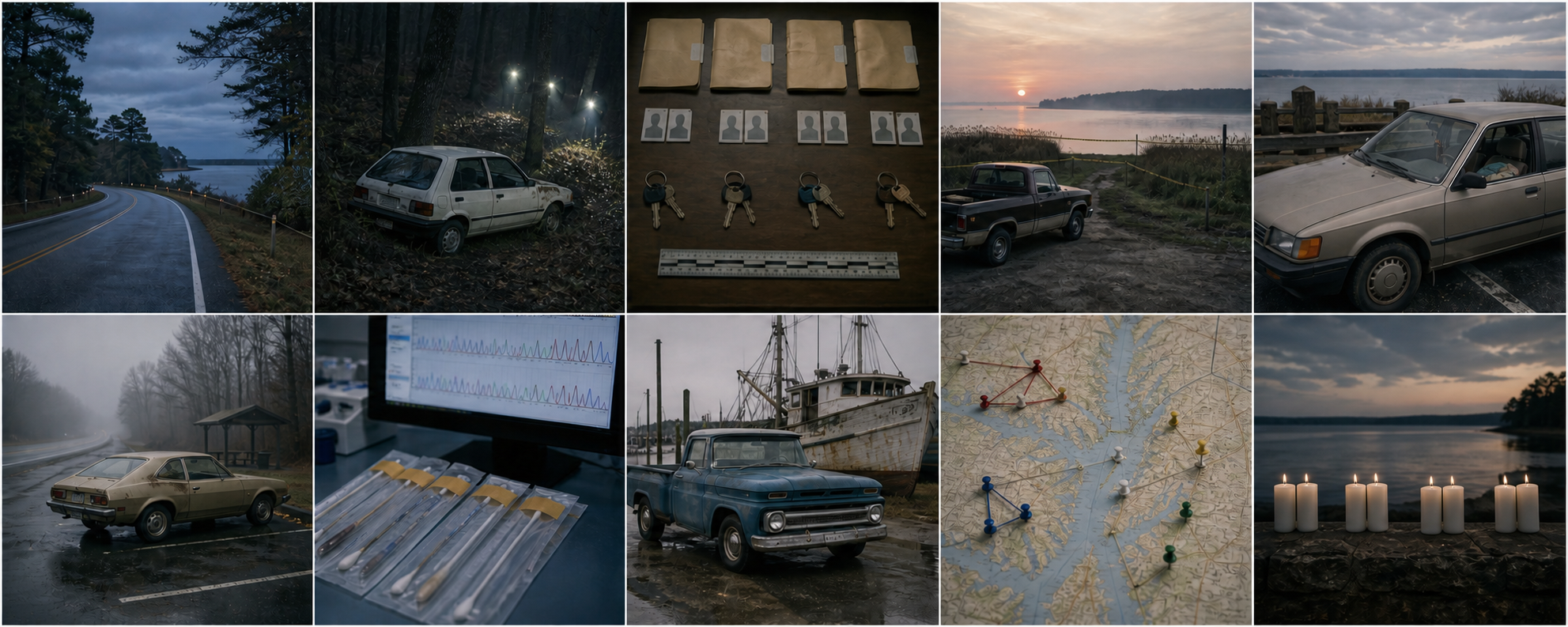
The name of the series is already a theory
The Colonial Parkway is a scenic road joining Yorktown, Williamsburg, and Jamestown. Its wooded pull-offs and river views created privacy after dark. Two of the four core files directly involve vehicles found on the parkway: Thomas-Dowski and Call-Hailey. The Knobling-Edwards scene was at the Ragged Island Wildlife Refuge in Isle of Wight County. The Phelps-Lauer vehicle was at a westbound Interstate 64 rest area in New Kent County. The umbrella name is convenient, not geographically exact.
In December 2009, the FBI publicly acknowledged both the similarities and the limit. Federal and state investigators were working with the theory that the cases were related, but the FBI said no conclusive physical evidence then tied all the homicides together. That sentence should have remained attached to every later documentary and suspect list. Similar circumstances can justify coordination. They do not erase differences in weapons, victim movement, body recovery, or forensic results.
The 2026 FBI announcement changes the map but preserves the caution. Wilmer is responsible for the first parkway double murder, Thomas and Dowski. Virginia State Police had already identified him in the Knobling-Edwards double murder. Those are two separate core folders now joined to one man by modern forensic work. The remaining two folders do not become solved by resemblance. The FBI explicitly says investigators continue to pursue unsolved cases related to the Colonial Parkway murders.
This distinction matters for families. A collective name brought attention and resources, but it also encouraged the public to treat resolution as all-or-nothing. The truth is now uneven. Four core victims have an identified killer. Two people remain missing. Two more were recovered but their killer is unidentified. A responsible account must be able to hold those outcomes at the same time.
Folder A: Cathleen Thomas and Rebecca Dowski
Cathleen Marian Thomas, twenty-seven, and Rebecca Ann Dowski, twenty-one, were last seen on Thursday evening, October 9, 1986, at a computer lab at the College of William and Mary. On October 12, the National Park Service received a report of a vehicle off the road east of Cheatham Annex. Rangers found Thomas's white 1980 Honda Civic in a wooded area between the Ringfield Plantation overlook and the York River. Both women were inside. The FBI's archived case summary says they had been stabbed and strangled.
Thomas was among the early women to graduate from the U.S. Naval Academy and was remembered by the FBI in 2026 as compassionate, intelligent, and close to family and friends. Dowski was a musician and college student remembered for creativity and kindness. Their relationship has often been discussed as a possible motive, but motive cannot be inferred from identity alone. The public record does not establish whether Wilmer selected them because they were women, because they were a couple, because they were isolated, or for some combination unknown outside the unreleased file.
The car is important because it appears to have been moved off the roadway into vegetation. A vehicle contains a sequence: where the couple stopped, how another person gained control, whether the offender entered, and who moved the car last. Public summaries describe the recovery but do not reveal the complete modern forensic basis. The 2026 FBI release attributes the breakthrough to advances in forensic science and DNA analysis, assisted by exhaustive review and SAKI-funded analytical support and testing. It does not identify the specific item, DNA type, or laboratory statistic.
That silence is appropriate. A press release can state the conclusion without exposing every protected detail. The U.S. Attorney's Office for the Eastern District of Virginia reviewed the developed evidence and said it would have supported federal prosecution if Wilmer were alive. This is stronger than calling him merely a person of interest. It is still not a conviction obtained in an adversarial trial, because his death made a trial impossible.
Folder B: David Knobling and Robin Edwards
David Lee Knobling, twenty, and Robin Margaret Edwards, fourteen, were last seen on September 19, 1987. Virginia State Police says they were reported missing on September 21. A beachcomber found their bodies on September 23 at the Ragged Island Wildlife Refuge in Isle of Wight County. Both died from gunshot wounds. The recovery site was along the James River, outside the parkway itself but within the larger Hampton Roads geography that made comparison reasonable.
On January 8, 2024, Virginia State Police announced that Wilmer had been forensically identified as responsible for both deaths. Reporting from the announcement said investigators had legally obtained his DNA after his death. He had no felony conviction requiring his profile to be stored in the law-enforcement database, so a crime-scene profile could remain unmatched even if it was technically usable.
This is the central cold-case lesson. A DNA profile is not a name. It can link two evidence items and still return no person. CODIS compares eligible forensic profiles with profiles collected under law from offenders, arrestees where authorized, and other cases. If the source person is absent from those indexes, the database cannot invent him. Once investigators obtained a lawful reference sample for Wilmer, the unknown pattern could become an identification.
The VSP public database still labels the Knobling-Edwards entry active while recording the 2024 identification. That is not necessarily a contradiction. A case can be resolved as to the principal offender while investigators continue reconstructing conduct, reviewing additional crimes, identifying possible assistance, or preserving tip channels. Administrative labels differ across agencies. The evidence statement is more informative than the single status word.
The six confirmed victims are not the original eight
The FBI said in 2026 that Wilmer was connected to at least six murders and disappearances of young people in Virginia between 1986 and 1989. The phrasing can be confusing because the Colonial Parkway label commonly contains eight core victims. The six currently identified victims are not simply six of those original eight.
Four are core Colonial Parkway victims: Cathleen Thomas, Rebecca Dowski, David Knobling, and Robin Edwards. Two are additional Virginia homicide victims whose cases were connected through forensic work: Laurie Ann Powell and Teresa Lynn Spaw Howell. Powell disappeared in March 1988 and was recovered in the Elizabeth River in April. Virginia State Police announced in November 2025 that DNA identified Wilmer as responsible. Howell was killed in Hampton in July 1989; authorities announced her identification to Wilmer alongside Knobling and Edwards in January 2024.
| Victim or pair | Relationship to the series | Current public status |
|---|---|---|
| Cathleen Thomas and Rebecca Dowski | Core Folder A, Colonial Parkway vehicle scene | FBI resolved to Wilmer, January 2026 |
| David Knobling and Robin Edwards | Core Folder B, Ragged Island scene | VSP forensically identified Wilmer, January 2024 |
| Laurie Ann Powell | Separate 1988 Virginia homicide near regional waterways | VSP linked Wilmer by DNA, November 2025 |
| Teresa Lynn Spaw Howell | Separate 1989 Hampton homicide | Authorities identified Wilmer, January 2024 |
| Richard Keith Call and Cassandra Hailey | Core Folder C, parkway vehicle recovery | Missing; unresolved |
| Annamaria Phelps and Daniel Lauer | Core Folder D, I-64 vehicle and woodland recovery | Homicide; unresolved |
Why insist on this bookkeeping? Because the arithmetic controls the conclusion. "Wilmer killed six" is supported by agency announcements. "Six of the eight parkway victims are solved" is not. Only four of the original eight have been officially attributed to him. Powell and Howell broaden the known pattern, but they do not replace the evidentiary work required in the Call-Hailey and Phelps-Lauer files.
Folder C: Richard Keith Call and Cassandra Hailey
Richard Keith Call, twenty, and Cassandra Lee Hailey, eighteen, went on their first date on Saturday, April 9, 1988. The FBI says they attended a party at the University Square Apartments in Newport News that continued past midnight. They were not seen again. Later Sunday morning, Call's father found his son's car at the York River overlook on the Colonial Parkway near Yorktown. Clothing belonging to both young people remained inside. Their bodies have never been recovered.
An abandoned car can tell investigators that a journey stopped, but not why. Clothing may support an unplanned separation from the vehicle, yet it cannot identify who forced that separation or where the pair went next. No body means no recovery-site trace pattern, no conventional autopsy findings, and no direct biological inventory from the victims after the event. The case must rely heavily on the car, witness timing, route reconstruction, items left or missing, and any offender behavior near the overlook.
Wilmer's life makes him a compelling person to investigate. Authorities said he drove a distinctive blue 1966 Dodge Fargo pickup bearing the vanity plate EM-RAW, operated a tree service, worked as a waterman, and used a wooden commercial fishing boat. Public reporting says the vehicle and Wilmer had drawn attention around the parkway investigation. His confirmed crimes place him in the right region and period, targeting young people near roads and water.
But "compelling" is not "resolved." The FBI's January 2026 announcement did not attribute Call and Hailey's disappearance to Wilmer. It said work on related unsolved cases continues. Without remains, a matching crime-scene profile, a verified confession, or another physical bridge, the Call-Hailey file must remain open even if Wilmer is the leading hypothesis.
Folder D: Annamaria Phelps and Daniel Lauer
Annamaria Phelps, eighteen, and Daniel Lauer, twenty-one, left Amelia County at about 11:15 p.m. on September 4, 1989, traveling toward Virginia Beach in Lauer's 1973 gold Chevrolet Nova. When they failed to arrive, family members contacted Virginia State Police. At approximately 5:30 p.m. on September 5, troopers found the Nova abandoned at the westbound Interstate 64 rest area in New Kent County.
On October 19, hunters discovered remains in woods about three miles east of the rest area. They were identified as Phelps and Lauer, both homicide victims. The current VSP cold-case entry corrects a common timeline error in older summaries that blur the day the vehicle was found with the later recovery of the bodies.
This folder differs from the first three. Its primary road is I-64 rather than the Colonial Parkway. The bodies were found several miles from the car and weeks after disappearance. The public VSP entry does not disclose cause of death or a forensic connection to Wilmer. The road, vehicle separation, young pair, and wooded recovery permit comparison. They do not establish a shared offender.
The distance between car and remains creates a transport question. Someone may have controlled the pair at the rest area, used another vehicle, or arranged a meeting that ended elsewhere. Investigators can compare soil, fibers, vehicle access, offender geography, and witness traffic. But the answer cannot be imported from Ragged Island simply because both cases involve a car near a route leading toward Hampton Roads.
What DNA resolved - and what it did not
DNA can answer a source question: whose biological material is this? It can link evidence from separate cases to a common source. Combined with location, victim account, injury pattern, exclusion of legitimate contact, and other investigation, it can support an attribution of responsibility. It does not automatically explain motive, sequence, intent, accomplices, or every crime committed in the same region.
The public announcements reveal three different levels of information. For Knobling-Edwards and Howell, authorities said DNA evidence identified Wilmer. For Powell, Virginia State Police said DNA from preserved evidence connected him. For Thomas-Dowski, the FBI cited DNA analysis and forensic advances but did not disclose the particular item or profile. Readers should not pretend those unreleased laboratory details are known.
SAKI funding is part of the story because it supports more than laboratory chemistry. The federal program funds inventory, testing, evidence tracking, investigation, prosecution work, victim notification, and multidisciplinary cold-case response. The FBI credited Virginia's Sexual Assault Kit Initiative with analytical support and testing for the 2026 resolution. A breakthrough described as "new DNA" often depends on decades of evidence custody, funding decisions, legal review, family notification, and traditional records work.
Wilmer's absence from offender databases also shows the boundary of a search. CODIS can compare an unknown crime-scene profile against eligible offender, arrestee, and forensic indexes. A man with no qualifying stored reference sample may remain outside that net. Investigators legally obtained Wilmer's DNA after his death, according to the 2024 announcement. The comparison then converted an unknown source into a name.
The man behind the reference sample
Alan Wade Wilmer Sr., known as "Pokey," died in Lancaster County in December 2017 at age sixty-three. Authorities described him as a waterman who worked in clamming and oystering, sometimes lived on his custom wooden fishing boat, and operated a tree service. He traveled among marinas and waterways in southeastern Virginia. He hunted and belonged to a regional hunt club. His work and recreation gave him geographic familiarity that an ordinary road map cannot measure.
The blue Dodge Fargo pickup and boat are high-value recognition details because they are specific and historically testable. A witness who saw that truck in 1987 may have dismissed it as a working vehicle. A marina ledger, repair receipt, photograph, hunting record, or property file could now attach a date to a movement. Investigators have asked people who knew or worked with Wilmer to report interactions, even if the information once seemed unimportant.
Those details must not become retroactive proof everywhere. A distinctive truck seen near one relevant location does not place it at every scene. Owning a boat does not explain every body recovered near water. Hunting familiarity does not prove use of the New Kent woods. The confirmed DNA cases justify a broad reconstruction of Wilmer's movements; they do not eliminate the need for case-specific corroboration.
His death changes the standard of public accountability. There will be no interrogation, cross-examination, defense testing, or sentencing. Investigators can still state a forensic conclusion, prosecutors can assess charge sufficiency, and families can receive answers. Writers should describe that process accurately: law enforcement identified him as responsible; a court did not convict him.
Testing the one-offender hypothesis
Before 2024, the one-offender theory rested mostly on pattern: young pairs, cars found in secluded places, water or woods, a three-year region, and apparent control without an obvious public witness. Now it has one crucial confirmation: the same identified man is responsible for two of the four core double murders. That makes his involvement in the remaining cases more plausible than it was, but probability is not transfer.
I tested the theory across six demands:
| Demand | Wilmer as common offender | Current limit |
|---|---|---|
| Right time and region | Strong. He lived and worked in the relevant southeastern Virginia geography. | Regional presence covers many innocent residents and workers. |
| Access to secluded roads and water | Strong. His occupations and boat support familiarity. | Access is opportunity, not scene placement. |
| Victim pattern | Moderate to strong. Confirmed victims were young and encountered around isolated travel or waterfront settings. | Age, relationship, and circumstances vary; one victim was alone. |
| Vehicle-control pattern | Moderate. Multiple core scenes begin with an abandoned or displaced vehicle. | The exact vehicle handling differs, and the released Powell/Howell summaries do not establish the same pattern. |
| Forensic bridge | Decisive for Folders A and B and the two additional cases. | No announced physical match for Folders C or D. |
| Offender communication | Unknown publicly. | No verified confession or protected-detail admission has been announced. |
My conclusion is tiered. Wilmer is the confirmed offender in Folders A and B. He is the leading comparative subject for Folder C because of the parkway setting, his known pattern, and released vehicle context, but the file remains unresolved. He is a necessary comparison for Folder D, though its highway rest-area geography and undisclosed forensic record make the public case weaker. A second offender, independent event, or accomplice cannot be excluded.
This is not excessive caution. It is the same logic that allowed DNA to improve the series. Investigators preserved the identity of each evidence item instead of averaging them into a legend. When the samples finally named Wilmer, they named him where the match existed. The remaining files deserve that same discipline.
Jurisdictional seams are part of the evidence history
The cases cross federal, state, and local boundaries. The National Park Service and FBI had responsibility for incidents on federal parkway land. Virginia State Police led the Ragged Island and New Kent investigations. Hampton Police handled Howell's case. Suffolk and other regional partners participated in later review. These divisions affect evidence storage, laboratory submissions, interview files, and the language each agency uses for closure.
In 2009, the FBI emphasized information sharing between agencies because the similarities justified a collective theory even without conclusive physical linkage. The 2026 resolution credits the FBI, Virginia State Police, Hampton Police, Suffolk Police, prosecutors, and Virginia's attorney general program. Four decades of coordination are not a footnote; they are a mechanism of the result.
Jurisdiction can also create apparent contradictions. One database may list a case active after another agency announces the offender. An archived FBI summary may compress a discovery date that a current VSP page corrects. A state homicide can sit inside a public "Colonial Parkway" list even though the actual scene is miles from the parkway. The remedy is not to choose the most dramatic version. It is to retain agency, date, and source beside each fact.
What the two open folders need
For Call and Hailey, the greatest need is location. Recovering either person could transform the file by establishing a scene, cause of death, trace history, and geographic corridor. Short of recovery, investigators need a credible witness, vehicle record, Wilmer movement record, or confession detail that connects the parkway car to a destination. The FBI tip channel remains relevant because someone may remember a truck, boat, marina absence, cleaning, disposal, or statement from April 1988.
For Phelps and Lauer, the bodies and car provide two physical anchors. The question is whether preserved material can identify a source, whether the Nova contained transfer evidence, and whether someone can connect a vehicle or person to the rest area and woodland corridor. The current VSP entry supplies a direct investigating-agent contact and labels the case active. That is stronger evidence of status than assumptions derived from the Wilmer announcements.
Both files also require negative results to be documented. If a preserved profile excludes Wilmer, that would narrow the series. If no usable DNA exists, that absence should not be rewritten as inclusion. If his known vehicle cannot be placed in the area, the hypothesis loses weight. Cold-case progress includes ruling out a compelling name where the evidence does not support it.
A tip gains value when it contains information that can be tested: a date, vehicle, location, object, statement, employer, marina, hunting property, or route. General resemblance and online accusation add noise. The FBI accepts tips at 1-800-CALL-FBI and tips.fbi.gov. The Virginia State Police cold-case pages provide case-specific submission links and agency contacts.
My verdict: the road contains two answers and two questions
The Colonial Parkway label once encouraged a binary question: one killer or several? The evidence now gives a more useful answer. At least two core double murders had the same offender, Alan Wade Wilmer Sr. His separate links to Powell and Howell show that his violence was not confined to couples or to the parkway. That broader pattern strengthens the reason to examine him in the remaining files.
But the series is not a single evidentiary object. Folder A has a federal resolution supported by DNA and prosecutorial review. Folder B has a state forensic identification. Folder C has an abandoned car and two people still missing. Folder D has a car and a recovery site three miles apart, with no announced Wilmer match. These are different proof states.
I believe Wilmer is the most important hypothesis for Call and Hailey because his confirmed crimes bracket their disappearance in time, his known geography fits, and the parkway context is unusually close. I do not call that case solved. I assign lower public confidence to his responsibility for Phelps and Lauer because the available record offers fewer specific Wilmer connections, though his regional access makes him impossible to ignore.
The next breakthrough may come from an old biological sample, but it may also come from paper: marina logs, photographs of the Dodge, hunting leases, tree-service jobs, repair receipts, property maps, or a witness who finally attaches a date to a memory. DNA named a man only because investigators could compare it with preserved evidence and a lawfully obtained reference. The remaining road must be crossed the same way - item by item.
The names that should outlast the label
Cathleen Thomas and Rebecca Dowski now have an official answer. David Knobling and Robin Edwards have one as well. Richard Keith Call and Cassandra Hailey remain missing. Annamaria Phelps and Daniel Lauer remain homicide victims in an active state case. The phrase "Colonial Parkway murders" helped keep their stories together, but it should never make any of them interchangeable.
The most important correction to the old narrative is therefore not merely the name Alan Wade Wilmer Sr. It is a new way to read the series: accept the forensic conclusion where it exists; protect uncertainty where it does not; and measure progress by what each family can now know, not by whether one headline can close every folder.
Sources and verification notes
- FBI Norfolk, "Resolution of 1986 Colonial Parkway Murders of Cathleen Thomas and Rebecca Dowski" (January 20, 2026) - current resolution, prosecutorial assessment, DNA and SAKI support, and confirmation that related unsolved cases remain active.
- FBI Norfolk archive, "Cold Case Murders" (January 7, 2010) - baseline chronology for Thomas-Dowski and Call-Hailey and historical summary of the state cases.
- FBI Norfolk, 2009 Colonial Parkway press conference - jurisdiction, historical evidence review, and the explicit statement that no conclusive physical evidence then tied every homicide together.
- Virginia State Police Cold Case Database, Edwards and Knobling - victim ages, dates, causes of death, 2024 forensic identification, active status, and tip contact.
- Virginia State Police Cold Case Database, Annamaria Phelps and Daniel Lauer - current official departure, vehicle-recovery, remains-recovery chronology and active status.
- Virginia State Police, Department History - agency record of the 2024 identification of Wilmer in the Knobling-Edwards and Howell cases.
- Associated Press, "Police name dead suspect in 3 Virginia cold cases" (January 8, 2024) - lawful posthumous DNA collection, database gap, Wilmer biography, distinctive vehicle and boat, and authorities' caution about other files.
- The Washington Post, "Serial killer linked to 1986 murders of Virginia women" (January 22, 2026) - family perspectives and contemporary context for the FBI resolution.
- The Washington Post, "DNA links suspected serial killer to 1988 slaying" (November 14, 2025) - Laurie Ann Powell identification and the distinction between confirmed and suspected cases.
- WSLS, "Virginia State Police: Cold case solved, linked to suspected serial killer" (November 14, 2025) - Powell timeline and DNA announcement.
- FBI, CODIS and NDIS Fact Sheet - what forensic, offender, arrestee, and missing-person DNA indexes can and cannot do.
- Bureau of Justice Assistance, National Sexual Assault Kit Initiative - program scope, evidence tracking, cold-case investigation, DNA testing, victim-centered coordination, and lawful CODIS work.
Editorial method: The article treats every core pair as a separate evidence file. Officially announced attributions are distinguished from the author's comparative hypothesis. The ten newly generated images are editorial reconstructions and do not portray victims, Wilmer, or verified crime-scene positions.