Albuquerque, New Mexico · An evidence-bound reconstruction
The desert did not solve the West Mesa murders when it gave up its dead. It preserved a location, a pattern of concealment, and eleven identities waiting to be restored. What it did not preserve was a name for the person who brought them there. This is my reconstruction of the case from the ground outward: first the trail, then the excavation grid, then the missing-person files, and only at the end the suspects. That order matters.
At dawn, the western edge of Albuquerque can make distance look simple. Subdivision roofs stop; pale dirt begins; volcanic ridges darken the horizon. Yet a mesa is not an empty page. Wind changes the surface. Arroyos carry soil. Vehicles leave parallel scars and then other vehicles cross them. Development approaches in rectangles. A place that looks vacant from a road may contain years of movement.
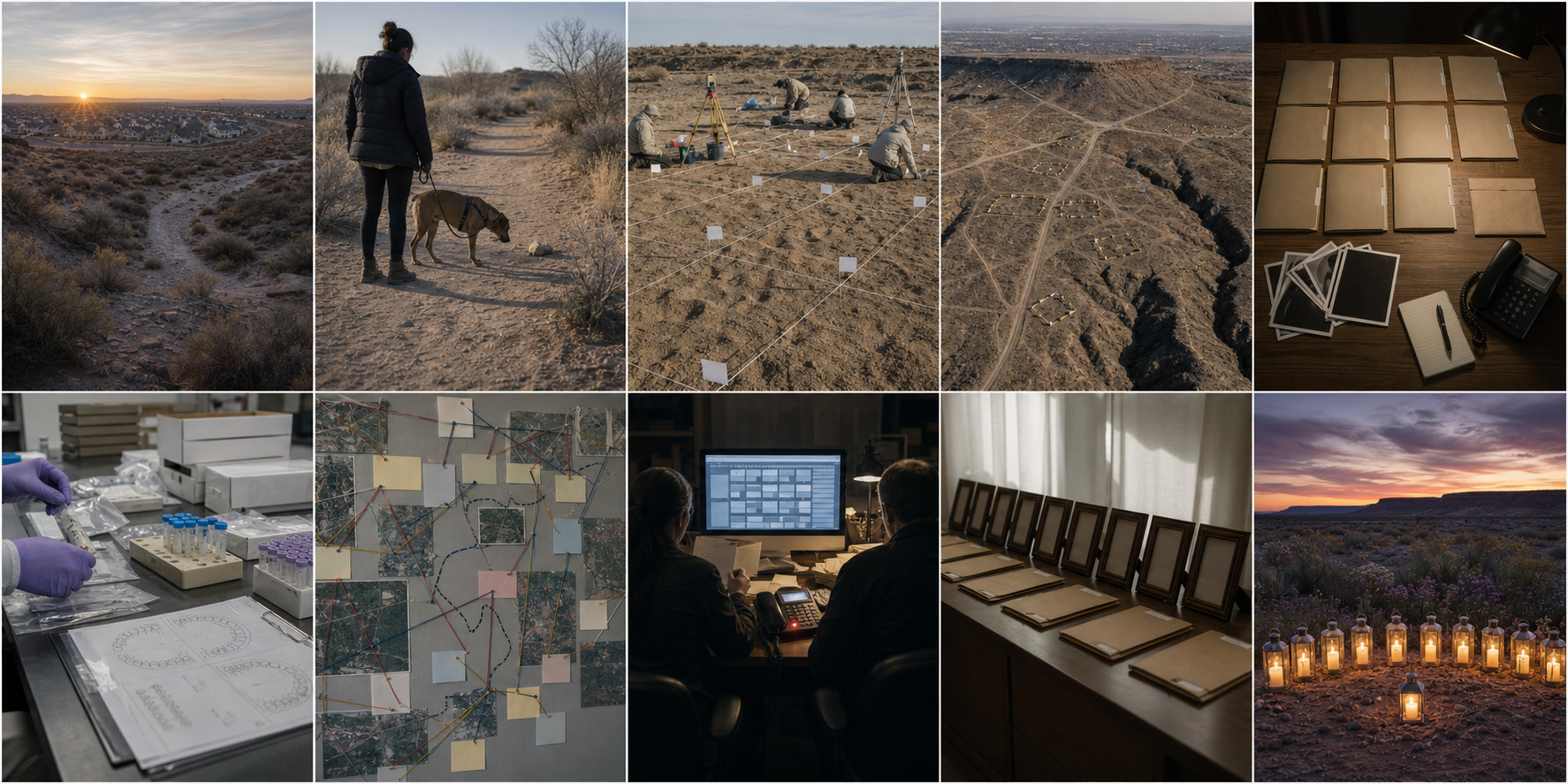
On February 2, 2009, Christine Ross was walking with her dog, Ruca, on Albuquerque's west side. According to the Albuquerque Police Department's official account, Ruca found a large bone protruding from an earthen trail. Ross photographed it and sent the image to her sister, a registered nurse. Her sister thought it resembled a human femur. Ross called police. The first question—human or animal?—was answered quickly. The harder questions would expand with every careful yard of soil.
The first boundary: what was found, and when
The date of discovery is exact. The duration of the crimes is not. During the ensuing search, investigators recovered the skeletal remains of eleven girls and women and one unborn child from makeshift graves near 118th Street and Dennis Chavez Boulevard. APD later said all eleven women had been identified. The Office of the Medical Investigator classified the deaths as the result of “homicidal violence,” a conclusion that identifies criminal death without supplying a public, individualized mechanism for each victim.
That distinction is essential. Popular retellings often compress the case into a single sentence: a serial killer buried eleven women in a mass grave. Each element needs care. Police do treat the deaths as a linked serial-homicide investigation. But “mass grave” can suggest one event and one pit. The official case page describes makeshift graves, plural. The publicly available record does not provide a courtroom-tested account of exactly how many visits occurred, in what order, or whether one person acted alone.
The first discovery was accidental, but the response was systematic. Once a scene may contain multiple burials, speed becomes dangerous. A boot placed casually can erase a track; a shovel can move an item from the layer that gave it meaning. The site had to be treated less like a patch of desert and more like a three-dimensional archive.
The grid was not bureaucracy. It was memory.
Forensic archaeology converts ground into coordinates. Investigators define squares, record elevations, photograph surfaces, remove soil in controlled layers, screen material, and preserve the relationship between one item and another. The technique does not merely answer “what is this?” It also protects “where was it, relative to everything else?”
APD's 2009 annual report notes that aerial photography aided the 118th Street excavation. Contemporary reporting described anthropologists working at the site and later examining recovered material through the Office of the Medical Investigator. Their immediate tasks included distinguishing human from nonhuman material, estimating biological profiles, looking for trauma, and supporting identification. A forensic odontologist described comparing dental images with missing-person records, while acknowledging the system's central weakness: it cannot make a match when the relevant dental record is absent.
I read the grid as the strongest surviving witness in the case, but not as a witness who can recognize a face. Spatial organization can show deliberate concealment. Repeated use of the same general area can imply familiarity and access. Soil layers and historical imagery may narrow periods when the land was disturbed. Routes can be compared with roads that existed at the time. None of those facts, by itself, converts proximity into identity.
| What the site can support | What it cannot support alone |
|---|---|
| That bodies were deliberately concealed in a defined desert area. | The legal identity of the person who concealed them. |
| Relative positions, depths, disturbances, and possible routes of access. | A reliable chronological order unless independent dating evidence exists. |
| Whether recoverable objects and materials belonged to particular contexts. | Ownership of an object merely because a person once possessed something similar. |
| Comparison with older aerial images and later land searches. | Proof that every nearby disturbance contains evidence, or that every related victim was buried there. |
| A base for DNA, dental, anthropological, and trace-evidence work. | A confession, motive, opportunity history, or chain linking a suspect to each victim. |
A map tempts us to draw one bold line from city streets to desert. Real movement is messier. Some roads change. Informal tracks appear and disappear. A person who knew the mesa could approach it differently from a person following a map. A construction worker, resident, recreational driver, utility employee, or frequent visitor might all know the ground for innocent reasons. Geographic familiarity narrows a behavioral question; it does not automatically narrow a population to one man.
Eleven names, not one label
The official APD page names the victims as Monica Candelaria, Victoria Chavez, Virginia Cloven, Syllannia Edwards, Cinnamon Elks, Doreen Marquez, Julie Nieto, Veronica Romero, Evelyn Salazar, Michelle Valdez, and Jamie Barela. Michelle Valdez was pregnant; her unborn child is counted separately in the recovered dead.
- Monica Candelaria
- Victoria Chavez
- Virginia Cloven
- Syllannia Edwards
- Cinnamon Elks
- Doreen Marquez
- Julie Nieto
- Veronica Romero
- Evelyn Salazar
- Michelle Valdez
- Jamie Barela
- Michelle's unborn child
Police say ten of the eleven women had links to drugs and prostitution; Jamie Barela had no known involvement in those activities. That language belongs to the investigative record, but it must not become the story's moral grammar. Addiction, poverty, street economies, unstable housing, and exploitation can make a person easier for a predator to isolate. They do not make her disappearance ordinary. The phrase “high-risk lifestyle,” once common in reporting, can quietly move responsibility from the person using violence to the person exposed to it.
The records show individual lives that refuse the shorthand. Syllannia Edwards was fifteen when she was last seen. Lawton, Oklahoma, authorities had classified her as an endangered runaway. Investigators used a forensic sketch and dental records to identify her in November 2009. Jamie Barela was also fifteen. She was last seen leaving a family gathering with her cousin Evelyn Salazar in April 2004; both were eventually identified among the West Mesa victims. Michelle Valdez was a daughter whose father remembered her wanting him to be proud of her. Those are not decorative details. They are the difference between a case count and a human loss.
Identification: eleven separate proofs
Discovery did not immediately restore every name. Identification proceeded in stages. Some comparisons used dental and medical records. Later identifications used DNA work involving the University of North Texas. On November 13, 2009, investigators announced Syllannia Edwards's identification through a sketch and dental records. On November 17, APD says DNA evidence identified Virginia Cloven and Evelyn Salazar. On January 26, 2010, Jamie Barela became the eleventh identified victim through DNA supplied to the university.
This sequence matters because “found” and “identified” are different achievements. A scene can establish that a homicide occurred before it can establish whose life ended there. A missing-person file can preserve a name without revealing a location. Identification joins the two records, and only then can detectives rebuild associations, last sightings, dental care, phones, residences, arrests, family contacts, and transportation.
The limits are equally important. Dental comparison depends on retrievable dental records. DNA comparison depends on preserved material, suitable profiles, and reference samples or databases. The delay in naming a victim is not evidence that nobody cared about her; sometimes it reflects the broken bridge between institutions. A person may be reported in one jurisdiction, treated under another name in a second, and known by a nickname on a third agency's document.
The chronology has a missing center
The public timeline is built from different clocks. One clock starts when a family last saw a woman. Another starts when police received or entered a missing-person report. A third is inferred from when land appears disturbed in historical imagery. A fourth begins with identification in 2009 or 2010. These clocks do not automatically agree.
APD asks to hear from people who knew women working on Albuquerque streets between 2001 and 2005. Its 2024 anniversary statement says eight additional women remained missing and were believed by investigators to be connected. The department's 2026 update, reported by KOAT, described those disappearances as occurring from 2003 through 2006 and sharing circumstances with the recovered victims. That wider range is not proof that one uninterrupted series began in 2001 and ended in 2006. It is an investigative window.
When I place the clocks on one page, the blank at the center is obvious: the interval between last reliable contact and death. For most of the victims, the public cannot see a minute-by-minute final journey. Without that journey, investigators must reconstruct opportunity indirectly—from associates, calls, street contacts, vehicles, residences, work, arrests, and remembered encounters. Time degrades all of them. Phones are replaced. Businesses close. Witnesses move. A detail that sounded trivial in 2004 may be decisive only after the shared burial ground is known in 2009.
Why a suspect comparison is not a verdict
Several men have been publicly discussed over the years. Some are dead; some were convicted of other violent crimes; some had geographic or behavioral connections that prompted scrutiny. Naming them all can create an illusion of progress because a list looks analytical. It often is not. The disciplined question is narrower: what evidence links a particular person to this site, to a particular victim, and to the relevant time?
I use four columns. The first is opportunity: could the person access victims and the mesa during the window? The second is behavioral relevance: does independently documented conduct resemble elements of the crime? The third is physical linkage: DNA, trace material, a uniquely identified object, digital location, or another item with a reliable chain. The fourth is case-wide coverage: does the evidence explain one victim, several, all eleven, or none?
| Evidence level | What it justifies | What it does not justify |
|---|---|---|
| Geographic proximity | Checking access, vehicles, property, work, and historical movements. | Calling a neighbor, worker, or resident the killer. |
| Violence against women or sex workers | Careful comparison of method, period, contacts, and forensic evidence. | Assuming every violent offender committed this series. |
| A disappearance pause after a person's death or imprisonment | Testing whether the timing is meaningful and whether reporting patterns changed. | Turning correlation into proof; the missing-person data are incomplete. |
| An object associated with a suspect type or occupation | Tracing manufacture, sale, ownership, uniqueness, and scene context. | Treating a common item as an individualized signature. |
| Police use of “person of interest” | Understanding that leads remain under evaluation. | Reporting an uncharged person as responsible. |
In February 2026, APD investigator Ida Lopez said there were still persons of interest under examination and warned against the public assuming police had a single number-one suspect. That statement should govern any honest reconstruction. If the agency holding the full file does not claim it has reached that point, a reader working from selected public facts should not pretend to outrun it.
The tip room is another kind of excavation
By February 2024, APD said more than 1,400 tips had been submitted, seven additional land searches had been completed, and the FBI had performed crime analysis early in the investigation and again in 2013. By February 2026, the publicly reported tip count had passed 1,500. APD also said it had recently served another search warrant, while withholding details.
A large tip count sounds like abundance. In practice it is a sorting problem. Each tip must be dated, sourced, checked for firsthand knowledge, compared with known facts, and linked—or not linked—to names, vehicles, addresses, and time periods. Repetition inflates volume. Public rumor can cause dozens of people to repeat one unsupported claim. A good tip is not necessarily dramatic; it may be a remembered ride, a nickname, a car parked where it should not have been, a person who knew an access road, or a record proving that someone could not have been present.
The investigation's long life changes the evidentiary landscape. New database comparisons become possible. Older DNA work may be reviewed with improved methods. Digital archives can make once-obscure property, business, and court records searchable. But time also removes witnesses and destroys informal records. Cold-case work is a race between improving tools and disappearing context.
The eight files that remain open in another sense
The recovered eleven do not define the full uncertainty. APD has repeatedly said that eight other women who disappeared under similar circumstances may be connected to the case. Their absence creates two opposed dangers. One is to ignore them because no remains were found at 118th Street. The other is to absorb them into the West Mesa total without proof.
The correct position is harder: keep both possibilities alive. Their cases deserve independent investigation as missing-person cases, while links to the West Mesa crimes are tested rather than presumed. A different burial site, survival under another identity, an unrelated homicide, an accidental death, or a separate offender are not comforting alternatives. They are the branches that an evidence-led inquiry must not cut off prematurely.
Searches of additional land show that investigators have not treated the original excavation boundary as a metaphysical border. But a search with no public recovery is still information only within its defined area, depth, method, and date. “Nothing found” can exclude a precise proposition; it cannot prove that nothing exists anywhere else on the mesa.
My reconstruction
I began with three broad possibilities. First, one offender repeatedly used a familiar concealment area. Second, more than one participant shared the site or assisted at different stages. Third, separate offenders used a landscape that only appears unified after discovery. The public record strongly favors intentional concealment and a meaningful relationship among the recovered cases; it is the basis for APD's serial-killer investigation. Yet the evidence released publicly does not allow me to prove the offender count.
The geography tells me the person responsible was comfortable enough with the mesa to bring victims there and leave. Comfort could come from residence, work, recreation, criminal activity, or repeated reconnaissance. The site was isolated enough for concealment but close enough to a growing city that discovery became more likely as development advanced. That balance—reachable, obscure, and temporary—may have mattered more than romantic ideas of a killer choosing “the desert.”
The victim pattern tells me the offender selected vulnerability. Ten women were connected in police records with drugs and prostitution, categories that place people in contact with strangers and often outside reliable guardianship. But Jamie Barela's presence warns against reducing selection to a single occupational profile. She disappeared with Evelyn Salazar. A relationship between victims can create access different from street contact. Any theory must explain both the pattern and the exception.
The identification history tells me that institutional gaps were part of the offender's advantage. If a woman was known under multiple names, traveled across jurisdictions, lacked stable records, or was not immediately entered into a searchable system, the line from absence to investigation weakened. The later success of dental and DNA comparison shows what becomes possible when those lines are joined. It also exposes what may have been missed earlier.
The suspect record tells me to stop one step before certainty. Timing, proximity, prior violence, and access can combine into a compelling investigative focus. They still require a bridge to victims and scene. APD's current statement—that persons of interest remain under review and there is no announced primary suspect—means the responsible conclusion is not a name.
What could actually move the case
A useful breakthrough would not need to arrive as a complete confession. It could be an authenticated record that places a vehicle and victim together; a witness who can explain a repeated contact method; preserved material yielding a probative DNA association; a photograph with verifiable date and location; property or employment records that make access specific rather than general; or information identifying another concealment site. The key is corroboration.
The $100,000 reward remains tied to information leading to arrest and successful prosecution. That wording reflects the difference between suspicion and a prosecutable case. APD's published contact is the homicide tip line at 505-768-2450; anonymous information can be reported to Crime Stoppers at 505-843-STOP. Anyone with firsthand information should give it to investigators, not turn it into social-media theater.
There is a memorial near the excavation site. It corrects the landscape in a way evidence markers cannot. A marker in a grid records where something was found. A memorial records who was lost. The investigation needs both forms of memory: technical precision that can survive a courtroom, and public remembrance that refuses to let eleven women and an unborn child be reduced to the name of the place where they were hidden.
Verdict, without a borrowed certainty
The West Mesa excavation established an enormous fact: these disappearances were not isolated absences. The graves joined names, years, and a landscape into one investigation. Forensic identification returned each recovered woman to her family and gave detectives a network of last contacts to rebuild. Repeated searches, FBI analysis, a living tip database, and a 2026 search warrant show that the case has not been abandoned.
But the case remains unsolved for a precise reason. Publicly known evidence has not crossed the final span from pattern to perpetrator. The burial grid can demonstrate design without signing it. A suspect profile can describe possibility without proving action. A pause in disappearances can be important without being unique. An object can be suggestive without being individualized.
So my conclusion is deliberately narrower than the story readers may expect: the mesa is a record of repeated concealment and of a system that was slow to connect vulnerable missing women. It is not, by itself, a confession written in soil. The honest work is to preserve the distinction until evidence—not repetition, resemblance, or rumor—supplies the missing name.
Sources and verification notes
- Albuquerque Police Department — West Mesa Homicide Investigation. Official discovery account, victim names, identifications, investigative request, and reward.
- City of Albuquerque — APD Honors West Mesa Victims on 15th Anniversary, February 2, 2024. Official search, tip, FBI-analysis, missing-women, and reward update.
- Albuquerque Police Department 2009 Annual Report. Contemporary departmental summary, including aerial-photography support for the 118th Street excavation.
- KOAT — Albuquerque police continue search for answers in West Mesa murders, updated February 3, 2026. Current status, persons of interest, tip count, missing women, and recent warrant.
- News Radio KKOB — 17 Years Later, West Mesa Homicide Investigation Still Active, February 2, 2026. Corroborating current investigation update.
- KOAT — Last West Mesa Victim Identified, January 27, 2010. Jamie Barela identification and relationship to Evelyn Salazar.
- KOAT — Forensic Odontologist Helps Identify West Mesa Victims, March 23, 2009. Dental-comparison process and limitations.
- KOAT — Anthropologists Work West Mesa Site, March 17, 2009. Contemporary account of anthropological recovery and examination.
- KOAT — West Mesa Victims' Families Remember Loved Ones, February 3, 2010. Family-centered remembrance and first-year investigation figures.
- KOAT — Memorial Honors Victims of West Mesa Murders, 2017. Memorial, families, and the continuing meaning of the site.
- KOAT — Police Give Update on West Mesa Murders Investigation, February 3, 2015. Investigative limits and the fluctuating person-of-interest list.
Editorial note: This article separates statements released by law enforcement from my own analytical inferences. No uncharged person is identified as the offender. The visual scenes are original editorial illustrations and do not depict real victims, suspects, human remains, or the exact evidence site.