The video seems complete because the figure is visible. It is not. The cameras inside Creekside Church of Christ recorded an unidentified person moving through corridors before Terri “Missy” Bevers arrived to prepare a 5 a.m. fitness class on April 18, 2016. They captured disguise, movement, damaged doors, and time. They did not capture the person's face, the fatal encounter, the route away, or a reliable motive. Ten years later, Midlothian police still call the case active. I reconstructed the morning as a building problem: what the church cameras could see, what their gaps concealed, and which conclusions survive the transition between those two zones.
1. Rain moved the class; darkness changed the risk
The week began with bad weather over Midlothian, Texas. Missy's early Camp Gladiator session was set for the Creekside Church property beside U.S. 287. Before dawn, the campus offered shelter and space. It also offered something a daytime visitor might not notice: long periods with no witnesses, multiple doors, interior corridors, and a parking lot separated from the highway by darkness and rain.
Missy knew the routine. She arrived before participants so she could unload and arrange equipment. Her work depended on being first. That ordinary responsibility created a predictable interval in which she would be alone—not because she was reckless, but because instructors everywhere prepare before clients arrive.
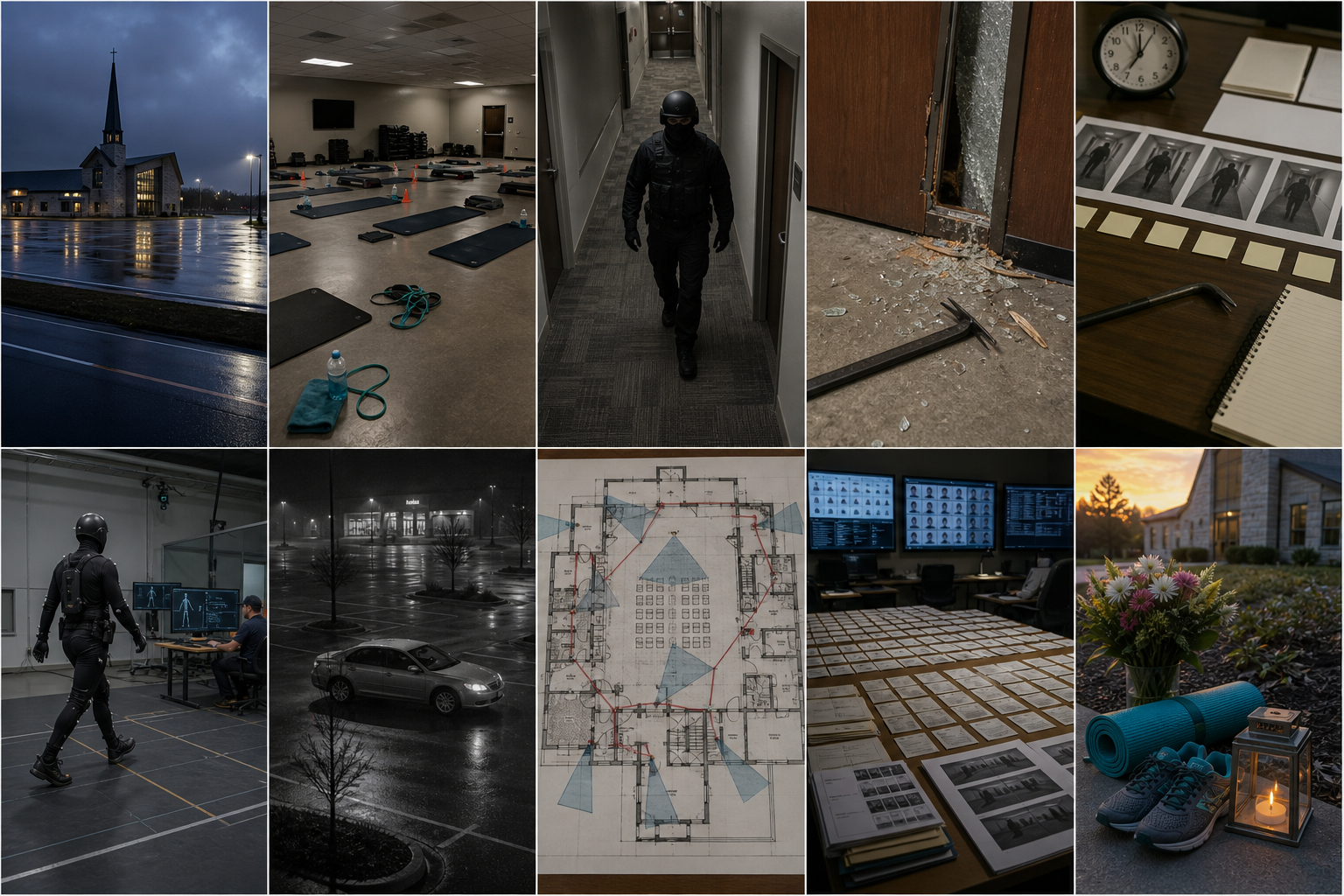
The Midlothian Police Department's 2026 anniversary statement, reported by multiple Texas newsrooms, identifies the case as number 16MP015685 and rejects the label “cold case.” More than one hundred leads were reviewed in the preceding year alone. That present tense should control any reconstruction: there is no official identification, no public arrest, and no authority for treating a popular internet theory as fact.
2. The class that was ready for people
Missy was 45 and built community through fitness. The room she intended to use would soon contain mats, water bottles, resistance bands, conversation, and the familiar strain of an early workout. Participants expected an instructor, not a crime scene. One member arrived around 4:35 a.m.; emergency calls followed near 5.
Keeping that purpose visible matters because the released video has shifted attention toward the intruder's costume. The masked figure has become the case's icon. Yet the event is not principally a mystery about unusual clothing. It is the unsolved killing of a woman who entered a place she was authorized and expected to use.
A victim-centered timeline also corrects hindsight. At 4:20 a.m., Missy did not enter “the murder church.” She entered a familiar venue to prepare for work. The intruder possessed information that she did not: someone had already forced entry and was moving inside.
3. At 3:50, the building acquired a second occupant
Police placed the intruder's first appearance on church surveillance at approximately 3:50 a.m. The person wore a helmet, face covering, gloves, dark clothing, and a heavy vest bearing police-style lettering. Public descriptions often call it SWAT gear. Investigators stressed that the components were not unique to a law-enforcement branch.
The clothing accomplished several things at once. It hid hair, face, body contour, and ordinary garments. It could make a witness hesitate, especially in low light, because the outline suggested official authority. It also burdened the wearer. Armor, helmet, belt, boots, and any carried tool change stride length, hip movement, foot angle, and speed.
That last point is central. The costume is not a transparent wrapper around the person's natural body. It is part of the movement we see. Any claim about sex, occupation, injury, age, or identity based on silhouette must account for padding, load, footwear, camera angle, and deliberate performance.
4. Damage as action, not motive
The released footage shows the intruder testing doors, moving between rooms, and breaking glass. A warrant described a hammer among the carried tools. No public account reports a meaningful theft, and Missy's wedding ring remained. These facts weakened a straightforward property-burglary explanation, but they did not automatically prove a targeted assassination.
Destruction can serve different purposes. It can be genuine searching by a burglar. It can be practice or vandalism. It can disguise a planned attack as interrupted burglary. It can create noise intended to draw an arriving person toward a corridor. It can also reflect an offender improvising without a coherent plan. The video records the behavior but does not tell us which purpose produced it.
The lack of theft is similarly ambiguous. A burglar surprised by an arrival may abandon property and attack. A person who entered to confront Missy may damage doors to stage another motive. A trespasser may have sought something not obvious in the public inventory. Evidence becomes diagnostic only when one hypothesis predicts it substantially better than the alternatives.
5. Thirty minutes of asymmetry
Time is the clearest part of the case. Police released a sequence that places the intruder inside well before Missy. The exact minute attached to her entrance varies slightly across early reports—4:18 or 4:20—but the order does not.
| Approximate time | Publicly reported event | Analytical significance |
|---|---|---|
| 3:50 a.m. | The disguised intruder first appears on interior surveillance after forced entry. | The person has roughly half an hour inside before Missy enters. |
| 4:16 a.m. | Missy's pickup is recorded entering the church parking area. | Her arrival is independently anchored before the interior sighting. |
| 4:18–4:20 a.m. | Missy enters the church to prepare for the 5 a.m. class. | The two occupants' timelines now overlap inside the building. |
| 4:35 a.m. | A class participant arrives. | The offender's available exit window is limited by arriving witnesses. |
| About 5:00 a.m. | Two emergency calls are received. | The discovery and response phase begins. |
The intruder's head start is compatible with both planning and coincidence. A targeted offender could arrive early to ensure position before a predictable instructor. A burglar could enter during an empty period and be surprised by the first legitimate user. The timeline makes a spontaneous encounter possible; it does not reveal whether the offender expected Missy by name.
6. The corridor where the public video stops
A search-warrant account says the interior video showed Missy walking toward the intruder's location. After that, neither she nor the intruder appeared again in the camera sequence described publicly. This is the decisive transition: two visible routes approach, then the event passes into a zone without released imagery.
The absence of a recorded encounter does not mean investigators lack spatial information. A floor plan can combine camera locations, fields of view, door states, sound paths, and time between motion triggers. If a tool strikes glass in one corridor, where could it be heard? From Missy's entry path, which doorway would appear first? How long would it take the disguised person to move from the last captured room to the unrecorded area?
The camera gaps therefore contain constraints, not emptiness. The offender must travel between known points within available time. An exit route must avoid or pass cameras in a particular order. If some exterior cameras were not functioning, nearby commercial and residential systems become more important. Police said in 2026 that details about additional surveillance and a vehicle believed connected to the case remain withheld to protect the investigation.
7. The walk that became a public suspect
Viewers repeatedly focused on the intruder's outward-turned feet and unusual gait. Comparisons to relatives, acquaintances, women, men, people with injuries, and people in specific occupations flooded tip lines. Police warned early about uninformed gait speculation. Years later, a forensic podiatrist who reviewed the footage at the FBI's request explained why caution was necessary.
Dr. Michael Nirenberg said more than one person can walk in a similar way and that gait should not stand alone in a prosecution. For this case, he tested how comparable armor affected movement. The gear and carried objects could alter the observed walk. He also noted outward rotation of the feet, particularly on the right, but did not treat it as a unique biometric signature.
A gait comparison can be useful in exclusion. A candidate whose height, limb proportions, or movement are incompatible with calibrated footage may fall in priority. A person with a consistent unusual pattern may merit closer investigation. But a match must be supported by access, time, digital records, physical evidence, statements, or possession of relevant clothing and tools. The walk is a filter, not a name.
The costume could also be performative. If the offender wanted witnesses or cameras to perceive a particular sex, injury, profession, or body type, oversized boots and load distribution would help. We cannot know from the public footage whether distortion was intentional. We can know that treating the recorded gait as unaltered natural movement is unsafe.
8. The silver sedan at 2 a.m.
Another surveillance thread began away from the church. Around 2 a.m., cameras at the nearby SWFA Outdoors parking lot recorded a light-colored sedan—initially described as resembling a 2010–2012 Nissan Altima—circling, stopping in a secluded area, flashing lights, and leaving. Police wanted to identify the owner or driver.
The timing and odd parking behavior make the vehicle relevant enough to investigate. They do not prove connection to the church intrusion nearly two hours later. Midlothian police emphasized that the driver was not necessarily involved and might simply remember something useful. The distinction between a vehicle of interest and a suspect vehicle is often lost online.
To connect the sedan reliably, investigators would need more: a continuous route, matching license-plate data, a witness, device-location history, occupant identification, distinctive vehicle features, or physical evidence. Without that bridge, the SWFA footage is a neighboring event. It could be reconnaissance, an unrelated driver, a rendezvous, or a witness who never realized the importance of the time.
9. Two stories inside the same hallway
The public evidence supports two broad narratives, neither complete. I tested them against the offender's preparation, behavior, timing, and apparent lack of theft.
STORY A: TARGETED ENTRY
The costume conceals identity and suggests forethought. The offender arrives before a class instructor whose early schedule may be predictable. Door damage creates a burglary appearance. Little or nothing is taken. The intruder remains until Missy arrives.
Unexplained: the wandering duration, the exposure to numerous interior cameras, and why the attacker chose a public building with imminent participants.
STORY B: INTERRUPTED INTRUSION
The person forces entry, tests rooms, and damages property before knowing who will arrive. Missy enters unexpectedly. A confrontation occurs, theft is abandoned, and the offender escapes before participants gather.
Unexplained: the unusually complete disguise for simple vandalism or burglary, the apparent absence of theft, and whether arrival timing was truly coincidental.
Targeted entry explains preparation better. Interrupted intrusion explains the visible door-to-door behavior more literally. Neither story can claim the video exclusively. An offender expecting Missy might deliberately imitate burglary. A burglar expecting an empty church might dress heavily to obscure identity from cameras. Motive remains the variable that the corridor footage cannot measure.
My judgment gives modestly greater weight to a planned encounter, but not enough to name a relationship category. The long disguise, early arrival, persistence inside, and lack of meaningful theft collectively lean away from ordinary burglary. Yet “planned encounter” does not tell us whether the offender knew Missy personally, learned the class schedule indirectly, or chose the venue and attacked the first arrival.
10. What the ring does—and does not—say
Reports that Missy's wedding ring remained are often used to eliminate robbery. The ring does make jewelry theft less likely as the principal aim. It cannot establish that nothing else was sought, that the attack was personal, or that the offender had time to search after the confrontation.
Negative evidence is always conditional on opportunity. If arriving participants forced a quick escape, failure to take property may reflect interruption. If the offender came for a document, device, or person, ordinary valuables would be irrelevant. If broken doors were staging, untouched property supports the performance. The same absence can sit inside several motives.
The strongest claim is narrow: public accounts do not show a conventional completed burglary. Anything beyond that requires information investigators have not released—what rooms were entered, what items were moved, which tool marks corresponded to which actions, and whether the offender searched or only damaged.
11. Ten years of tips, one protected database
In April 2026, Midlothian police said the case remained open and fluid, that credible tips were reviewed, and that forensic advances continued to be applied. More than one hundred leads had been evaluated in the preceding year and cross-referenced with an active case database. The department also said it had not refused outside assistance and named cooperation with the Texas Rangers, the Ellis County District Attorney's Office, and appropriate federal partners.
Cross-referencing is essential in a case distorted by resemblance tips. A useful lead must be tested against facts held back from the public. Did the source know an unreleased entry point, object, route, time, or behavior? Does a candidate's phone or vehicle record intersect the protected timeline? Can clothing or tools be traced? Does a statement remain consistent when compared with contemporaneous records?
Police also said no individual had been completely ruled out. That is not an invitation to accuse everyone previously mentioned. It is procedural caution: elimination may change if new evidence changes the question. Public writers should preserve the opposite presumption. Unless an agency names a suspect or evidence is filed in court, private individuals remain outside a responsible accusation.
12. My reconstruction of the unseen encounter
I reconstruct the event this way. The offender enters by 3:50 and spends time moving through rooms while masked and armored. Missy's truck arrives at 4:16. She enters moments later and follows a route consistent with setup duties or a response to sound. The two routes converge beyond the released camera coverage. The offender then leaves within the narrowing interval before or around the arrival of the first class participant.
This reconstruction does not require the person to move with military skill. The footage shows hesitation, testing, and wandering. It does not require the silver sedan to belong to the offender. It does not determine sex from gait. It does require advance concealment and enough familiarity—or enough improvisational luck—to exit before the building filled with witnesses.
The question most likely to solve the case is not “Who walks like that?” It is “Who had a reason and opportunity to be prepared before 3:50, knew or could learn the building's early-morning use, and can be independently connected to the disguise, tools, route, or unreleased evidence?” That is a smaller and more testable universe than the internet's catalog of look-alikes.
13. The last image should not belong to the offender
Surveillance gives offenders an accidental afterlife. A few minutes of hallway video can repeat for decades while the victim's ordinary voice, work, and relationships recede. Missy's friends remembered a kind woman dedicated to fitness and healthy living. Her participants came to the church expecting her leadership.
The case remains solvable because the video is not the only evidence. It fixes time, clothing, tools, movement, and place. Those facts can meet records created elsewhere: a purchase, borrowed equipment, a vehicle, a device, a work absence, a private statement, or a detail known to only one participant. The face may remain hidden while the surrounding life of the offender becomes visible.
Ten years after the rainy morning, the corridor still ends before the answer. But an active investigation does not need the missing frame to materialize. It needs an independent fact strong enough to identify who walked into it.
Sources and verification
- CBS News Texas, April 15, 2026 — current Midlothian Police statement, active-case status, 100-plus recent leads, public suspect description, and tip contacts.
- KWTX, April 15, 2026 — case number, agency partnerships, withheld surveillance details, and police response to misinformation.
- CBS News Texas: 2016 police timeline — 3:50 intruder sighting, 4:16 vehicle arrival, 4:20 entrance, 4:35 participant arrival, and emergency response times.
- ABC News: release of additional church footage — forced entry and police appeal.
- CBS/AP: public search-warrant details — clothing, carried tool, 4:18 arrival, and the point where released camera coverage ends.
- CBS News Texas: forensic podiatrist on gait evidence — gear effects, non-uniqueness, and the need for corroboration.
- CBS News Texas: police request to identify the SWFA vehicle driver.
- Solve the Case: Terri Leann Bevers — structured case chronology and agency attribution.
- Crime Stoppers of Ellis County — current anonymous-tip channel referenced by Midlothian police.
- The Dallas Morning News: warrants and early investigative context.
Source check completed August 10, 2026. The 2026 police statement was accessed through contemporaneous Texas reporting because the department distributed it through social media. Investigators may possess video, forensic results, or timelines not released publicly; those protected facts are not reconstructed here.