The Dardeen Family Murders: What the Second Scene Changes
The first alarm was not a scream or a telephone call. It was an empty chair at a water-treatment plant. Russell Keith Dardeen was dependable, and when he did not arrive for his morning shift, routine became concern. By the end of the search, investigators were no longer dealing with one sealed rural home. They had a family crime scene, a missing red car, a second killing site, and a question that every theory still has to answer: why separate Keith from everyone else?
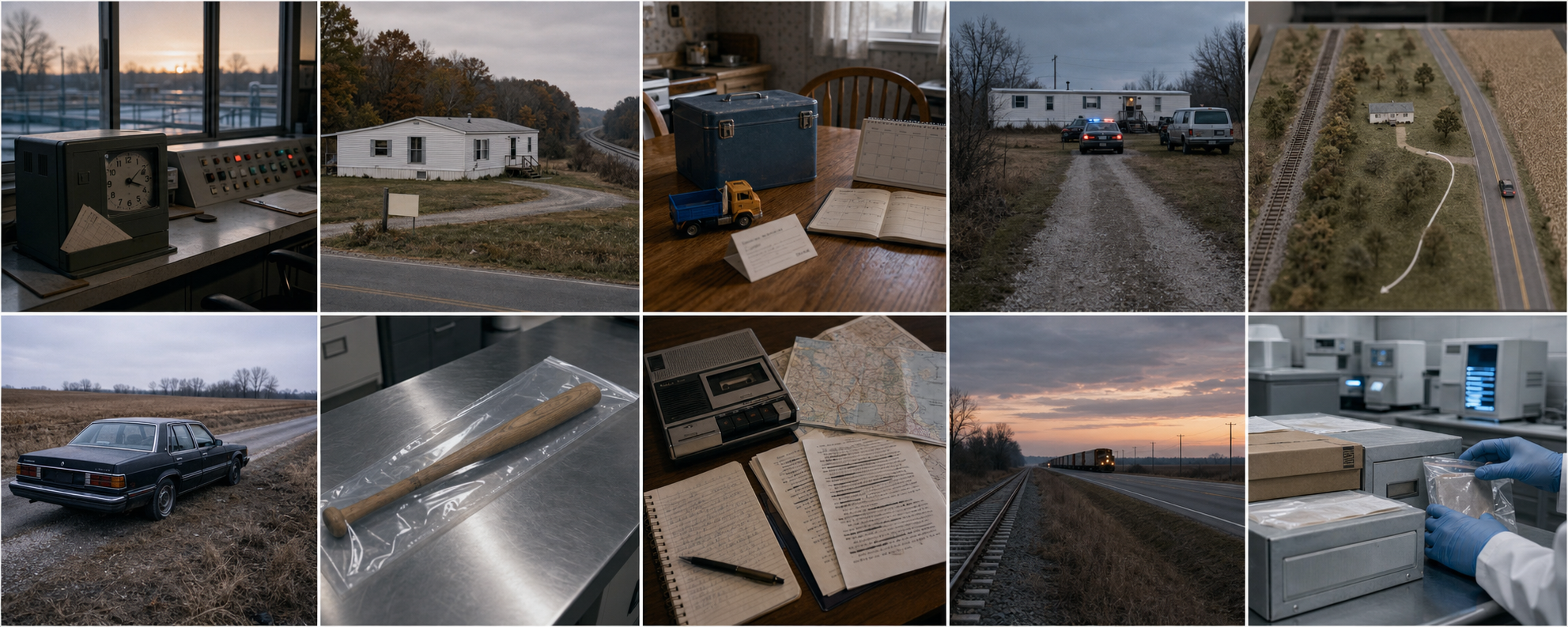
An unused time card at the plant begins the documented discovery sequence. The scene is illustrative; no readable workplace record is invented.
A missed shift opened the case from the outside
Keith was twenty-nine and worked at a water plant near Ina in southern Illinois. His wife, Ruby Elaine Dardeen, was thirty and in the final months of pregnancy. Their son Peter was three. Contemporary and later local reports describe a family active in a small Baptist church, with Keith singing and Elaine playing piano. They were preparing for the arrival of a daughter whom the family would know as Casey Elaine.
The discovery did not follow an eyewitness report. Keith failed to appear at work, did not call, and could not be reached. His family was contacted, and law enforcement went to the mobile home. This matters because the offender did not create the alert. The clock began only when an external routine was broken. Whatever happened had time to pass unnoticed before anyone with authority entered the property.
Dates in summaries are sometimes compressed into November 17, while accounts of the missed shift and discovery place the welfare check on the following day. That difference should not be hidden. A careful chronology separates the estimated period of death, the morning Keith was expected at work, the first entry into the home, the recovery of the car, and the later discovery of his body. Treating all of them as one moment makes the offender's movement disappear.
The empty workstation supplies a fixed point: Keith had not arrived by the beginning of a scheduled shift. It does not establish whether he was already dead, restrained, transported, or unable to leave. The difference can only come from physical evidence in the car and at the two scenes.
The home stood in a rural corridor near a highway and railroad. Its apparent isolation increased privacy for the family and, potentially, for an offender.
The house was not simply remote; it sat inside a transport corridor
The Dardeens lived in a modest mobile home outside Ina, near Illinois Route 37 and a railroad line. Descriptions of the property often use the word isolated. That is partly true: neighbours were not pressed against the walls, and darkness would have reduced casual observation. But a house beside road and rail is also connected. Vehicles and strangers can pass without necessarily appearing out of place.
Keith and Elaine had reportedly considered selling the home. Family members said Keith had become cautious about letting strangers inside amid a series of violent crimes in the region. That caution is relevant but not absolute. Security habits are tendencies, not locks. A familiar visitor, a convincing pretext related to the sale, a person in need, or someone who arrived while one family member was outside could still gain access.
The small sale sign later became part of one version of Tommy Lynn Sells' story. Yet a publicly visible sign is not secret knowledge. It may explain how an unknown visitor chose the door, but it cannot corroborate the identity of that visitor. Any theory that rests on the sign must still show who was present, whether the door was opened voluntarily, and how one or more adults were controlled.
The layout creates three different approach channels: the road, the rail corridor, and local access across nearby property. It also creates multiple exit choices. A reconstruction should therefore begin with traffic and opportunity records, not with a dramatic personality profile. Who drove Route 37 that night? Which workers, deliveries, trains, bars, service stations, or late businesses produced independent timestamps? Which interviews were taken before publicity contaminated memory?
A lunchbox, a toy, and a calendar restore the household's ordinary context without recreating the victims or the attack.
The victims were a household, not a collection of clues
The extremity of the crime has often swallowed the people themselves. Keith had a job whose schedule was predictable. Elaine had a church role and a family network. Peter was a small child. Casey Elaine was born during the assault and did not survive. Those facts are sufficient; repeating graphic detail adds no analytical value.
Victimology should ask practical questions. Who knew Keith's shift? Who knew Elaine would be home? Who had been inside and understood the floor plan? Who knew the car, the sale plans, or the family's church routine? Which recent conflicts, transactions, visitors, telephone calls, repairs, and property inquiries were documented at the time rather than reconstructed years later?
A predictable work schedule can create both opportunity and risk for an offender. It tells someone when a household is likely to change state. It also guarantees that an unexplained absence will be noticed. The fact that the crime was discovered through work suggests either that the offender accepted a short detection window or did not think about it. Abandoning the car in a visible public place points to the same tension: some planning was present, but the plan did not erase the trail.
The family reportedly hoped to move. That generates a finite investigative list: callers responding to a sign or advertisement, people shown the home, lenders, landlords, neighbours, and anyone who knew a sale might put cash or valuables in the household. Public reporting does not establish that such a list identified the offender. It does show why a stranger-at-the-door scenario cannot be dismissed solely because Keith was cautious.
The welfare check is shown from a distance. What investigators first saw matters less here than the sequence of who entered, when, and what was preserved.
The first scene answered who, but not why
Inside the home, investigators found Elaine, Peter, and the newborn Casey Elaine. Keith was absent. The family's red car was also gone, while his truck remained at the property. A baseball bat was reported as the instrument used in the home. The circumstances clearly established homicide, but they did not supply a conventional motive.
No reliable public account establishes a simple theft narrative. The degree of violence can tempt observers to infer personal hatred, sexual jealousy, ritual, drugs, or organized crime. None of those labels is evidence. Extreme violence can occur in personal crimes, stranger crimes, coercive control, panic after resistance, or an offender's attempt to dominate a scene. Behavioural intensity narrows less than people imagine.
Keith's absence initially made him an inevitable investigative focus. That was a reasonable working step, not a finding of guilt. His missing car could suggest flight until the vehicle and his body changed the case. The speed with which a family member becomes a provisional suspect is exactly why early records need timestamps: suspicion formed before evidence from the second scene must not be allowed to rewrite later interpretation.
Scene One: what can be stated without embellishment
Established through reporting: three victims were recovered in the residence; Keith and the red car were absent; his truck remained; the home was not treated as an ordinary burglary.
Not established in the accessible public record: a complete evidence inventory, every tested fingerprint or biological sample, the exact entry mechanism, the precise order of assaults, and the offender count.
A route model keeps the home, road, rail line, field, and car in one frame. A theory must connect all five.
The second scene turns the case into a logistics problem
Local station KFVS reported that roughly seven hours after investigators opened the case, the red car was found abandoned in a bank parking lot in Benton. Blood was visible inside. Keith's body was found later the same day in a field about a mile from the home, and investigators concluded that he had been killed inside the car.
Those facts create a transport chain. The car had to leave the Dardeen property. Keith had to be inside it at some point. The vehicle reached the field or another killing position, his body was removed, and the car then reached Benton. Finally, the offender needed a way to leave the bank lot. That last step is frequently omitted, yet it may be the step most likely to require another person, a second vehicle, a planned walk, public transport, or a return through the rail corridor.
A single offender could perform the sequence by controlling Keith, driving the red car, leaving the body, parking the car, and walking or obtaining a ride. Multiple offenders could divide those tasks. The scenes do not prove offender count. They do show that the person responsible had mobility and enough confidence to move incriminating property beyond the private residence.
The location of the car also changes the meaning of concealment. A bank parking lot is not a permanent hiding place. It is a place where an unattended vehicle can briefly look ordinary. The offender may have prioritized separation from the body over long-term concealment, or may have intended the car to be found after useful traces had been removed. Without the original processing report, claims that the interior was "cleaned" or "staged" should remain claims, not facts.
The abandoned sedan is empty and non-graphic. Its evidentiary importance lies in where it was driven, how it was left, and how the driver departed.
The car is the bridge evidence
The residence and field are endpoints. The car is the bridge between them. It could preserve blood distribution, seating position, footwear transfer, fibres, hairs, latent prints, tool marks, soil, vegetation, fuel level, odometer readings, keys, and signs of cleaning. Each item can test movement without naming a suspect in advance.
One disputed detail later became important when Sells described the seat in which Keith was shot. Former Jefferson County prosecutor Gary Duncan told the Associated Press that evidence disproved Sells' claim. This is not a minor inconsistency. It concerns the central bridge scene, where the physical record should be strongest.
At the same time, public summaries do not disclose enough of the vehicle examination to reconstruct it independently. Was the driver's seat occupied during every shot? Did bloodstain direction indicate movement? Were door handles and controls printed? Did soil from the field match material in the footwells or trunk? Which items were preserved in conditions suitable for modern testing?
The car also limits the chronology. If investigators were correct that Keith was killed inside it, then a theory must place him alive or recently deceased in the vehicle after the home encounter began. The relevant question is no longer merely "who entered the trailer?" It becomes "who could control the home and then complete the car route without being recognized?"
The reported household weapon is shown only as a sealed object. Its value lies in trace evidence and provenance, not graphic reconstruction.
A household object may indicate improvisation, access, or misdirection
Reports identify a baseball bat from the home as the weapon used against Elaine and the children. If its origin was securely established, that would suggest the offender did not necessarily arrive carrying every instrument used. It might indicate improvisation after entry, confidence in using available objects, or an intentional choice meant to make the event appear domestic.
But a weapon from the residence does not prove that the killer was known to the family. Strangers use objects found at scenes. Nor does it prove sudden rage; an offender can plan violence while planning to avoid transporting a weapon. The item's evidentiary weight depends on fingerprints, biological material, handling marks, where it was found, and who normally used it.
The contrast between the reported methods at the home and in the car is more informative than either instrument alone. Different methods can mean different phases, changes in control, different available tools, or more than one offender. They can also reflect a single offender adapting to location. The contrast supports testing; it does not justify assigning a personality or relationship.
If the bat and its packaging still exist, modern examination should begin with chain of custody. Touch DNA accumulated through innocent household contact is especially difficult on a family object. A useful profile would need to be interpreted by location, mixture composition, and elimination samples, not presented as automatically belonging to the killer.
No obvious motive is evidence of missing context, not of randomness
Former investigator Mike Anthis summarized the case for KFVS as a family wiped out with no immediate or direct motive. That absence has encouraged grand explanations. Yet "no motive found" means investigators could not demonstrate one from the surviving record. It does not mean the act was motiveless.
A targeted offender may act on a grievance known only to the offender. A mistaken-identity attack may be targeted but directed at the wrong household. A stranger may begin with a mundane purpose and escalate after resistance. An associate may conceal a dispute the family never shared. More than one offender may bring different motives to the same scene.
The separation of Keith may be the most motive-sensitive behaviour. He could have been the primary target, removed to isolate him from witnesses. He could have been forced to cooperate through threats against his family. He could have been killed first and used as a means of access. Or the offender might have moved him simply because the car offered privacy and transport. The public evidence does not settle the order.
The responsible approach is to ask what each scenario predicts. A personal grievance predicts prior contact, focused treatment, or knowledge of routine. A property pretext predicts sale inquiries or a stranger seen near the sign. An opportunistic intruder predicts trace evidence and a less efficient exit. Multiple offenders predict communications, a second vehicle, or inconsistent trace patterns. Predictions can be searched for; adjectives cannot.
A cassette interview and unreadable transcript represent the disputed confession. The test is what was known before the interview and what the evidence independently confirms.
Tommy Lynn Sells supplied a story, not a conviction
After his arrest in Texas in 1999, serial killer Tommy Lynn Sells claimed responsibility for numerous crimes, including the Dardeen killings. Some investigators considered him a strong suspect. A 2007 local report said detectives then felt confident in the identification. Seven years later, reporting after his execution documented the unresolved doubts that prevented a charge.
According to Duncan, Sells accurately described some details, but some could have come from media coverage. Asked about a nonpublic feature of Elaine's position, he first answered incorrectly and then gave the correct response. That sequence is ambiguous. A correct secret detail can corroborate a confession only if the interview was clean: the question was not leading, the answer was recorded verbatim, the information had not leaked, and the suspect had not been shown files or photographs.
The vehicle statement weighs in the other direction. Duncan said physical evidence disproved Sells' account of where Keith was seated when shot. Sells also proposed an invitation narrative that Keith's mother rejected as completely inconsistent with her son. Family character evidence cannot alone disprove an encounter, but an implausible access story and a contradicted car detail weaken the confession's mechanical fit.
Sells offered to return to Illinois and identify hidden evidence. Texas authorities would not release him from death-row custody for the trip. That prevented one possible test, but it did not transform the offer into corroboration. A valid confession should still be checked against travel records, employment, incarceration, witnesses, geography, undisclosed scene facts, and physical evidence.
Most important, prosecutors had no physical evidence linking Sells to the Dardeen case. Duncan declined to charge him and said there remained a fair possibility that the actual killer was elsewhere. Sells was executed in Texas in 2014 for another murder. His death ended further interviewing; it did not close the Ina case.
A confession must be tested as evidence, not received as an ending
KFVS reported in 2019 that the Dardeen file had grown to twenty-one four-inch binders and had been digitized. The station also noted that Sells confessed to the murders of Sherri and Megan Scherer, but DNA proved that claim false. That known error does not prove every Sells confession false. It does mean his words require independent corroboration rather than reputational credit.
For this case, a confession-validation chart should list each claim, the date it was first recorded, whether it was public, every question that preceded it, and the physical or documentary source that confirms or contradicts it. Details learned after coaching or correction should be marked differently from uninterrupted narrative facts. Contradictions should not be dismissed as trauma, time, or offender deception only when convenient.
The same chart should test alternative suspects and persons of interest. A person does not become more likely merely because Sells is less likely. Every candidate needs opportunity, route, scene knowledge, and evidence. The absence of a satisfactory confession leaves the case open; it does not authorize replacing one unsupported certainty with another.
The most honest conclusion about Sells is narrower than either camp prefers: he was a legitimate investigative lead whose account contained enough detail to examine and enough contradiction to prevent proof. That is exactly why the physical case file still matters.
The highway and rail line invite comparisons with travelling offenders. Geography can generate leads, but it cannot substitute for a case-specific link.
The railroad hypothesis is a search tool, not a verdict
The nearby tracks later encouraged comparison with travelling offenders, including the so-called Railroad Killer, Angel Maturino Resendez. The FBI has documented how ViCAP linked a 1999 series of murders near railroad lines across states, demonstrating the real value of cross-jurisdiction pattern analysis. The Dardeen location makes such comparison reasonable.
Reasonable comparison is not identification. A corridor overlap is common evidence; many people use roads and railways. The Dardeen scene differs in victim group, residence dynamics, vehicle use, and the unexplained separation of Keith. Public reporting has not established physical evidence connecting Resendez to the family. The hypothesis should therefore remain an eliminated-or-unconfirmed comparison, not a competing solution presented for suspense.
The rail line still matters operationally. It could provide a way to approach or leave the area, a source of transient witnesses, and a framework for comparing work crews and freight schedules. But the red car ended in a bank lot, so a rail-based theory must connect that lot to a reachable station, track, ride, or accomplice at the relevant time.
Modern geographic analysis could reconstruct drive times, walking routes, sight lines, November darkness, train movements, and businesses open along the corridor. Its purpose would be to narrow feasible movement, not to create a cinematic drifter because the tracks happen to be nearby.
Five explanations survive, but they do not carry equal burdens
| Scenario | What it explains | What it must still prove | My assessment |
|---|---|---|---|
| Known visitor with a personal grievance | Voluntary entry, household knowledge, focused violence, confidence at the scene | No publicly established grievance or physical link; must explain car-lot escape | Structurally strong, evidentially unproved |
| Stranger using the home sale or another pretext | Access despite caution, rural corridor, offender not recognized in local circle | Control of multiple victims, extended route, and lack of independent sighting | Plausible; pretext is not identity |
| Keith was the primary target | His separation, different location, vehicle use, possible coercion of the household | Why Elaine and the children were killed and why no motive surfaced | Best explanation of separation, not a complete case |
| Multiple offenders | Simultaneous control, vehicle logistics, final escape from Benton | No disclosed second-offender trace, witness, communication, or confession | Operationally efficient but adds an unsupported actor |
| Travelling serial offender | No local motive, road-and-rail access, extreme violence | Case-specific physical evidence, reliable timeline, and accurate nonpublic knowledge | A comparison class, not a solved identity |
The table reveals why a personal or targeted encounter deserves priority without becoming an accusation. It requires fewer coincidences than a wholly random prolonged attack and better explains the separation of Keith. Yet the accessible public record contains no person-specific evidence strong enough to identify who carried it out.
The final panel looks forward: preserved evidence, documented custody, and modern comparison offer more value than another unsupported suspect theory.
My reconstruction and verdict
The crime was most likely a controlled, targeted encounter in which Keith was central to the offender's plan, even if the offender was not personally known to him. The two-location sequence, use of the family car, different treatment of Keith, and necessary departure from the bank lot are harder to explain as a sudden burglary than as an encounter with a purpose.
I cannot determine whether Keith was first restrained at home, lured away and returned, or killed before the assault in the residence. The publicly available evidence does not establish the order. That missing order is the critical gap because it decides whether the home was the starting point, the destination, or one phase of a larger plan.
One offender could have completed the route, but the final escape from Benton makes assistance worth testing. Multiple offenders should not be asserted without communications, a second vehicle, or independent trace evidence. It remains a logistical possibility, not an evidentiary conclusion.
Tommy Lynn Sells cannot responsibly be named as the killer on the present public record. His confession contained possible corroboration, but also a central contradiction and no disclosed physical link. The prosecutor's refusal to charge was not a technicality. It reflected the difference between a disturbing story and proof.
What a modern review should do next
The digitized binders should become a single event-and-source database. Every statement needs a timestamp, interviewer, original medium, and marker showing whether it preceded publicity. Every vehicle, person, call, sale inquiry, route sighting, and property visit can then be plotted without mixing early evidence with later memory.
Preserved items from the car and residence should be audited before testing. Packaging history, temperature, prior laboratory methods, and elimination samples matter. Suitable biological material could support modern STR work, Y-chromosome testing, mitochondrial comparison, or investigative genetic genealogy where law and policy allow. A partial or mixed profile must not be oversold.
The car evidence deserves a fresh multidisciplinary reconstruction: bloodstain pattern review, seating geometry, trajectory, door and control handling, soil and plant comparison, and mapping of every documented item. This could test Sells' seat claim, determine whether Keith changed positions, and clarify whether the same person likely drove away.
Finally, investigators should reconstruct the bank-lot exit. Contemporary street maps, business hours, bus or taxi records, railroad schedules, weather, lighting, and interviews with employees may define which departures were feasible. Even if records are gone, the physical walking and driving network can eliminate impossible versions of the story.
The Dardeen case does not need a more shocking retelling. It needs a sequence. The missed shift, closed home, moving car, rural field, and public parking lot are not separate mysteries. They are one route. The person who can be placed on that route by evidence—not reputation, resemblance, or confession alone—is the person the case has been waiting for.
Sources and evidence boundaries
- Associated Press report republished by Shaw Local, 2014 - family discovery account, locations, Sells' disputed nonpublic detail, contradicted vehicle claim, absence of physical evidence, and former prosecutor Gary Duncan's assessment.
- KFVS Heartland Unsolved, 2019 - digitized twenty-one-binder case file, vehicle recovery sequence, investigative conclusion that Keith was killed in the car, Sells reliability problem, interest in DNA review, and confirmation that the case remained open.
- 14 News twentieth-anniversary report, 2007 - family context, early suspicion created by Keith's absence, historical investigator position on Sells, and the family's unresolved doubt.
- 14 News case summary, 2008 - date, location, victims, separate recovery of Keith, and historical status of the Sells confession.
- American Crime Journal, case-file reconstruction - rural setting, discovery chronology, scene relationship, regional fear, suspect comparison, and the evidentiary dispute around Sells. Used as a secondary synthesis, not as an official finding.
- American Crime Journal, dated event timeline - a cross-check for the estimated death window, investigation milestones, later suspect reviews, and continuing unresolved status.
Editorial method: graphic details not necessary to evaluate the evidence are omitted. Where dates, confession details, or investigative conclusions differ among reports, the disagreement is stated. The verdict is my evidence-weighted inference, not an official finding and not an accusation against any uncharged person.