The Fort Worth Missing Trio: The Car, the Letter, and the Lost First Hours
Two days before Christmas, a married seventeen-year-old, a fourteen-year-old, and a nine-year-old went shopping in Fort Worth. Their car waited under the mall lights. Gifts and new jeans waited inside it. A letter arrived after they vanished, offering an answer so convenient that it created a second mystery instead.
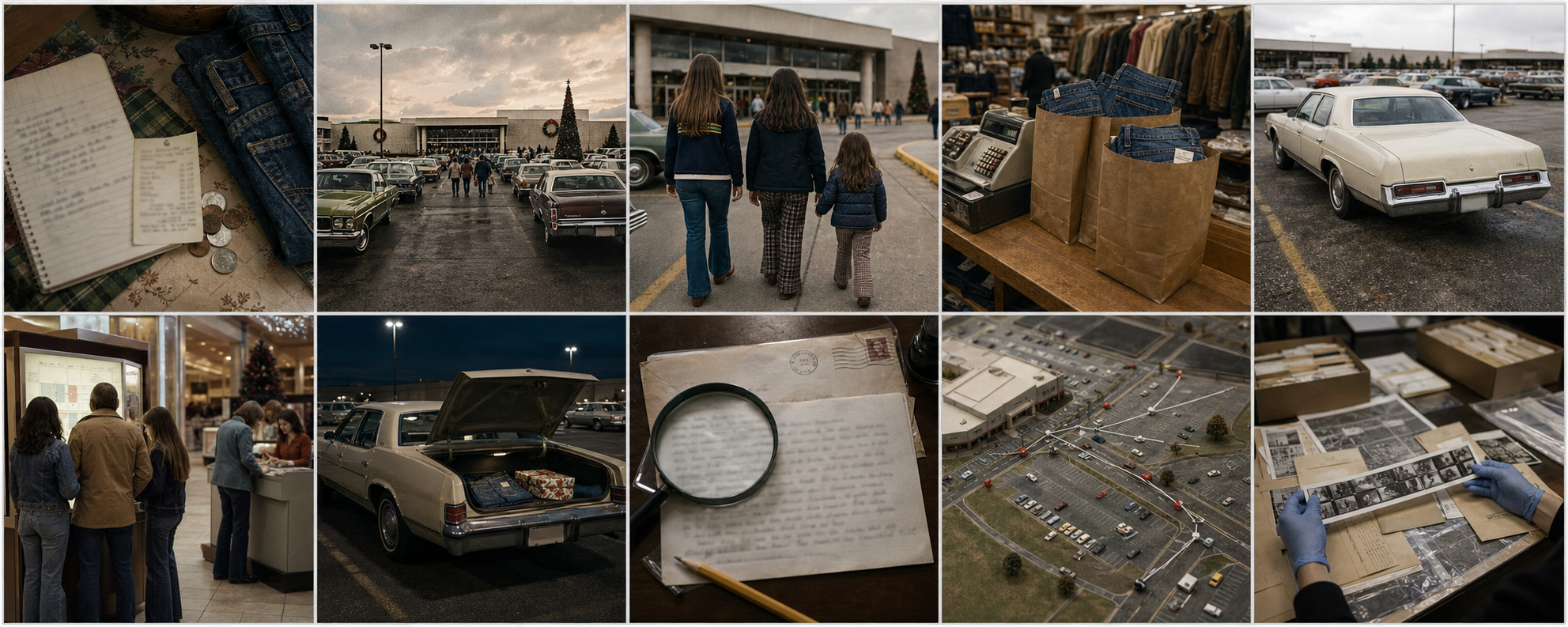
A shopping list, layaway receipt, coins, and denim place the last trip inside the practical errands of Christmas 1974. The documents are illustrative; no invented wording is shown.
The day began with a small change of company
Mary Rachel Trlica was seventeen and recently married. Lisa Renee Wilson, usually called Renee in family accounts, was fourteen. Julie Ann Moseley was nine. The girls were connected, but they were not a single peer group: Renee was Rachel's friend, while Julie was the younger sister of Terry Moseley, Renee's boyfriend. Julie joined the outing after Terry decided not to go.
That age spread matters. A stranger who could influence an older married teenager, a younger teenager, and a child at the same moment had a difficult control problem. A familiar adult, an apparent authority figure, or a convincing emergency would face less resistance. The age difference does not identify anyone, but it changes what a plausible departure from a crowded mall must explain.
According to the case chronology preserved in local reporting and the Fort Worth Police Department case entry hosted by Solve the Case, they left at about 10:45 a.m. Their first known errand was an Army-Navy store, where jeans on layaway were collected. They then continued to Seminary South Shopping Center, the complex later known as La Gran Plaza.
The shopping plan was ordinary and time-limited. Renee was expected back that afternoon, and Rachel had Christmas preparations at home. Nothing in the verified record resembles a carefully prepared disappearance: there was no known packed luggage, travel booking, or later independent contact from any of the three.
The mall exterior represents the holiday crowd that could provide cover and witnesses at the same time. In 1974 it offered almost none of the digital traces a modern shopping center would create.
Three separate lives entered the same evidence gap
Nicknames such as “the missing trio” are memorable, but they can obscure the individual stakes. Rachel had a husband and household to return to. Renee had family plans and a relationship. Julie had asked permission to spend the day with older companions. For all three to choose an unannounced week away together would require a shared purpose strong enough to override different obligations and a nine-year-old's dependence.
The Texas Department of Public Safety classifies Renee's disappearance as endangered with foul play possible. Its public bulletin fixes the date and place and records that the companions never contacted their families. The National Center for Missing & Exploited Children likewise keeps the girls linked as companions last seen at Seminary South.
That official language is deliberately modest. It does not claim that investigators saw an abduction, that the parking lot was the exact crime scene, or that a named suspect was present. It says three people disappeared from a shared trip and remained silent. I preserve that distinction throughout this reconstruction.
Three anonymous figures of different heights approach the entrance. Their differences make the central logistical question visible: what could persuade or compel all three to leave together?
The jeans prove the errand happened
Two pairs of jeans collected from layaway were later found in Rachel's car. This is a small piece of evidence with unusually clean logic. It supports the reported stop before the mall and shows that at least one completed purchase reached the vehicle. It also means someone returned to, or had access to, the car after the store visit.
The jeans do not prove that all three returned to the car together. Rachel could have placed them there while the younger girls waited nearby; the group could have returned between shops; or another person with the keys could have moved them. Without a documented witness or a reliable time stamp, the transfer from store to trunk is an interval, not a filmed event.
Yet the bags weaken one popular form of voluntary-runaway theory. People secretly beginning a distant trip do not usually complete a mundane purchase, secure it in a car they intend to abandon, and then leave without money, transportation, or a trace. A short spontaneous detour remains possible. A planned permanent departure does not fit well.
Folded jeans at a surplus-store counter illustrate a completed errand. The useful inference is movement of the purchase to the car, not a precise reconstruction of who carried it.
The Oldsmobile is the last fixed point
Rachel's 1972 Oldsmobile was found in the shopping center's upper lot near Sears at about 6 p.m. The Texas DPS bulletin says it was locked and the keys were gone. Purchases remained inside. No verified sign in the public record shows where the girls went after their last contact with the car.
A locked car can suggest ordinary departure: the driver expected to return and secured the vehicle. It can also be staged. Because the keys were missing, anyone who controlled Rachel or obtained her keys could have locked it. The lock state therefore supports intentional closure of the vehicle, but cannot tell me whose intention it was.
The parking space is often described as the site from which the girls vanished. More precisely, it is the place where their transport and purchases stopped moving. They might have been approached inside the mall, at an exit, beside the car, or after voluntarily entering another vehicle for what they expected to be a brief ride. Each scenario leaves the Oldsmobile behind.
A period sedan in the upper lot is the reconstruction's anchor. Its continued presence narrows transportation, but it does not locate the first coercive act.
The alarm rose in stages, and the first hours escaped
The most important failure in the case may not be a single mistake. It is the ordinary delay between an expected return and recognition that three people have vanished. Contemporary and anniversary reporting describes families moving from irritation to worry as afternoon promises passed, then going to the mall and locating the car around 6 p.m.
A 1974 mall two days before Christmas was an evidence-destroying machine without meaning to be. Cars entered and left. Cash purchases created weak identity records. Public telephones generated no personal location history. Store employees saw hundreds of faces. Weather, foot traffic, and later searchers altered the lot before anyone could define a protected scene.
Police initially considered the possibility that the girls had left voluntarily. That assumption was common in missing-teen investigations of the period, but Julie's age and the abandoned car should have made the joint disappearance exceptional. Even a few hours affected which shoppers could be located, how precisely they remembered vehicles, and whether physical traces remained recoverable.
Family members search directories and shop counters as daylight fades. The scene marks the conversion of a late return into a recognized emergency.
What a 1974 mall could not preserve
Today, investigators might seek license-plate cameras, store CCTV, card transactions, mobile-phone locations, Wi-Fi contacts, digital photographs, and time-stamped messages. Seminary South offered none of that network. A camera, if present at an individual business, would likely have been local, low-resolution, and routinely overwritten or never recording.
The useful records would have been human and paper: shift rosters, security logs, layaway documents, receipts, vehicle descriptions, calls made from nearby phones, maintenance access, and the order in which witnesses came forward. Those records differ in reliability. A receipt created during the event is not equivalent to a memory elicited after press coverage.
Witnesses reportedly placed the girls in the mall and offered descriptions of forceful encounters involving trucks or vans. The Fort Worth case entry notes that these accounts were never verified. I do not combine them into one cinematic abduction. They may describe separate observations, mistaken identities, rumours, or a genuine event whose details changed in transmission.
A credible sighting needs more than resemblance: an independently recorded time, a location, a distinctive feature known before publicity, and a route compatible with other evidence. Without those anchors, the number of people in a holiday mall makes sincere error likely.
The car at dusk contains the day's completed purchases. What is absent - the three occupants and the keys - carries more analytical weight than an imagined struggle.
The letter promises certainty it cannot authenticate
A letter addressed to Rachel's husband arrived after the disappearance, postmarked December 24. It said, in substance, that the girls had needed to get away, were going to Houston, would return in about a week, and that the car was in the Sears upper lot. The envelope identified Rachel as sender.
The message appears to solve the immediate puzzle. It explains absence, destination, duration, and the parked car in a few lines. That completeness is exactly why it requires a strict provenance test. According to later reporting, the note was written in ink while the envelope was addressed in pencil. The FBI compared the handwriting more than once, but the results were inconclusive; investigators reportedly did not match the envelope writing to any of the girls.
My four tests for the letter
Authorship: can the handwriting be attributed to Rachel rather than merely resembling it?
Custody: who first handled the envelope, and were the stamp, seal, paper, ink, and pencil preserved?
Knowledge: which details were public by the time it was mailed, and which could only come from someone at the car?
Purpose: did it communicate a genuine plan, delay the search, redirect it toward Houston, or imitate a runaway explanation?
The Sears location sounds like private knowledge, but that depends on mailing time and public circulation. Family members had found the car on the evening of December 23, and news coverage began quickly. A December 24 postmark alone cannot prove the writer knew the location before the family or press did. The exact collection office and postal route would matter.
I therefore treat the letter as evidence that someone wanted the husband to receive a runaway narrative. I do not treat it as evidence that the three reached Houston. Its destination claim produced searches and speculation, but no verified contact from the girls followed.
Ink, pencil, postmark, paper, and seal each carry a different forensic question. The recreated writing is intentionally unreadable and makes no claim to reproduce the original.
Five departure routes, one missing transition
| Route from the last fixed point | What it explains | What it must still carry |
|---|---|---|
| Voluntary trip arranged in advance | Quiet exit and locked car | No preparation, no later contact, Julie's involvement, and three separate obligations abandoned |
| Spontaneous short ride with someone known | Why all three might enter another vehicle without a scene | How a harmless detour became permanent disappearance and why no reliable witness emerged |
| Deception by an apparent authority | Compliance by different ages in a public place | The role used, vehicle, route, and absence of corroborating mall records |
| Coercion beside the Oldsmobile | Abandoned purchases and transport in another vehicle | Rapid control of three people in holiday traffic without a confirmed observation |
| Approach inside the mall | A controlled conversation before reaching the lot | How the jeans reached the car and where the transfer to the other vehicle occurred |
The strongest route is not a dramatic stranger attack in open view. It is a brief movement that did not initially look dangerous: a ride, request, instruction, or meeting that brought the girls away from the most observable part of the mall. Coercion may have begun only after the second vehicle moved.
That conclusion remains a mechanism, not an accusation. A known person is not necessarily a close friend; familiarity can mean a face recognized from school, work, the neighbourhood, mall security, or previous contact. An apparent authority can be real or impersonated. The public evidence cannot choose the identity.
An overhead route reconstruction separates mall interior, exits, parking lanes, and roads. Every theory must explain the transition between the known car and an unknown second journey.
Later searches tested claims; they did not strengthen them
For decades, tips sent investigators and families toward bridges, fields, distant counties, and water. In 1981, a search in Brazoria County followed the discovery of human remains; the remains and later bone fragments were not linked to the missing trio. A private investigator pursued other informants, but his files were reportedly destroyed after his death, removing the ability to audit their origin.
Much later, Rachel's brother and volunteer divers examined submerged vehicles in Benbrook Lake. Local reporting documents the effort and its emotional cost. Forensic examination excluded two recovered cars; a third was too deteriorated to raise safely during one attempt, and subsequent searching produced no resolution.
Negative searches matter. They remove specific cars or sites from a responsible theory. They do not mean the lake, bridge, or field was ever a probable destination merely because it attracted equipment and headlines. Search intensity measures commitment, not prior evidentiary strength.
The case has accumulated an enormous folklore layer because the first transition was never captured. Whenever a new location is proposed, I ask for a chain: who supplied it, when, what nonpublic fact supported it, and what independent evidence connects that location to December 23. Without that chain, a precise map pin remains a story.
Modern investigators review old tips as separate records, preserving dates and sources. A large archive becomes useful only when repetition is distinguished from independent corroboration.
My reconstruction and verdict
The best fit is an involuntary disappearance that began with a seemingly manageable departure from the mall or its parking area. The completed purchase, locked Oldsmobile, missing keys, missed plans, three different ages, and permanent silence make a coordinated long-term runaway explanation extremely weak.
I think the girls most likely entered or approached a second vehicle because the first seconds did not present as an abduction to all three. The person may have been known, recognizable, or able to project authority. Once away from the holiday crowd, the encounter changed or the person's real intention became clear. This explains quiet movement better than an open, prolonged struggle beside the car.
The letter does not establish Houston or voluntary travel. Its value lies in its attempted narrative and in any surviving physical material, not in the claim it makes. Until authorship and mailing knowledge are proved, it should be kept outside the hard timeline.
The decisive missing piece remains the transition: a reliable identification of the person or vehicle that carried the trio beyond Seminary South, or recoverable physical evidence connecting that transition to a later site.
What a modern cold-case review can still test
The public record says the case remains open. A modern review should begin by preserving provenance, not by selecting a favourite suspect. Every witness statement can be dated against the first news reports to separate independent memory from details learned later. Vehicle descriptions can be normalized by body style, colour, damage, and direction instead of forcing every truck or van report into one composite.
If the original envelope, stamp, seal, letter, bags, or vehicle evidence survives, investigators can inventory what was touched, how it was stored, and whether carefully limited DNA, fingerprint, paper, ink, or adhesive testing is justified. A modern result is only useful when contamination history and comparison samples are documented.
Mall employment, security, maintenance, delivery, and shop records may be incomplete after half a century, but surviving names can be compared with vehicle ownership, later offences, addresses, and travel. The purpose is not to declare every employee suspicious. It is to test who could naturally approach three shoppers without causing alarm and then leave the complex.
Finally, the archive should distinguish leads tested and excluded from rumours that were merely repeated. Fort Worth police have said new evidence, rather than recycled theory, is needed. The families' current advocacy site maintains a reward and an anonymous tip channel, while official tips may be directed to law enforcement. Anyone with first-hand information should preserve original documents and describe how they know a fact, not embellish it to make the story complete.
Sources and evidence boundaries
- Texas Department of Public Safety, Lisa Renee Wilson bulletin - official date, location, companion names, vehicle condition, and current classification.
- National Center for Missing & Exploited Children, Lisa Renee Wilson poster - linked companion record, last-seen location, identifiers, and Fort Worth Police contact.
- Solve the Case entry attributed to Fort Worth Police Department case information - open status, route, car discovery, letter summary, and the explicit warning that reported sightings were unverified.
- Fort Worth Star-Telegram, fiftieth-anniversary investigation - family interviews, contemporary archive material, early investigative limits, searches, and current cold-case context.
- Fort Worth Star-Telegram, Benbrook Lake search report - documented vehicle recoveries, forensic exclusions, and the limits of later site searches.
- Fort Worth Missing Trio family advocacy site - current reward and anonymous information channel.
Editorial method: official bulletins and contemporary-source reporting define the factual spine. Later witness claims are labelled unverified. The scenario analysis is my inference from documented constraints; it does not accuse any person.