The Springfield Three: What the House Could Still Tell Us
Graduation ended on Saturday night. By Sunday morning, a mother and two young women were gone from a central Springfield house. Their cars remained. Their purses remained. The dog remained. The quietness of the rooms became the loudest fact in the case.
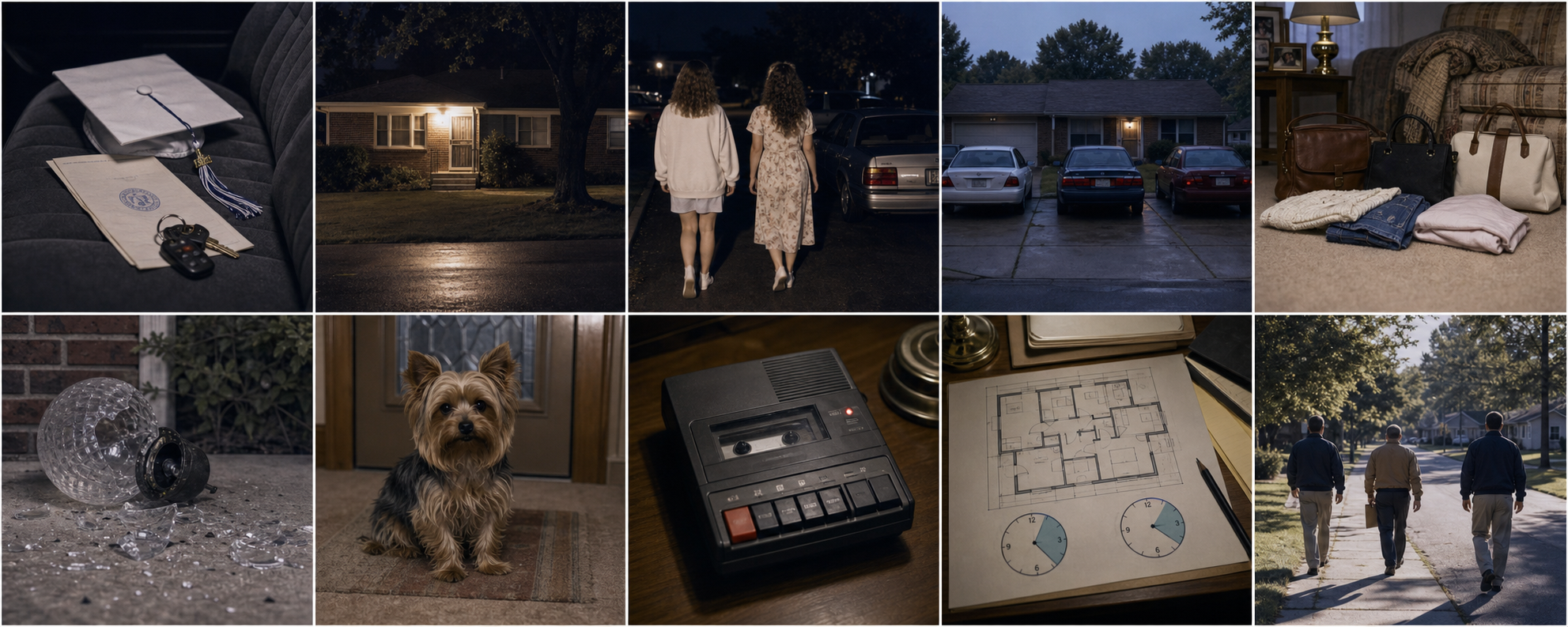
A graduation cap, programme, and car keys mark the ordinary celebration that preceded the disappearance; they are atmosphere only because the documented timeline gives them a place.
Three women, not one collective nickname
The phrase “Springfield Three” is useful, but it can flatten three lives into a single riddle. Sherrill Elizabeth Levitt was 47, a cosmetologist and the mother of Suzie. Suzanne Elizabeth Streeter was 19. Stacy Kathleen McCall was 18 and had graduated from Kickapoo High School with Suzie hours earlier. Their different ages, routines, relationships, and social circles matter because an offender could have selected one person and encountered the other two.
The FBI's ViCAP notice supplies the hard center of the chronology. Suzie and Stacy attended graduation parties on June 6. They then returned to Sherrill's East Delmar Street home to spend the night. The three were last known to be at that address, and none has been heard from or seen since.
Later retellings add many details about changed overnight plans, party stops, calls, and arrival times. Some come from family interviews and contemporary reporting; others have been repeated so often that their original source is difficult to see. I keep the FBI's 2:15–7:30 interval as the firm frame and label everything more exact by its provenance.
This restraint does not make the case less vivid. It prevents a five-minute estimate from deciding which suspect could have been where, and it leaves room for the possibility that the women arrived at different moments or that an encounter began outside the house.
The Delmar Street house at night is treated as a location with entrances, sight lines, neighbours, and a changing light level—not as a sealed stage.
The last confirmed movement points toward home
Suzie and Stacy had options after the graduation celebrations. Plans shifted, as teenage plans often do. What matters is that investigators concluded they reached the Levitt residence. Their cars were there the next morning, and clothing and personal effects indicated that the night had progressed beyond a simple drive-by.
Arrival is not the same as safety. A person can be followed from a party, observed while parking, confronted at the door, or awakened later by someone already known to the household. The house is the final confirmed node, not proof that every critical event occurred inside it.
I plotted three approach zones: the streets used to reach East Delmar, the driveway and porch visible from nearby homes, and the interior rooms. Each zone produces different evidence. A following vehicle might be remembered on the road. A porch confrontation might disturb the light fixture. A quiet entry by a familiar person might leave little sign of force.
No surviving account allows me to choose among those locations with certainty. The useful inference is smaller: whoever removed three people either controlled the encounter quickly or created a reason for them to cooperate long enough to leave the immediate scene.
Two anonymous graduates walk toward a period sedan. The rear view avoids invented likenesses while making the final travel decision concrete.
The driveway fixes what did not travel
By morning, all three women's vehicles were at the residence. That fact sharply limits voluntary explanations. A planned trip involving all three would normally require a vehicle, tickets, packed belongings, or a later trace. None is known. It remains possible that they entered another person's vehicle voluntarily for a short errand, but the absence of their own transportation makes a longer secret departure difficult to sustain.
The vehicles also create a control problem for an offender. Moving three alert adults is harder than moving one. A lone stranger using only verbal threats risks resistance, escape, noise, and witnesses. Multiple offenders, a weapon, surprise, deception, or a trusted identity would reduce that difficulty. These are mechanisms, not accusations.
The lack of an obvious struggle is often treated as proof that the women knew whoever came to the house. It is not. Surprise and coercion can suppress visible damage. Nor does an unlocked or open door prove willing departure; visitors may have opened it after the fact. The condition of the scene must be tied to who observed it first and when.
Three parked cars at dawn are negative evidence: they show which transportation options the women did not use.
I inventoried the objects before forming a theory
Local reporting states that keys, purses, money, clothing, and other personal items remained, while the family dog was left behind. The house did not present an obvious scene of violent disorder. Each item is modest on its own; together they argue against a prepared disappearance.
The object pattern suggests interruption. The women appear to have expected the house to remain the center of their next hours. Yet “interruption” covers many possibilities: a knock, a call, a fabricated emergency, a familiar visitor, or an offender entering with force too limited to leave obvious damage.
This is where the case becomes easy to over-write. A handbag on a floor does not tell us that its owner was barefoot, asleep, or standing beside it. A folded outfit does not prove she changed at a specific time. The inventory constrains intention; it does not reconstruct posture.
Handbags and folded clothes are presented as a documented pattern of interrupted routine, not as props that reveal an unrecorded confrontation.
The broken porch light is evidence with a damaged history
Accounts of the first morning describe a broken glass globe at the porch light and visitors sweeping the fragments away. If accurate, the break could have occurred during an assault, while someone disabled light, through accident, or before the disappearance. Its position, fracture pattern, prints, and trace material might once have distinguished those possibilities.
But the scene was not initially recognized as the site of a probable abduction. Friends and relatives entered, used the telephone, handled ordinary objects, and tidied. Their choices were human, not malicious. They expected to find people who had overslept or changed plans, not to preserve a forensic environment.
Scene contamination is often narrated as though it erased the entire case. That is too absolute. Investigators still had vehicles, the house, interviews, records, and whatever physical items were retained. The correct conclusion is that evidentiary value was reduced and provenance became harder to establish.
What the swept glass can no longer answer
Where did each fragment land? Was the impact from outside or inside? Were fibres, blood, skin cells, or fingerprints present? Had weather affected the break? A reconstruction made decades later cannot recover those relationships from memory alone.
A broken glass globe is photographed before anyone touches it—the documentation step the real scene could not repeat after fragments were swept.
The dog proves presence, not identity
The small dog left inside deepens the sense of interrupted domestic life. It is tempting to use an animal's calmness or agitation as a witness statement. That is unreliable unless behaviour was recorded promptly by someone familiar with the animal's baseline reactions.
A dog may react differently to a regular visitor, a stranger, a noise outside, a sleeping household, or stress hours earlier. By the time friends entered, the animal had experienced an unknown interval. Its presence supports the argument that the residents did not intentionally close the house for a long absence. It does not identify who crossed the threshold.
This distinction is a small example of the whole investigation. The case contains many details that are emotionally strong but mechanically weak. Their proper use is to narrow categories of explanation, not to select a named person.
The dog waiting at the door represents interrupted household routine; its later behaviour cannot be converted into a reliable identification.
The erased message is a missing source, not a hidden confession
A widely repeated account says an unusual or obscene message was heard on the answering machine and inadvertently erased. Another report concerns later prank or anonymous communications. These details have become magnets for theories because the original audio is unavailable.
An erased message has almost unlimited narrative flexibility. It can be imagined as a threat, a wrong number, a prank, an offender testing the home, or something unrelated. Without the recording, number data, exact wording, voice characteristics, and time stamp, none can be tested.
I therefore give the message two roles only. First, it shows how quickly potentially relevant information can vanish before a case is recognized. Second, it explains why later recollection cannot bear the weight of a suspect theory. It does not prove the caller knew what happened.
The answering machine is also a reminder of 1992's technological limits. There were no smartphones continuously producing location histories, photographs, application logs, and cloud backups. Home telephone records could establish calls, but not the full movement of each person. The evidentiary silence is partly the silence of the period.
A period answering machine is treated as a lost recording channel. The absence of audio prevents later writers from assigning exact meaning to the call.
The interval has three internal phases
The FBI window spans more than five hours. I divided it into phases rather than pretending it was one continuous scene.
Phase one: arrival and settling
The teenagers returned after graduation parties. Clothing and vehicles support that they reached the home. Noise from arrival, conversation, and movement may have been ordinary enough not to register with neighbours.
Phase two: the unknown encounter
An approach could occur immediately after arrival or hours later. The later it occurred, the more likely occupants were asleep or preparing for morning; the earlier, the more likely someone followed the party route or knew the changed plan. The public record does not fix this phase.
Phase three: removal and concealment
Three women and an offender vehicle had to leave without producing a confirmed witness account. The route out of a residential area, the location of a waiting vehicle, and the time before normal Sunday activity increased are central. The absence of bodies or confirmed belongings suggests concealment beyond the immediate house, but says little about distance.
This phased model makes one point clear: a theory that explains only how someone entered the home is incomplete. It must also explain control of three people, transportation, exit without a reliable witness, and decades of successful concealment.
The floor plan and clock graphics divide the official window into arrival, encounter, and removal without inventing minute-by-minute certainty.
I scored scenarios by the burden they must carry
| Scenario | What it explains | What it must still explain | Current weight |
|---|---|---|---|
| Voluntary departure by all three | Little visible struggle | Cars, purses, money, dog, no later contact, and three separate lives abandoned together | Very weak |
| One intended target, two unexpected witnesses | Why three people vanished despite different ages and circles | How the offender adapted, controlled everyone, and transported them | Plausible |
| Deceptive request or familiar visitor | Quiet departure and limited damage | Why all three left without key belongings and never reappeared | Plausible mechanism, identity unknown |
| Armed coercion by one or more offenders | Rapid control and abandoned possessions | Arrival, exit, vehicle placement, and lack of confirmed witnesses | Strong mechanism, not a complete theory |
| Random intruder entering the house | Unplanned encounter | Selection of the house, control of three adults, and successful long-term concealment | Possible but costly |
The matrix cannot name an offender. It shows why an involuntary removal best fits the abandoned objects and total silence, while leaving the initial access method unresolved. A weapon, deception, familiarity, and multiple offenders are not mutually exclusive.
Rumours should not be promoted into evidence
Over decades, imprisoned offenders, suspicious vans, anonymous letters, properties, wells, and a hospital parking structure have entered public discussion. Local police examined numerous leads. KY3 reports that a theory about bodies beneath the CoxHealth parking garage lacked evidence, and police did not seek to destroy the concrete.
A claim becomes sticky when it contains a precise place. Precision feels like inside knowledge even when it was produced by speculation. Ground-penetrating radar interpretations, anonymous tips, and statements by convicted offenders require corroboration: construction records, soil disturbance, independent witnesses, travel evidence, or recoverable remains.
I do not name living or deceased individuals as the likely offender without a public evidentiary basis. The responsible analysis concerns mechanisms and constraints. Publishing a confident suspect theory can harm innocent relatives, distort witness memory, and flood investigators with recycled claims.
Detectives canvass the street from the victims' last confirmed location outward; a verifiable route matters more than a dramatic rumour about a distant site.
My reconstruction and verdict
The evidence best supports an involuntary removal from or immediately around the Delmar Street home after Suzie and Stacy arrived. The parked cars, retained purses and keys, dog, lack of preparation, and permanent silence make a coordinated voluntary disappearance extremely unlikely.
The offender probably gained a short period of control through surprise, coercion, deception, familiarity, or some combination. One woman may have been the intended target while the other two became witnesses, but the public record cannot establish which woman or why. More than one offender would reduce the logistical burden, yet a single armed or trusted person remains physically possible.
The house does not disclose the final destination. It records interruption, limited time, and transportation by someone else. The decisive missing evidence is a reliable observation of the other vehicle or person, a preserved trace from the first scene, or corroborated knowledge of the concealment location.
What a modern review can still do
The case remains active, according to police statements reported on its thirtieth anniversary. A modern review can standardize every tip by source date, separate first-hand observations from copied stories, digitize handwritten material, re-map addresses and travel times, and compare vehicle descriptions without forcing them into one model.
Retained physical evidence can be inventoried for modern DNA and trace methods, but testing must preserve material and avoid contamination introduced during the first morning. Old interviews can be re-read for facts known before media coverage. Construction, property, employment, and vehicle records may test specific location claims.
The FBI ViCAP notice asks law-enforcement agencies to compare the case through a national violent-crime database. That cross-jurisdictional work is important because an offender capable of controlling three people and concealing them may have committed other crimes or disclosed knowledge elsewhere.
The public's most useful role is not to repeat a favourite suspect. It is to preserve original photographs and documents, identify the source of a memory, and send genuinely new information to investigators. The women are missing people, not characters available for accusation-driven entertainment.
Sources and evidence boundaries
- FBI ViCAP, “The Springfield Three” — official disappearance window, location, and status.
- FBI ViCAP alert and case poster — official identifying information, NamUs numbers, Springfield Police case number 92-40169, and agency contacts.
- National Center for Missing & Exploited Children, Stacy McCall poster — missing-person record and last-known location.
- KY3, thirtieth-anniversary case review — local reporting on the house, belongings, searches, eliminated claims, and continuing investigation.
- KY3 interview with Stacy McCall's family and a former case detective — investigative context, retained possessions, overwhelming tip volume, and the family's continuing search for answers.
Editorial method: official records define the hard timeline. Details preserved mainly through later reporting are labelled accordingly. No person is accused, and scenario rankings describe mechanisms rather than suspects.