The Sodder Children: A Fire Scene Buried Before It Could Answer
At the foot of the staircase there were Christmas presents, shoes, and the ordinary debris of a large family. Above it, five beds were believed to hold five children. By sunrise the house was a foundation full of heat and ash. The mystery was not created only by what the fire destroyed. It was created by what nobody preserved.
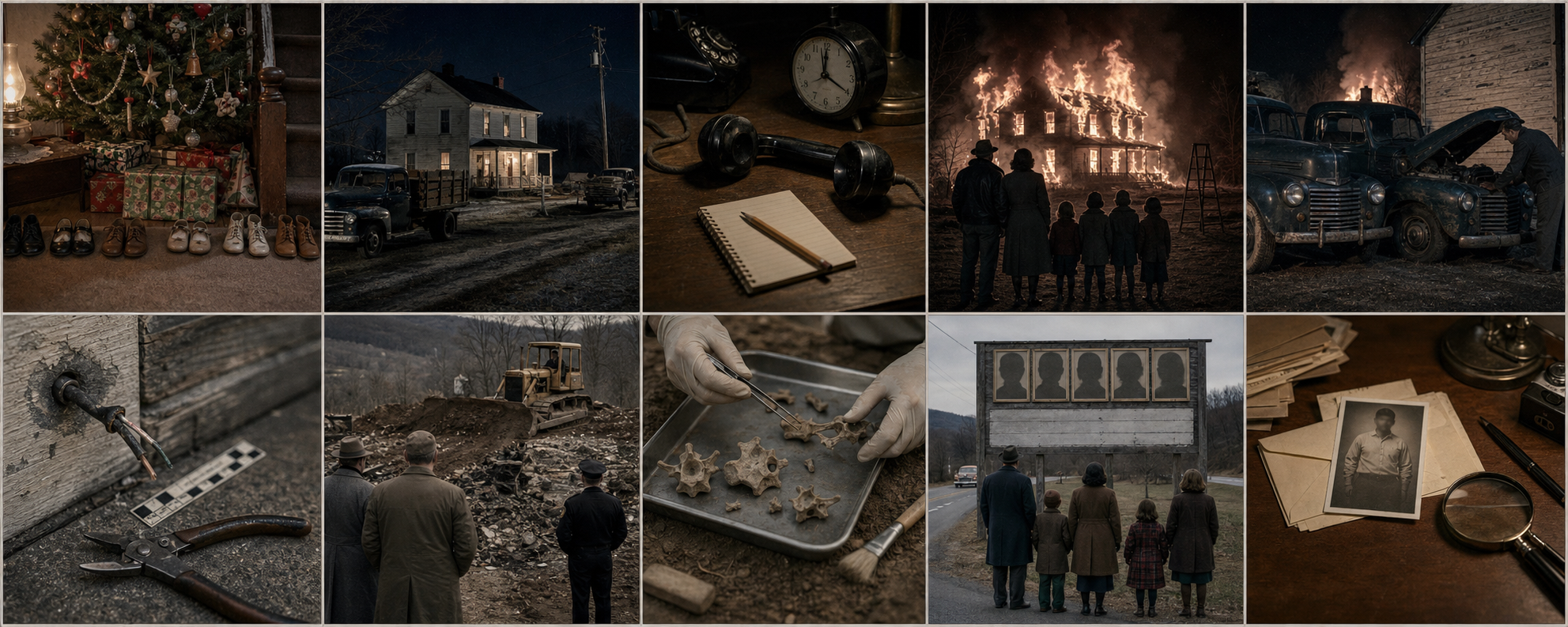
A modest Christmas tree and five pairs of shoes represent the household that existed before the blaze. The arrangement is illustrative and does not claim to reproduce the original rooms.
Five names inside one terrible sentence
Maurice Sodder was fourteen, Martha twelve, Louis nine, Jennie eight, and Betty five. They were five of George and Jennie Sodder's ten children. Nine children were at the family's two-story home outside Fayetteville on Christmas Eve; one older son was away. When fire spread through the house around 1 a.m., the parents and four children escaped. The other five were never reliably seen again.
That is the hard center shared by contemporary reporting, later family accounts, Smithsonian's historical review, and a 2005 public-radio investigation. Everything beyond it becomes more difficult: which children were definitely in which bedrooms, whether anyone reached the upper floor after the alarm, what burned for how long, what fragments were seen on Christmas morning, and what happened to material later covered by tons of soil.
The children are often introduced as having “vanished in a fire,” language that quietly assumes two incompatible things at once. Vanished suggests departure. Fire suggests death at the scene. The evidence must choose between them, not the verb.
I therefore treat the family house as a damaged ledger. Its stairs, windows, vehicles, utility lines, fuel, basement, ash, and later fill dirt each contain a possible entry. Unfortunately, many entries were never recorded when their context still existed.
The rural house, yard, trucks, and utility line form one system. A theory must explain movement through that system, not simply list odd objects found around it.
The last hour is built mostly from family memory
On Christmas Eve, the younger children were allowed to stay up late. Jennie eventually went to bed. Later, an unfamiliar woman telephoned and asked for a name Jennie did not recognize; laughter and glasses could be heard in the background. Police reportedly located the caller, who said she had dialed the wrong number.
The call has atmosphere but little mechanical value. Wrong numbers were common on manually routed and party-line-era systems. The caller did not threaten the family, mention the children, or supply nonpublic knowledge. Unless a telephone log, operator record, or link to another actor survives, the call belongs in the timeline but not at the center of a conspiracy.
Jennie later recalled that lights remained on, curtains were open, and a door was unlocked. She saw an older daughter asleep downstairs and assumed the younger children had gone upstairs. That word—assumed—is crucial. It does not mean they were absent. It means the final confirmation of all five children in their bedrooms is weaker than many retellings imply.
Shortly after returning to bed, she heard a hard impact on the roof followed by a rolling sound. Roughly half an hour later she smelled smoke. The later discovery of a hard rubber object in the yard led the family to suspect an incendiary device, but no preserved laboratory examination publicly establishes what the object was, when it arrived, or whether it caused the fire.
The late telephone call is kept in proportion: documented as a remembered event, but not promoted into proof that someone coordinated the fire.
Fire converted a floor plan into a trap
George and Jennie awoke to fire in the downstairs portion of the home. Four children escaped with them. The staircase to the upper rooms was involved, and smoke prevented George from re-entering through a broken window. Smithsonian's account records that he badly cut his arm during the attempt.
The five younger children were believed to be in rooms on the second floor. If so, the burning staircase removed their obvious route. Children in structure fires may hide from heat and smoke rather than move toward a dangerous landing; a West Virginia fire marshal interviewed decades later emphasized that young victims are often found under beds, in closets, or in bathrooms.
No family member reported seeing the five at an upstairs window. That absence became a pillar of the escape theory. It is not proof of escape. Smoke inhalation can disable a person rapidly, visibility can fall to almost nothing, and a frightened child may retreat from a window or never reach it. Conversely, nobody reported hearing them from inside. The silence is consistent with incapacitation but cannot locate them.
The family outside the burning house is shown from behind. The relevant fact is the blocked upper floor, not an invented view of any child inside.
The missing ladder and silent trucks form a cluster, not a conclusion
George kept a ladder against the house. That night it was missing from its usual place, preventing an immediate climb to the upper windows. He then tried to use one of his coal trucks as a platform. Accounts say neither truck would start even though both had recently worked.
These details can be read as coordinated sabotage: remove the ladder, disable the trucks, cut the line, start the fire. But a cluster of failures is not automatically one plan. A ladder can be borrowed or moved. Cold weather, fuel, batteries, panic, or imperfect memory can affect vehicles. A man later admitted stealing a block and tackle from the property but denied involvement in the fire.
The responsible question is whether the objects were documented before the story grew. Where exactly was the ladder found? Were batteries, ignition circuits, fuel systems, or engines tested? Were tool marks recorded? Did the confessed theft occur before, during, or after the blaze? Public retellings rarely provide the examination notes needed to connect these facts.
The cluster is genuinely suspicious because each failure hindered rescue or communication. Its evidentiary weight is limited because the individual causes were not forensically established. It supports investigation of deliberate interference. It does not by itself prove that five children had already been removed.
Two period trucks fail while the house burns beyond them. Mechanical failure increased the rescue burden, but no surviving public test identifies sabotage.
The telephone line is stronger than the wrong-number call
A telephone repair worker reportedly told the family that the line had been cut rather than burned through. If that observation was contemporaneous and based on the conductor ends, it is significant. It would place human interference outside the house and help explain failed efforts to summon aid from the property.
But even this fact needs a chain of custody. The public record does not offer a preserved section of wire, photographs of the cut, a report describing tool marks, or a precise location relative to the fire. Later writers often repeat “cut phone lines” as settled forensic proof when it may rest on one technician's oral statement.
Deliberate cutting would strengthen an arson theory. Arson still does not require abduction. An offender might have intended intimidation, property destruction, or mass harm. To reach kidnapping, a theory must add a safe entry, control of five children aged five to fourteen, movement from an upper floor, transport, and lifelong silence.
A recreated cut line shows the examination that would matter: cut geometry, tool marks, heat effects, and the exact place where the conductor failed.
Seven hours turned rescue into recovery
Family and neighbours struggled to reach the volunteer fire department. The department had no modern central alarm. A caller or operator had to reach the chief, and firefighters were then assembled through a telephone chain. Although the station was only a few miles away, the crew did not reach the property until about 8 a.m.
The delay is sometimes presented as evidence that the fire department participated in a plot. The documented system provides a less dramatic explanation: a small volunteer service, Christmas morning, limited equipment, failed calls, and individual notification. An inadequate response can be tragic without being conspiratorial.
By arrival, the house had collapsed into its basement and the ruins were still hot. A brief search followed. Here the sources diverge. Smithsonian's review says no human remains were found in the initial search. The later public-radio account says firefighters encountered a few bones and pieces of organs but the family was not informed. Neither version is supported online by a complete original inventory.
The first-search conflict
If no suspected remains were seen, the case begins with a failed recovery. If fragments were seen but not collected, labelled, and examined, it begins with lost evidence. Both possibilities lead to the same procedural conclusion: the Christmas Day search cannot sustain a confident claim that five bodies were either present or absent.
The coroner issued five death certificates listing fire or suffocation, and a state police inspector attributed the fire to faulty wiring. Those documents reflect the official conclusion reached from circumstance. They are not equivalent to five identifications based on bodies, dental work, or biological samples.
Covering the foundation with soil erased spatial relationships between rooms, debris, and possible bone fragments. It also introduced material from somewhere else.
The decisive evidence was buried within days
Authorities reportedly told the family to leave the scene intact for further inspection. Less than a week later, overwhelmed and intending to make a memorial, George used earthmoving equipment to place roughly four or five feet of soil over the basement. Flowers were planted above it.
That choice is understandable as grief and catastrophic as evidence handling. It crushed and moved fragile burned material, mixed imported soil with the fire layer, changed oxygen and heat retention, and destroyed the exact depth and room association of objects. Any later fragment could come from the house, the fill, the equipment, or the surrounding ground.
The burial also created a feedback loop. Because the first search was brief, the family could not accept the absence of remains. Because they could not accept it, the scene became a memorial. Because it became a memorial, no later search could reproduce the first scene well enough to answer the original doubt.
This is the case's true irreversible act. Telephone calls can be reconsidered, witnesses re-interviewed, and photographs re-examined. A mixed and compressed fire layer can never again reveal its original map.
“No bones” is important, but not a complete experiment
Jennie tested the official explanation by burning animal bones and observing that charred pieces remained. Her instinct was scientifically sound: cremation does not ordinarily make the mineral skeleton vanish. Modern forensic literature says even controlled cremation leaves substantial fragmented bone, later mechanically processed into what families call ashes.
Yet the comparison cannot be transferred directly. Human bodies in a collapsing house experience uneven heat, impact, water, debris, oxygen, fuel, and post-fire disturbance. Burned bone becomes brittle and can fragment below easy visual recognition. Recovery quality depends on screening methods, trained identification, scene mapping, and whether material was later moved or buried.
Modern research therefore supports two statements at once. A house fire should not be assumed to erase five complete skeletons. A poor, brief, and later contaminated search can fail to recognize or recover small thermally altered remains. The public debate often selects only the first statement.
The absence is still meaningful. Five children should produce many bones and teeth, not one ambiguous fragment. But meaningful absence requires adequate searching. The scene history prevents me from treating it as proof that the children left alive.
The 1949 excavation is rendered as a careful recovery. In reality, every object had to be judged against years of soil mixing and lost original context.
The 1949 vertebrae answered a different question
Four years after the fire, the family reopened the filled basement with help from Washington pathologist Oscar B. Hunter. The excavation recovered damaged household objects and several lumbar vertebral fragments. The bones were sent to the Smithsonian Institution.
Smithsonian specialists concluded that the vertebrae came from one individual whose skeletal maturation most likely exceeded that of Maurice, the oldest missing child. The bones showed no evidence of fire exposure. Their report found it strange that an allegedly careful excavation located no other bones and considered it most likely that the vertebrae arrived in the soil used to fill the basement.
This finding is often misused in opposite directions. It does not prove the children were kidnapped; the vertebrae were probably unrelated. It also does not validate the original recovery; a 1949 dig through imported soil cannot repair a 1945 search. It demonstrates contamination, exactly the condition that makes later negative evidence weaker.
State hearings followed, and officials closed the matter. Closure was administrative, not an identification of the five children. The family continued to treat them as missing.
Sightings grew as the physical evidence shrank
Witnesses later reported children in a passing car during the fire, at a tourist stop the next morning, and at a Charleston hotel days later. Others sent tips from New York, St. Louis, Texas, Florida, and beyond. None produced a verified identity, a document created before publicity, or a recoverable trail.
A group of five siblings is distinctive, but press photographs can shape recognition. A witness who sees four or five dark-haired children after reading the story may be sincere and wrong. To carry weight, a sighting needs a timestamp, names registered independently, vehicle records, a detail not released to newspapers, or later corroboration from one of the children.
The family wrote to the FBI in 1947. Director J. Edgar Hoover replied that the matter appeared local and outside the bureau's investigative jurisdiction, while offering assistance if local authorities requested it. The local agencies declined. That exchange is sometimes described as the FBI “refusing the case,” but jurisdiction and agency consent were real constraints; it does not reveal what the FBI believed happened.
The billboard kept five faces in public memory for decades. It generated leads, but repeated exposure also increased the risk of resemblance-based sightings.
The photograph of “Louis” has no testable chain
In the late 1960s an envelope postmarked in Kentucky brought the family a photograph of a young adult man and a cryptic message naming Louis. George and Jennie saw resemblance to their missing nine-year-old. They hired an investigator, who reportedly did not return with an answer.
A photograph can be powerful while proving very little. Its evidentiary questions are basic: who made the print, when was the negative exposed, where was it processed, who mailed it, and how did the sender know the family? Without a negative, studio record, fingerprint, handwriting comparison, or identified setting, resemblance is subjective.
If the sender were Louis, lifelong silence would still require explanation. Five children were old enough to remember names, parents, siblings, and Fayetteville. A successful kidnapping must prevent every child from making contact across decades despite national publicity. Death after removal could explain silence, but then the theory gives up its strongest emotional premise: that they survived.
The image should be preserved and analyzed as an anonymous communication, not treated as an age-progression match. It shows that someone knew the Sodder story and wanted the family to connect one face to Louis. It does not prove the face belonged to him.
The anonymous photograph is reconstructed without reproducing the real face. Paper stock, processing marks, postmark, and provenance matter more than resemblance.
I tested four complete explanations
| Explanation | What it fits | What it must still explain | Evidence weight |
|---|---|---|---|
| Accidental electrical fire; children died inside | Official conclusion, blocked stairs, no verified later contact | Reported live electricity, possible cut line, and failure to recover five bodies | Plausible outcome; ignition cause uncertain |
| Deliberate arson; children died inside | Threat reports, roof impact, line and rescue anomalies, permanent silence | No tested incendiary device or publicly preserved arson evidence | Plausible, unproved |
| Children left before the fire independently | Weak final bedroom confirmation and no remains | Why five children left at night, where they went, and why none contacted family | Very weak |
| Coordinated abduction concealed by arson | No identified remains and later sightings | Entry, control of five children, silent removal, transport, no durable trace, decades without contact | Possible but requires the most unsupported steps |
The matrix exposes a common error: comparing a detailed kidnapping story with a caricatured fire story. The fire explanation has serious evidentiary gaps, but it requires fewer invisible actors and fewer successful transitions. Arson and death inside are compatible; suspicious utility evidence does not automatically move the children out of the house.
My reconstruction and verdict
The evidence-weighted explanation is that the five children most likely died in or immediately around the house, while the exact cause of the fire remains uncertain. Smoke, blocked stairs, childhood hiding behaviour, the lack of any verified later contact, and the enormous logistical burden of silently removing five siblings make death at the scene more probable than coordinated abduction.
I do not consider the original investigation capable of proving that conclusion. The delayed response, brief and disputed first search, absent inventory, untested physical claims, rapid burial, and later soil contamination destroyed the chance to identify remains or reconstruct the fire scientifically.
Deliberate arson remains plausible if the telephone line was truly cut and the roof object was related, but the public record lacks the preserved examinations required to establish ignition. An arsonist could have intended destruction or revenge without kidnapping anyone.
The family's belief grew in the space left by procedure. That belief should be treated with compassion, not used as a substitute for evidence. The mystery persists because the most probable answer was never forensically demonstrated when demonstration was still possible.
What can still be done without inventing certainty
A modern historical review could assemble every surviving contemporary newspaper report, death certificate, coroner record, fire-marshal document, operator log, property map, utility note, insurance file, FBI correspondence, and legislative-hearing transcript into one dated archive. Later interviews should be kept separate from statements made before national publicity.
If any original items survive—the Kentucky photograph and envelope, the suspected rubber object, wire, photographs of the ruins, soil samples, vertebral documentation, or unidentified fragments—their custody must be established before testing. Modern imaging, paper and ink comparison, tool-mark work, and DNA analysis might answer narrow questions. They cannot restore a destroyed scene.
The most valuable correction is epistemic. “No remains were identified” is supportable. “The fire consumed every trace” was never demonstrated. “The children were kidnapped” was also never demonstrated. Keeping those three statements separate honours both the lost children and the limits of the record.
The billboard is gone, but its question remains. The responsible answer is neither a comforting survival story nor blind acceptance of a certificate. It is an account of probable death, uncertain ignition, and investigative decisions that made certainty unreachable.
Sources and evidence boundaries
- Smithsonian Magazine, updated historical investigation - family chronology, contemporary press record, official findings, FBI correspondence, 1949 excavation, Smithsonian bone analysis, hearings, sightings, and the later photograph.
- NPR / Texas Public Radio, Fayetteville report - volunteer fire response, conflicting account of the first search, scene burial, local fire-professional interpretation, and the billboard's effect on memory.
- West Virginia Press Association, local retrospective - the case's place in Fayette County history and provenance of the surviving billboard photograph.
- December 28, 1945 West Virginia newspaper clipping - contemporary report that the state fire marshal would examine possible arson after the family raised concern.
- Forensic investigation of burnt human remains, peer-reviewed review - persistence, fragmentation, recovery, and interpretation of cremated bone.
- WIREs Forensic Science, bone colour and fire exposure review - limits of inferring temperature and duration from thermally altered skeletal material.
Editorial method: where Smithsonian and NPR preserve conflicting accounts of the first search, both are stated rather than merged. My verdict is an inference from the documented constraints, not an official finding and not an accusation.