A case can change without becoming simple. In 2025, Austin police announced that two technologies—one reading a paternal DNA line, the other comparing cartridge-case images—had redirected a 34-year-old murder investigation toward Robert Eugene Brashers. That announcement did not erase the fire-damaged scene, the false or disputed confessions, the overturned convictions, or the years in which the wrong theory appeared legally settled. I reopened the record to ask a narrower question: what, precisely, does the new convergence prove—and what must remain unsaid?
1. The file begins again in a laboratory
I do not begin this account on the night of December 6, 1991. That night has been replayed so often that repetition can create the illusion of understanding. I begin instead in 2025, with old evidence under new light. A cartridge case recovered from a drain enters a modern comparison system. A male-line DNA profile is searched beyond the boundaries of one city and one decade. Separate databases, built for different purposes, point investigators toward the same dead man.
That is the moment when the shape of the mystery changes. It no longer resembles a locked room containing only the original scene and the men once prosecuted. It becomes a network: Austin, a 1990 South Carolina crime, a 1991 checkpoint near the Texas–New Mexico line, a 1998 Kentucky homicide, and a 1999 death by suicide. The connections do not arrive as one cinematic revelation. They arrive as records made years apart by people who could not have known how the records would later be compared.
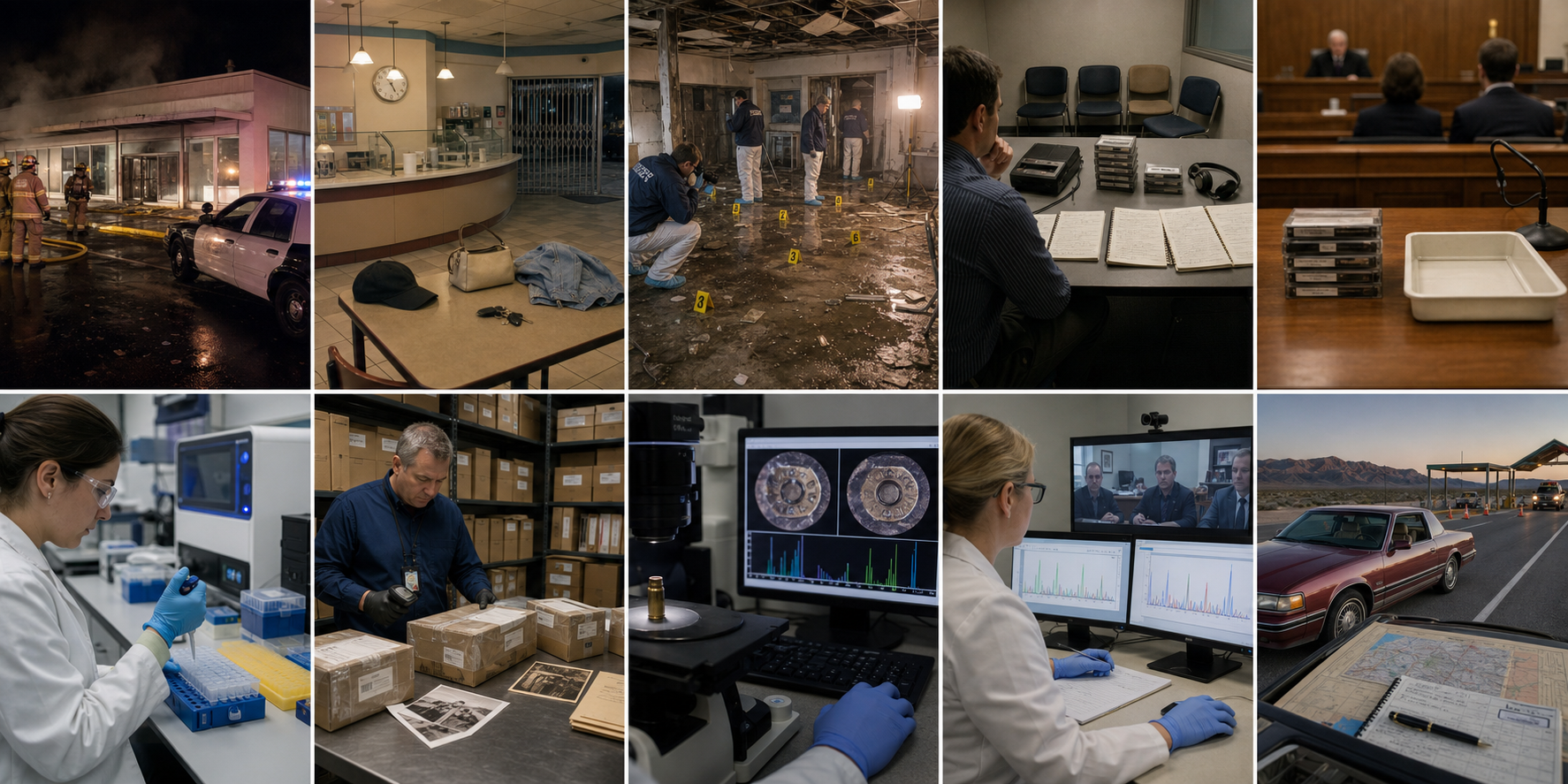
The Austin Police Department's September 2025 presentation described this as a significant breakthrough, while also stating that the investigation remained open. That distinction matters. A breakthrough identifies a far stronger direction. It does not automatically supply a trial, a cross-examination, or a judicial finding. Brashers died in 1999. The justice system cannot test the theory in the ordinary adversarial way.
My working rule, therefore, is severe: no single result gets to carry more weight than its scientific meaning allows. A Y-STR match is not an individualizing autosomal DNA match. A NIBIN lead is not, by itself, a confirmed firearm identification. A confession is not reliable merely because it sounds detailed. And an official announcement is not a license to fill remaining gaps with narrative certainty.
2. Four lives, one ordinary closing shift
The victims were Jennifer Harbison, 17; her sister Sarah Harbison, 15; Eliza Thomas, 17; and Amy Ayers, 13. Jennifer and Eliza worked at the I Can't Believe It's Yogurt! store at 2949 West Anderson Lane. Sarah and Amy were there near closing. Shortly before midnight, an Austin patrol officer noticed a fire. Firefighters entered and found the four girls.
The plainness of the setting is essential. A neighborhood shop, a closing routine, friends and sisters waiting together: nothing in those circumstances warned that the location was about to become one of Austin's longest and most painful investigations. True-crime retellings sometimes allow the offenders to dominate the page. The file reads differently when the girls remain at its center. They were not clues produced for a puzzle. They had families, plans, familiar routes, and an expectation of returning home.
For the investigation, however, the store immediately became a hostile environment. Fire altered materials. The sprinkler system and firefighting water moved, diluted, or damaged potential evidence. Responders had the urgent task of extinguishing flames and protecting life before anyone could preserve a pristine forensic scene. Later investigators inherited the consequences of that necessity.
This is the first source of uncertainty, and it is physical rather than philosophical. Evidence can survive and still lose context. An object may remain, but its original position may be uncertain. Biological material may be recoverable, but incomplete. A cartridge case may endure in a drain while other trace evidence is lost. The case would eventually turn on the fact that damaged is not identical to destroyed.
3. What the fire changed—and what it failed to erase
Imagine the scene not as a photograph but as layers. The first layer is the store before the crime: surfaces, doors, counters, the back area, ordinary objects handled by customers and employees. The second is the offense itself. The third is the attempt to burn the store. The fourth is suppression of the fire. The fifth is the work of responders and investigators. Every later interpretation must decide which layer deposited, moved, or altered a particular trace.
The 2025 breakthrough depended on evidence that crossed decades: male DNA suitable for Y-STR analysis and a .380-caliber cartridge case. Their survival should not be romanticized. Storage, documentation, chain of custody, retesting decisions, and the evolving sensitivity of laboratory methods all mattered. A cold case is not solved merely because technology improves. Someone must decide which item to test, which question to ask, and which jurisdiction might hold the comparison that matters.
| Evidence or record | What it can support | What it cannot establish alone |
|---|---|---|
| Y-STR profile from scene evidence | A paternal-line association and exclusions of men who do not share that profile | Unique identification of one individual among all paternal relatives |
| .380 cartridge case | Comparison to other cartridge cases through imaging, followed by expert examination | The shooter's identity without a reliable link between firearm, person, place, and time |
| Confession statements | Investigative leads if independently corroborated | Truth merely because a statement contains detail or implicates another person |
| Checkpoint and weapon records | A documented route, possession event, and continuity of a serial-numbered firearm | Presence inside the yogurt shop or the complete sequence of the crime |
| Out-of-state case comparisons | Independent convergence across jurisdictions | A substitute for testing and validating each underlying link |
This ledger prevents a familiar error: treating every item as if it answers the same question. DNA can associate a biological contributor. Toolmark evidence can associate ammunition components with a firearm. A travel record can place someone on a route. None is interchangeable. The emerging case against Brashers is persuasive because these different categories converge, not because any one category becomes magical.
4. The confession years
Within a week of the murders, police arrested Maurice Pierce after he was found with the same make and model of .22-caliber firearm associated with part of the crime. According to the Austin Police Department's later account, a confession obtained the following morning did not match important features of the scene, and ballistics were inconclusive. He was released. That early episode did not vanish; it became the beginning of a theory that would return years later.
In 1999, a task force focused on Pierce, Robert Springsteen, Michael Scott, and Forrest Welborn. Springsteen and Scott gave statements implicating themselves and each other. All four were arrested. Scott and Springsteen were eventually convicted. Yet the prosecution had no physical evidence linking any of the four to the store, and the confession evidence became entangled with a constitutional problem: each accused man could not fully confront the other man's statement when it was used against him.
The Supreme Court's 2004 decision in Crawford v. Washington transformed the legal treatment of testimonial hearsay. It did not decide this Austin case, but it changed the framework controlling whether testimonial statements could be admitted when the declarant was unavailable for cross-examination. New trials became necessary. At the same time, improved DNA testing produced a 16-marker unknown male Y-STR profile that excluded the four prosecuted men. The charges against Scott and Springsteen were dropped in 2009.
It is tempting to compress that history into a morality play about foolish investigators and triumphant science. The record deserves a sharper lesson. Confessions are hypotheses until corroborated. Details may be suggested, contaminated, guessed, or supplied through a long interrogation. Mutual implication can create the appearance of independent confirmation even when the statements grew within the same investigative environment. When physical evidence points elsewhere, the proper response is not to protect the old theory but to reopen the architecture of the case.
5. A courtroom answer that never became final
The distinction among conviction, exoneration, dismissal, and factual innocence is often blurred in summaries. Here is the responsible sequence. Two men were convicted. Legal and evidentiary developments undermined the route by which those convictions could stand. DNA testing excluded the four accused men from the unknown male Y-STR profile recovered from evidence. Prosecutors dismissed the remaining charges. None of that, by itself, named the true offender.
But the exclusions did something crucial: they changed the burden of explanation. A theory centered on the four men now had to explain why a relevant unknown male profile belonged to none of them, why no physical evidence connected them to the shop, and why the confessions should override those absences. The more parsimonious position was no longer that the scientific result was an inconvenient loose end. It was that the investigative center had been misplaced.
This is where the case went cold in the public imagination, though not in the evidence room. Cold cases are frequently described as motionless. In reality, their files accumulate dormant possibilities. A database grows. Another jurisdiction uploads a record. A laboratory expands its marker set. A software algorithm improves. A detective rereads an old submission log and notices that an item was not searched again after a system upgrade. Years of apparent silence can be the interval during which future comparisons become possible.
6. Reading a paternal line
In 2022, Detective Daniel Jackson was assigned to the case and organized evidence into tiers for retesting. That choice was analytical, not merely administrative. Testing consumes sample, time, and laboratory capacity. The most promising material must be approached in an order that preserves future options. By 2025, investigators were able to search a more complete Y-STR profile across laboratories beyond Texas.
A Y-STR profile examines short tandem repeats on the Y chromosome. Because the Y chromosome passes through the paternal line, men in the same paternal lineage can share substantially the same profile. This makes Y-STR testing valuable when a male component must be detected in a mixture or when ordinary autosomal testing does not provide a usable individual profile. It also imposes a limit: a Y-STR match generally identifies a lineage, not one man to the exclusion of every paternal relative.
The first scientific question is therefore not, “Does this name the killer?” It is, “How rare is the observed profile, how was it generated, and who can be excluded or included within the relevant paternal line?” Laboratory interpretation, population data, quality controls, and the number of markers all matter. Austin police reported that a South Carolina laboratory obtained a complete match across 27 alleles between the Austin evidence and a known profile from a 1990 Greenville case associated with Brashers.
That result is far stronger than a vague similarity. Yet its proper wording remains lineage-conscious. Brashers becomes the central suspect when the DNA association is combined with other independent records: his documented crimes, his movements, and firearm-related evidence. The argument is cumulative. The Y-STR result opens the correct door; the other records determine whether the person behind that door fits the rest of the house.
7. The evidence room remembers what investigators forget
One detail in the police account is easy to miss: the .380 cartridge case from a drain had not been reentered into the National Integrated Ballistic Information Network for years. NIBIN had changed. New entries had accumulated. The comparison software had improved. In June 2025, the old Austin evidence was searched again.
This illustrates why “it was tested before” is not an endpoint. A database search is time-dependent. Searching in 2005 asks whether a comparison exists among the records available in 2005 and detectable by the system then in use. Repeating the search in 2025 asks a different question of a larger and technically changed universe. The evidence object may be identical; the comparison environment is not.
The renewed search produced a lead connected to an unsolved 1998 murder in Kentucky. The word lead must carry its full caution. The Bureau of Alcohol, Tobacco, Firearms and Explosives explains that NIBIN correlates digital images of cartridge cases and generates possible links for investigation. A trained firearms examiner must examine physical evidence microscopically before declaring a confirmed association. Software ranks resemblance; it does not take an oath in court.
Even so, the Kentucky connection mattered because it pointed toward a known serial offender operating across states. It was not extracted from the Austin confession theory. It arrived from an independent evidence system. Independence is the hidden strength of convergence. When unrelated pathways—DNA records and firearm records—approach the same person without having been designed to confirm each other, the chance of a purely narrative coincidence decreases.
8. The cartridge case crosses a map
Brashers was already associated with violent crimes in several states. The 2025 inquiry linked the Austin evidence to a 1990 Greenville, South Carolina case through the 27-allele Y-STR comparison. Separately, the renewed ballistic search connected the Austin cartridge case to the 1998 Kentucky homicide investigation. The police presentation then added a contemporaneous travel record.
On December 8, 1991—less than forty-eight hours after the Austin murders—Brashers was stopped at a westbound checkpoint between El Paso and Las Cruces. He was driving a car stolen in Georgia and possessed a .380-caliber pistol. Investigators later compared serial-number records and determined that the checkpoint pistol was the same individual firearm Brashers used when he died by suicide in 1999. This is not merely a statement that he owned the same model. It is continuity attached to a serial number.
Geography alone would be weak. Interstate travelers pass through checkpoints every day. Gun ownership alone would also be weak. Many people possessed .380 pistols. What raises the value of the record is its timing, its direction of travel, the stolen car, the continuity of the firearm, and the separate biological and ballistic associations. Each fact changes the probability assigned to the others.
Still, several questions remain publically unresolved. Was the NIBIN lead confirmed through a microscopic comparison of the physical cartridge cases? Can the recovered biological material be narrowed beyond the paternal line? Does evidence demonstrate that Brashers acted alone? What exact sequence occurred inside the shop, and what motive best fits it? The police have said additional testing and investigation continue. An honest reconstruction leaves those spaces open.
9. Two databases meet without sharing a script
The case now contains two competing forms of convergence. The old case had confessions in which suspects implicated themselves and one another. That looked mutually reinforcing, but the statements arose inside the same investigative process and lacked physical corroboration. The new case has a Y-STR association from one scientific pathway, a ballistic lead from another, and a checkpoint record created for an unrelated law-enforcement purpose. These sources are structurally more independent.
Independence does not make them infallible. Laboratory error, database metadata error, chain-of-custody problems, or overstatement of a preliminary lead are all possible and must be tested. But independence reduces the risk that every piece merely repeats the same initial assumption. The 1991 checkpoint officer was not writing for an Austin cold-case theory. The South Carolina laboratory was not manufacturing a profile to validate an Austin interrogation. The Kentucky cartridge record existed before the 2025 correlation. Their later alignment is evidentially meaningful.
I would describe the present case as a braided inference. Strand one: a relevant male-line DNA profile excludes the previously prosecuted men and matches the Brashers-associated profile at the reported 27 alleles. Strand two: a cartridge case produces a cross-state ballistic lead tied to a homicide attributed to Brashers. Strand three: a near-contemporaneous checkpoint documents Brashers traveling west of Austin with a particular .380 pistol whose serial number reappears at his death. Braided together, the strands support far more weight than one alone.
10. My reconstruction of the investigative failure
The central failure was not that police lacked a perfect clue in 1991. No one could have performed a 2025 database search against records that did not yet exist. The failure was epistemic: once confessions created a coherent story, contradictions and absences were too readily treated as secondary. A story had become the container into which evidence was poured.
The better method is the reverse. Build separate columns for scene evidence, witness evidence, statements, legal admissibility, laboratory results, travel records, and offender-pattern comparisons. Ask what each column proves independently. Then test whether the columns converge without forcing them. If a confession is accurate, it should predict evidence not fed to the speaker. If a DNA association is relevant, its location and context should survive alternative explanations. If a firearm link is claimed, the distinction between a computer lead and an examiner-confirmed identification must remain visible.
This method also guards against a second wrongful certainty. Now that Brashers is the dominant suspect, the public may be tempted to make every unknown detail fit him. That would repeat the original mistake with a stronger candidate. The new evidence justifies a major reallocation of probability. It does not authorize invented motive, imagined dialogue, or an unsupported accomplice theory.
11. The checkpoint in the rear-view mirror
The checkpoint record is the image that stays with me. Not because it proves the whole case, but because it shows how close a crucial fact can come to recognition and still remain disconnected for decades. A man is stopped on a westbound road. A stolen car is recorded. A pistol is documented. The encounter ends and the paperwork enters an archive. Elsewhere, Austin detectives stare at a damaged store and do not yet possess the connective tissue that would make that stop legible.
In a novel, the checkpoint officer might notice the decisive detail and turn the car around. Real investigations rarely grant such symmetry. Records are separated by jurisdiction, technology, naming conventions, and time. The link exists only retrospectively. What appears obvious in a completed timeline was invisible to people living through it.
That is why the 2025 announcement feels both clarifying and unfinished. It offers the families a far more evidence-based account of who may have killed Jennifer, Sarah, Eliza, and Amy. It also confirms how deeply the earlier prosecutions depended on a theory that physical evidence did not support. The breakthrough restores direction, but it cannot restore the lost opportunity to question a living suspect or bring a case before a jury.
12. Verdict: a transformed case, not a closed courtroom
The most responsible final sentence is therefore conditional. If further laboratory work confirms the remaining physical links and excludes a plausible paternal relative or alternative contributor, the evidentiary case against Brashers will become stronger still. If investigators establish a confirmed firearm identification rather than a database lead, another uncertainty will narrow. Until those details are public, the correct description is the one Austin police used in substance: a major breakthrough in an investigation that remains open.
The enduring lesson reaches beyond this case. Lengthy interrogation can generate detail without truth. A conviction can create social closure without scientific closure. Damaged evidence can outlive a mistaken theory. And a cold-case detective's most consequential act may be neither an arrest nor an interview, but the decision to submit one old object to a changed system.
Four girls lost their lives in an ordinary place at the edge of midnight. For more than three decades, the public story moved through accusation, conviction, reversal, and uncertainty. The 2025 evidence does not make that history neat. It does something more valuable: it changes the hierarchy of what should be believed.
Sources and verification notes
- Austin Police Department: detailed 2025 breakthrough presentation — principal source for the case chronology, Y-STR comparison, NIBIN lead, checkpoint, and open-investigation status.
- Austin Police Department: preliminary breakthrough announcement.
- Travis County District Attorney: statement on the new evidence.
- FBI Vault: Austin Yogurt Shop Murders records.
- ATF: National Integrated Ballistic Information Network fact sheet — basis for the distinction between a correlation lead and a confirmed firearms examination.
- National Institute of Standards and Technology: Y-STR definition.
- NIST/ISFG: recommendations on forensic Y-chromosome STR analysis.
- Supreme Court of the United States, Volume 541: Crawford v. Washington.
- South Carolina Law Enforcement Division: state DNA database information.
- KUT 90.5: local reporting on the 2025 announcement.
- Associated Press: national report on the identification of Brashers as the central suspect.
Research note: Sources were checked against the public record available on August 10, 2026. Later laboratory disclosures or official findings may change the assessment. Editorial reconstructions are used only to clarify setting, process, and evidence categories.