The most famous image in Jennifer Kesse's case appears to show a person while revealing almost nothing about that person. A security camera recorded someone walking away from her black Chevrolet Malibu on January 24, 2006. In each usable frame, fence bars crossed the figure at exactly the wrong place. Twenty years later, the Florida Department of Law Enforcement says the investigation is active. I reconstructed the case by separating two timelines—the last known movements of Jennifer and the later movements of her car—because the narrow interval between them carries more reliable information than the silhouette.
1. The camera preserved an exit, not an identity
Surveillance systems are often imagined as neutral witnesses. The Huntington on the Green camera was more like a witness who blinked at regular intervals. It did not record a smooth, high-resolution movie. It sampled moments. Between the lens and the walkway stood a metal fence. As the unidentified person moved past it, the sampling cadence and the spacing of the bars combined to hide the head and face.
That accident of geometry made the footage unforgettable. It also made it dangerous. A vague image attracts completion: viewers supply height, sex, occupation, posture, and even guilt from a few pixels. The FBI's current notice uses a more disciplined description. It says surveillance footage shows a person of interest walking away after parking Jennifer's 2004 Chevrolet Malibu at an apartment complex about one mile from her condominium. It does not claim that the frames identify the person's face, employer, or relationship to Jennifer.
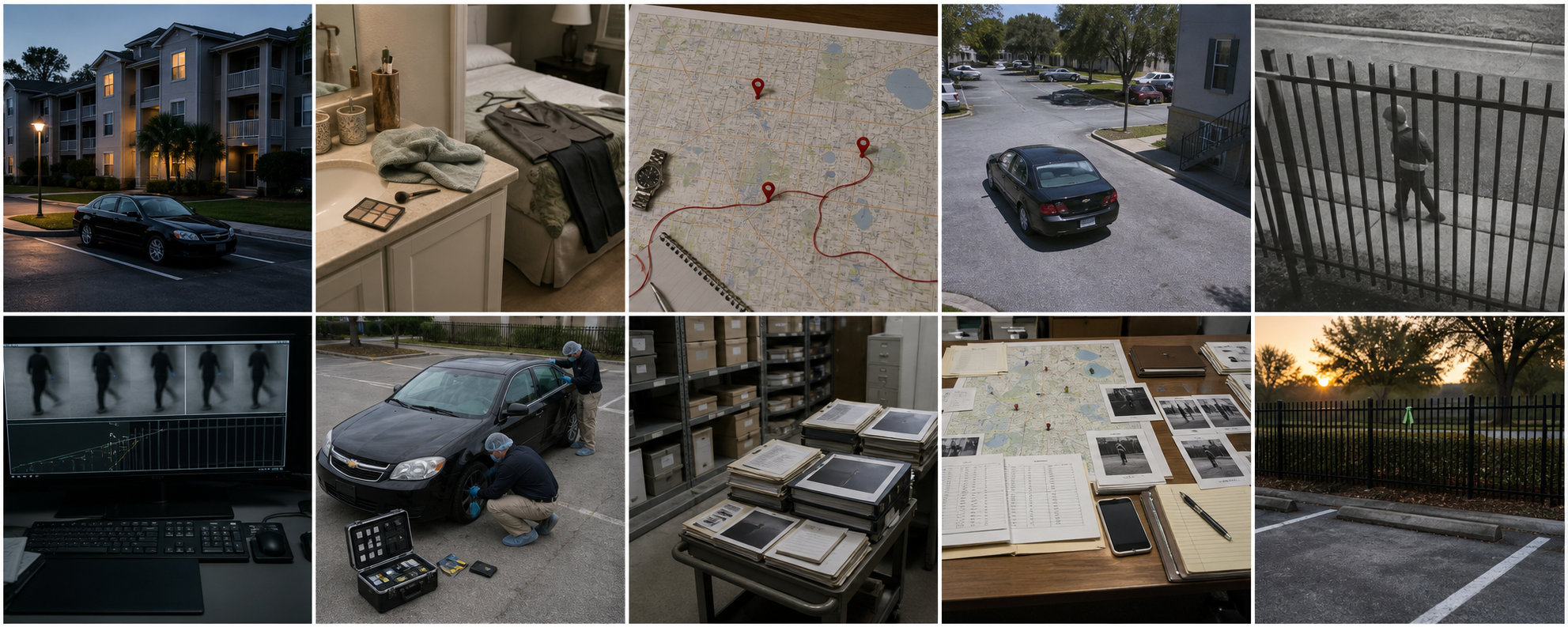
My first conclusion is therefore negative but important: the footage should be used to establish an action, not an identity. Someone who had control of Jennifer's car parked it at the other complex and walked away. That person may be the offender, an accomplice, or someone acting under circumstances not yet public. The frames prove the relocation event far better than they prove who performed it.
2. Two clocks begin on different nights
Jennifer was 24, a University of Central Florida graduate and a finance manager at Westgate Resorts. She had returned from a trip with her boyfriend and went back to work on Monday, January 23. The family-run case site records her last phone call at 9:56 p.m. that evening. By the next morning she did not arrive at work, did not answer her phones, and did not contact the people who expected to hear from her.
These facts form the person clock. The vehicle clock begins later, when the Malibu appears at Huntington on the Green. Public timelines place that parking event around noon on January 24. The car was not discovered until the morning of January 26. Confusing the two clocks creates theories that feel precise but are not.
PERSON CLOCK
Jan. 23, evening: Jennifer returns home after work and speaks with family and her boyfriend. The family site places the final call at 9:56 p.m.
Jan. 24, morning: She does not reach work or make her customary contacts. Her whereabouts are unknown.
VEHICLE CLOCK
Jan. 24, about noon: An unidentified person parks her Malibu roughly one mile from her condominium and walks away.
Jan. 26, morning: The car is located at Huntington on the Green.
The clocks overlap only after Jennifer's last known communication and before the car's relocation. They do not tell us whether the initiating event occurred late Monday, inside the condominium, in the parking area Tuesday morning, or somewhere along a route. They do tell us that by around noon Tuesday, someone other than an identified Jennifer was operating the most visible piece of her property.
3. The last ordinary evening
There is a quiet cruelty in the surviving routine. Jennifer had just resumed normal life after travel. She worked Monday, returned to her condominium at Mosaic at Millenia, called people close to her, and prepared for the next workday. The official record is concise; family and later news accounts supply the domestic details. Her parents found a home that looked recently occupied rather than abandoned. Makeup was out, clothing from the night was present, and moisture remained in the shower area.
Those details support a morning-preparation inference, but they do not time-stamp every action. A damp shower is consistent with bathing before work. It is not a clock accurate to the minute. Clothes laid out or discarded can reflect routine without proving that Jennifer reached the front door. The locked or orderly appearance of a home can argue against a prolonged struggle inside, yet it cannot exclude coercion, a brief confrontation, or an encounter elsewhere.
The missing objects are more concrete. The FBI lists her Verizon phone, Nextel phone, iPod, keys, driver's license, and purse as absent from the residence. Her car was also gone. Together, those items resemble what a commuter might carry. They are compatible with Jennifer leaving voluntarily for work. They are also the objects an offender would need to move the car, delay alarms, or make the departure look routine. Compatibility is not discrimination: the same evidence fits more than one pathway.
4. The no-show became the first alarm
Jennifer's employer contacted her family after she failed to report for work. That response narrowed the delay that harms many adult missing-person investigations. Her parents traveled from the Tampa area toward Orlando. Before they arrived, a condominium manager checked the residence with a spare key and reportedly found nothing obviously wrong. By the afternoon, family and friends were searching and distributing flyers.
FDLE's January 2026 release says Jennifer was reported missing on January 24 from her Conroy Road apartment complex. The agency describes her as last seen leaving her Orlando home. The FBI public page, more cautiously, centers the failure to appear at work and the later vehicle footage. These formulations are not necessarily contradictory, but they reflect different levels of certainty about what “last seen” means. No public description identifies a named eyewitness who watched Jennifer get into her car that morning.
For reconstruction, I use a conservative boundary: Jennifer was last in confirmed contact late Monday, and her residence showed signs consistent with preparation for Tuesday. The moment she crossed from home to parking lot remains an inference unless investigators possess a witness or record not publicly disclosed.
5. The one-mile triangle
Three places define the visible case: Jennifer's home at Mosaic at Millenia, her workplace in Ocoee, and the Huntington on the Green complex where the Malibu was left. A map makes the car's location appear close to home. That proximity is meaningful, but not in the simplistic sense that the offender must have lived nearby.
A one-mile relocation offers several practical advantages. It removes the car from the immediate search radius around Jennifer's building. It allows a driver to leave the vehicle and return on foot within a manageable time. It may place the car in a lot where an unfamiliar vehicle would not immediately trigger attention. It also avoids a long drive that would create more cameras, witnesses, fuel use, and exposure.
But distance cannot tell us whether the person returned to Mosaic, continued to another destination, entered a waiting vehicle, or lived nearby. Walking direction after the last camera frame is not the same as final destination. A route that looks purposeful may simply be the shortest path out of view.
The map is most useful as a test of time. If the Malibu was parked around noon, the person had several hours after the expected morning commute to control the car, reach Huntington on the Green, and depart. That interval is large enough for many scenarios and small enough to make certain records valuable: gate logs, work schedules, maintenance assignments, phone activity, road cameras, and witnesses who saw the car during the missing hours.
6. Noon: the car enters a second story
At approximately noon on January 24, a black sedan matching Jennifer's Malibu entered the surveillance system's field. An unidentified person parked it and walked away. The car was found on January 26 after residents or managers recognized it from public information. That gap matters: the discovery time is not the parking time.
The vehicle relocation has the structure of a deliberate act. Cars do not transport themselves, and a driver abandoning one a mile from its registered owner's home creates physical distance between the original location and the object searchers will eventually find. The act may have been hurried or planned; the public evidence cannot choose between those descriptions. What it strongly suggests is that someone wanted to end possession of the Malibu at Huntington on the Green.
The driver did not leave the car in a wilderness or destroy it. It was placed in an ordinary residential lot. That could mean the person expected it to blend in temporarily, lacked time or means for a more elaborate disposal, or needed to continue on foot. The ordinariness of the lot is not evidence of sophistication. It is evidence of a practical transition: car travel ended, walking began.
7. Why the fence cannot be “enhanced” into a face
The impulse to rescue a hidden face with modern software is understandable. It is also where analysis can become fabrication. Enhancement can improve contrast, stabilize frames, or interpolate motion for viewing. It cannot recover facial pixels that the fence blocked and the camera never recorded. A generative system may produce a plausible face, but plausibility is not recovery.
Height estimates from surveillance are similarly conditional. They depend on camera geometry, lens distortion, ground plane, footwear, posture, and a reliable reference measurement. Apparent work clothing is not an occupation. A light outfit can be a uniform, coveralls, ordinary clothing, or a color error caused by exposure. Gait comparison from a few distant frames is a lead-development tool, not a unique identifier.
The responsible use of the footage is behavioral. The person appears able to park the Malibu, exit, and walk away without visible hesitation in the sampled images. The route relative to the fence can be reconstructed. The time and vehicle can be cross-referenced. Clothing, body proportions, and gait may help investigators exclude impossible candidates or prioritize interviews, but public viewers should not assign a name from resemblance.
8. The car is evidence—and a boundary
When police located the Malibu, the car became the best physical bridge between Jennifer and the unidentified driver. A vehicle can contain fingerprints, touch DNA, fibers, hair, soil, fluids, receipts, electronic data, seat-position changes, and damage. Yet it is also a frequently touched environment. Family, friends, mechanics, valet staff, and earlier passengers may all contribute trace material.
Public reporting about possible DNA retesting has evolved, and Jennifer's family expressed renewed hope in 2025. FDLE's January 2026 statement does not announce a DNA identification or name a suspect. It says agents are analyzing evidence, pursuing leads, and conducting interviews. That official wording is the proper ceiling for a public conclusion.
A useful question for any reported trace is not simply “Whose is it?” but “Where exactly was it recovered, how likely is innocent transfer, and was the area normally touched by Jennifer or known passengers?” A profile from an exterior door handle has a different interpretive value from one inside a protected surface. A mixed profile requires different caution from a clean single-source profile. Until an agency releases those details, claims of a genetic solution remain premature.
The car also marks the edge of the visible trail. We know where it reappeared. We do not know where it traveled between Jennifer's home and the recovery lot, whether Jennifer was ever inside during that interval, or whether another vehicle participated. The Malibu is a bridge with its middle section missing.
9. Four interruption points
Instead of ranking named suspects, I tested four possible places where Jennifer's normal Tuesday could have been interrupted. This avoids the internet habit of selecting a person first and arranging facts afterward.
| Interruption point | What fits | What remains unexplained |
|---|---|---|
| Inside the condominium | Privacy, control of personal items, and no need for a public approach | The orderly appearance, lack of a publicly reported forced entry, and how an offender gained access |
| Between the door and the car | A brief vulnerable transition and offender access to the vehicle | Absence of a confirmed witness, alarm, or publicly described struggle |
| After Jennifer began driving | The Malibu leaves normally and is later controlled by someone else | Where and why she stopped, and how the second person entered or took control |
| Late Monday night | Fits the end of confirmed communication | Morning-preparation indicators and the car's later movement |
The second and third locations best fit the combined public facts, but that is an inference, not a finding. The apparent morning routine favors an event after waking. The missing purse, keys, phones, license, and car favor a departure or departure-like staging. The lack of a publicly described disturbance inside favors a rapid encounter outside or during travel. None of those facts excludes a known person, a stranger, a worker with legitimate access to the complex, or an offender who approached under a pretext.
Speculation about construction workers at Mosaic has been persistent because the property was still being developed and Jennifer reportedly told relatives that some workers made her uncomfortable. That information deserves investigation, but occupation-themed clothing in a blurred frame does not convert a broad workforce into suspects. A sound theory would need records: who was present, who had access, who disappeared from a shift, who knew the layout, whose movements fit the noon return, and what physical evidence corroborates the connection.
10. A case file changes custodians
Over the years, Jennifer's family pressed for access to the investigative file and greater momentum. A 2019 settlement transferred records after litigation involving the Orlando Police Department. In November 2022, FDLE assumed the lead investigative role. A change of agency does not reset the evidence to pristine condition, but it can reset assumptions.
By January 2026, FDLE reported more than 115 interviews, tens of thousands of documents and pieces of evidence reviewed from the earlier investigation, and thousands of hours spent re-examining the case. Those numbers are not proof of proximity to an arrest. They describe a methodical audit: witnesses retold, old statements compared, evidence inventories checked, and leads tested against the full record.
Cold-case review can expose contradictions that were invisible when reports lived in separate folders. It can also correct the gravitational pull of famous clues. The surveillance figure has dominated public attention because it is visual. A renewed investigator may find more value in an obscure work schedule, a maintenance log, a phone serial number, an untested swab, a vehicle tow record, or a witness whose 2006 statement was never compared with later information.
11. What an active investigation now means
FDLE's twentieth-anniversary release is unusually useful because it sets present-tense boundaries. Agents are actively pursuing leads, analyzing evidence, and conducting interviews. The agency's stated goal is to find Jennifer and bring justice. It provides a direct Orlando office number and cold-case email for tips. The FBI continues to list Jennifer through ViCAP and retains the surveillance images and missing-property details.
“Active” does not mean solved in secret. It means investigative actions continue and information can still be tested. The passage of twenty years weakens memory, but it also changes relationships. Loyalties fade. People who feared consequences may reconsider. Technology improves. A former resident may recognize the significance of a vehicle, schedule, conversation, or absence that seemed ordinary in 2006.
The most useful tip is not a viral resemblance to the pixelated figure. It is specific, first-hand, and checkable: a person with access to the Malibu, a documented change in routine, a statement made before case details were public, an unexplained trip, a location connected to physical evidence, or knowledge of property that only a participant should possess. Investigators can compare such information with records the public has never seen.
12. My reconstruction: the relocation was the message
This reconstruction explains the strongest facts with the fewest additions. It accounts for the prepared residence and missing commuter items. It accounts for the car's later appearance and the unidentified driver. It does not require the camera to reveal a face or clothing to reveal an occupation. It leaves open whether the offender knew Jennifer, selected her opportunistically, approached inside the complex, or intercepted her on the road.
The decisive unknown is what happened before the Malibu reached Huntington on the Green. If Jennifer was not in the car during that trip, where had the driver come from? If she was, when did she leave it? Did the driver walk back toward Mosaic, meet someone, or disappear into the neighborhood? The surveillance sequence begins too late to answer the most important question.
That is why the hidden face, although haunting, is not the whole case. The driver's action is a timestamped transfer of control. It can be compared with alibis, work records, travel times, phone events, and forensic traces. The person need not be recognized visually if independent evidence can identify who was able to make that trip.
13. The empty space after twenty years
An empty parking space is not usually evidence. In Jennifer's case, absence became the first visible change: her car was gone, her phones did not answer, her office chair remained empty. Two days later, the car returned to view in the wrong place. The person who left it passed behind a fence and out of the frame.
The public has spent twenty years staring at those bars. I think the better direction is sideways—toward the clocks on either side of the image. Who could control the car before noon? Whose movements fit the walk away? Which records were created without knowledge that they would become evidence? Which trace in the Malibu belongs to an innocent past contact, and which cannot be explained that way?
Jennifer should not be reduced to the silhouette of someone else. The current investigation is about locating her, testing evidence, and giving her family an answer that survives more than resemblance. The camera captured a person-shaped absence. The rest of the file must supply the name.
Sources and verification
- Florida Department of Law Enforcement, January 24, 2026 — current lead-agency status, review totals, tip contacts, and official case summary.
- FBI ViCAP: Jennifer Joyce Kesse — missing-property list, physical description, vehicle and surveillance summary.
- FBI ViCAP Alert 2023-06-01 — official downloadable case alert.
- FDLE Unsolved Cases in Florida database — case number, lead agency, vehicle recovery date, and suspicious-circumstances designation.
- Kesse family case site: disappearance and vehicle chronology — family account of the final evening, routine, and early response.
- Kesse family case site: person-of-interest images and public appeal.
- CBS News: documented timeline and family account of the residence.
- ABC News: 2019 record-transfer litigation and renewed search context.
- WKMG News 6, January 2026: twentieth-anniversary reporting and forensic-review context.
- Florida Legislature, 2008 Senate history — legislative record for the Jennifer Kesse and Tiffany Sessions Missing Persons Act.
Checked against sources available August 10, 2026. Where family or news accounts provide details beyond the short official summary, they are identified as such. Later FDLE findings may alter the reconstruction. Tips should go directly to FDLE Orlando at the contact information in its current release.