The most important evidence lasted only seconds. At approximately 10:44 on the morning of February 2, 2008, a call reached emergency dispatch from the Lane Bryant store at Brookside Marketplace in Tinley Park, Illinois. Store manager Rhoda McFarland whispered the business name, the suburb, and one urgent word: hurry. The line remained open long enough to preserve fragments of the offender's voice. An officer arrived within minutes. The man was already gone. Five women were dead; a sixth survived. Eighteen years later, police say the investigation has never stopped.
1. A shopping plaza before the emergency
Brookside Marketplace sat near the intersection of 191st Street and Harlem Avenue, in the broad suburban landscape south of Chicago. On a cold Saturday morning, the center was beginning its ordinary weekend rhythm: workers unlocking doors, customers arriving after ten, delivery vehicles moving between storefronts, and traffic feeding toward major roads. Nothing about that setting announced an isolated interior crisis.
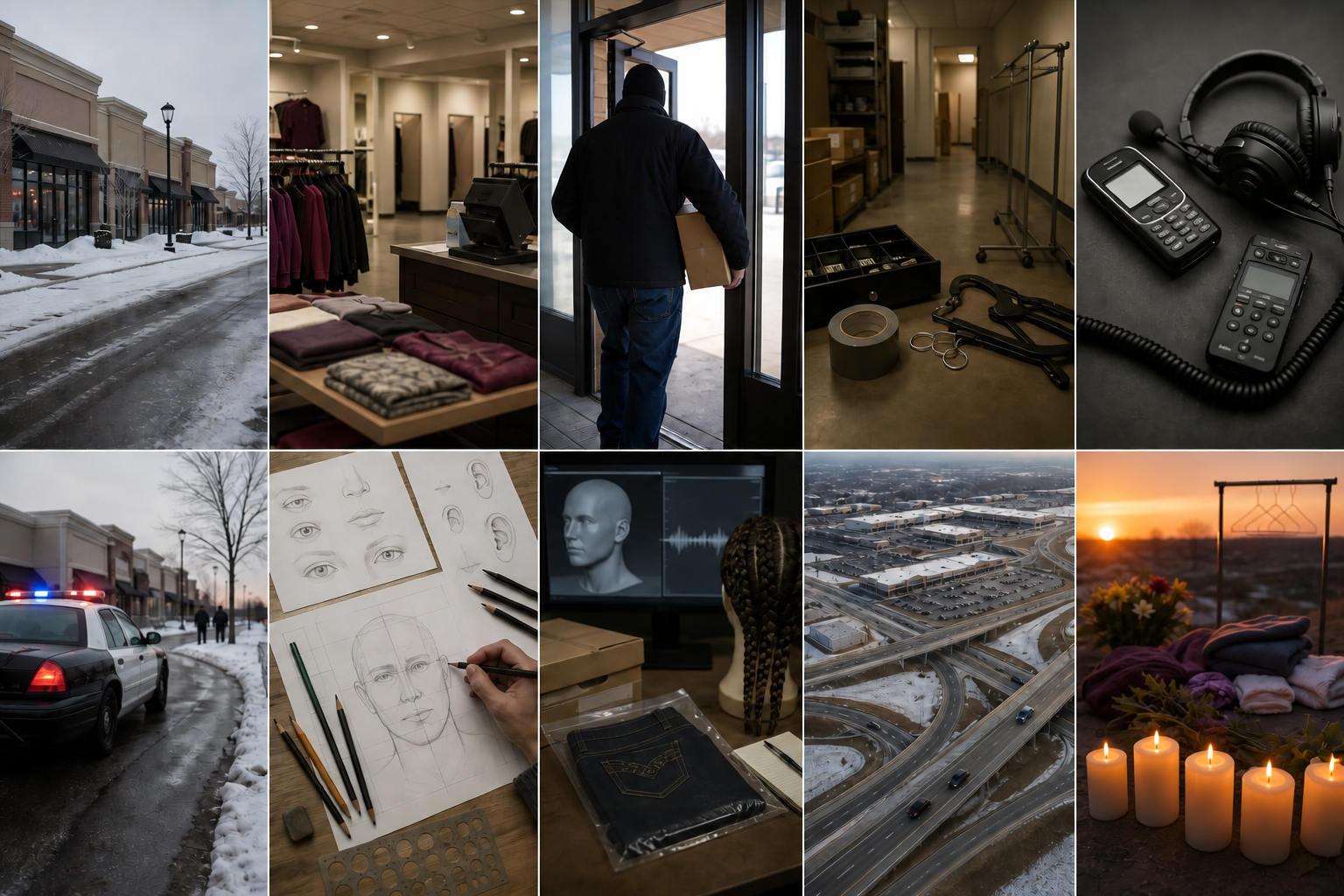
The public nature of the plaza creates the first paradox. A retail store appears exposed because it has glass, neighboring businesses, parking lanes, and predictable traffic. Yet visibility is uneven. A passerby sees the entrance, not the fitting area. A camera across the lot may record vehicles while missing faces. A customer in one aisle may not know what is happening behind a partition. The offender did not need the entire plaza to be empty. He needed control of one interior space for a limited interval.
Tinley Park police and the Village now maintain a dedicated case page with the suspect image, voice recording, reward information, and tip channels. In February 2026, Police Chief Tom Tilton said detectives and partner agencies continued to review evidence and apply forensic tools as they evolved. That statement matters because it separates an unsolved case from an abandoned one: the public may see the same composite for years, while investigators can retest material, compare tips, and revisit records that were technologically limited in 2008.
2. The women inside the store
The store had opened for business that morning. Rhoda McFarland, 42, was the manager. Carrie Hudek Chiuso, 33, was a social worker. Connie R. Woolfolk, 37, Sarah T. Szafranski, 22, and Jennifer L. Bishop, 34, were customers. A sixth woman, an employee whose name authorities have protected, survived.
Lists of names can flatten people into a case statistic, especially when the crime is repeatedly described as a mass killing. The useful correction is to remember why each woman was there. One managed a workplace. One worked alongside her. Four entered as customers. They did not gather for a risky activity or choose a hidden location. The violence was imposed on an ordinary commercial morning.
That distinction also controls the language of analysis. The women were not “players” in competing theories. Their movements were routine; the offender's actions created the mystery. Any hypothesis must explain how one man converted an open store into a controlled back-room scene, why he remained long enough for a covert call to begin, and how he left before responding officers could contain the plaza.
3. Three zones, three different kinds of evidence
I rebuilt the event as three connected zones. This avoids a common error: treating “the store” as one room with one level of visibility.
ZONE A — THE PLAZA
Parking lanes, neighboring businesses, approach roads, exterior witnesses, and any cameras outside the store. This zone can reveal arrival and escape without proving who occupied a vehicle.
ZONE B — THE SALES FLOOR
Entrance, registers, clothing racks, and customer movement. This is where a delivery story or normal shopping posture could delay alarm.
ZONE C — THE REAR AREA
Fitting or stock spaces shielded from casual exterior view. Control became easier, but a hidden telephone call also became possible.
Police said the offender posed as a delivery worker. A plain parcel and confident entrance would exploit the boundary between Zones A and B. Employees routinely decide whether an arrival is a customer, contractor, courier, or someone at the wrong door. The disguise did not need theatrical perfection. It needed to look ordinary for a few seconds.
Once a weapon was displayed, the building's meaning changed. Clothing racks that invite browsing interrupted sightlines. Fitting areas intended for privacy became concealment. The rear space separated the group from the windows and neighboring stores. The same architecture that made shopping comfortable made outside detection difficult.
4. The hidden call changed the timetable
McFarland's decision to call 911 is the hinge of the case. The released segment records her whispering “Lane Bryant,” answering “Tinley Park,” and urging the dispatcher to hurry. Another edited portion preserved fragments attributed to the offender. Police asked the media not to enhance the recording because aggressive processing could distort the voice.
The call is often described as though it were a clear voice sample. It is better understood as a damaged acoustic trace. The microphone was not positioned for identification. The speaker was not reciting a controlled phrase. Distance, clothing, room reflections, compression, overlapping sound, and the caller's need for concealment all affected the signal. A familiar listener might recognize cadence or a distinctive expression; a laboratory cannot manufacture frequencies that the phone never captured.
Still, the call achieved something more important than voice identification. It brought police toward the store while the crime was in progress. ABC7's 2026 retrospective reported that the first officer arrived within about two minutes. That compressed the offender's possible departure window and transformed every nearby observation—an opening door, a running person, a vehicle leaving, a change of clothing—from background noise into time-linked evidence.
5. What can be fixed on the clock
Public accounts do not disclose every minute, and later documentaries have debated how long the offender may have been inside. A responsible reconstruction should therefore distinguish fixed anchors from estimates.
| Time anchor | Publicly reported event | What it establishes |
|---|---|---|
| Shortly after 10 a.m. | The store is open and normal customer activity begins. | The offender enters a functioning retail environment rather than a closed building. |
| Before 10:44 a.m. | The six women are forced to the rear area and restrained. | The offender has already gained control before the emergency call. |
| About 10:44 a.m. | McFarland's covert 911 call reaches dispatch; portions of the offender's voice are captured. | Police receive location information and an immediate response begins. |
| Within roughly two minutes | The first responding officer reaches the store area. | The escape interval after the call is very short. |
| After entry by police | Five women are found dead; the sixth survivor provides crucial information. | The investigation gains both a crime scene and a living eyewitness. |
The open interval before the call remains important. If the delivery pose was used at entry, the offender may have been observed before he displayed the weapon. If customers arrived separately, each arrival changed the number of people he had to control. If the robbery was the original objective, delay increased risk without increasing obvious reward. If another motive existed, the robbery behavior could have been genuine, opportunistic, or a cover.
The clock does not choose among those explanations. It does reject one simplistic image: a shooter who entered, immediately fired, and vanished. The crime included approach, social contact, control, movement to the rear, restraint, a hidden call, violence, and escape. Each stage offered a different possibility of leaving evidence.
6. The back room was not outside the world
The rear area feels sealed when described in prose. It was not. Sound still traveled. A telephone still connected to dispatch. Doors still led toward a public plaza. Merchandise, tape, fixtures, clothing, floors, handles, and packaging could retain impressions or transfers. The offender brought in objects and left through a route that connected him again to the outside.
Contemporaneous reporting mentioned a fingerprint and extensive examination of nearby video. The current police case page does not publicly explain the status or quality of every item. That absence should not be filled with certainty. A print may be partial, shared by many comparisons, attributable to an innocent visitor, or excluded from useful databases. A video may fix a vehicle class while failing to show a plate. Investigators often protect exactly the facts that would allow them to test a confession or tip.
The survivor is another connection to the outside world. She endured the same controlled scene and lived long enough to describe the man. Her account shaped the composite and physical description. Yet her privacy has been guarded. That is not a missing chapter for the public to force open. It is a boundary that preserves a witness who has already given the investigation something no camera could provide.
7. The first officer arrived to a geometry problem
A fast response does not guarantee interception. An outdoor shopping center has multiple storefronts, parking rows, service lanes, medians, and exits. The caller's whisper identified the business and suburb, but officers still had to reach the correct door, assess whether the threat remained, and enter without knowing the gunman's position.
Imagine two clocks running at once. Dispatch time measures seconds from the call to arrival. Offender time begins earlier: the moment he notices or suspects the call, decides to end control, selects an exit, crosses the store, and blends into the plaza. Even a two-minute police response can lag behind a man who starts moving before the dispatcher finishes sending units.
The geometry explains why the call was both heroic and insufficient. It shortened the crime, summoned help, and created an audio record. It did not close every exit. The same call that brought police may also have accelerated the offender's decisions, reducing the opportunity to take property or erase traces. The apparent incompleteness of the robbery may therefore reflect interruption rather than original intent.
8. A composite is a search instrument, not a face
The survivor described a Black man with a medium-to-dark skin tone, a husky build and broad shoulders. The 2018 Tinley Park release described him as approximately six feet to six feet two inches tall and 25 to 35 years old in 2008. The most distinctive reported feature was braided hair: three to five thick cornrows pulled back, with one braid near the right cheek ending in four light-green beads. He wore a dark waist-length jacket, a charcoal-gray knit cap, and dark jeans with decorative embroidery on the rear pockets.
Specific detail feels equivalent to accuracy, but the two are not identical. A traumatized witness may remember a bead color precisely while estimating age or height less reliably. A hat changes the apparent hairline. A bulky winter jacket changes shoulder width. Viewing angle changes facial proportions. The composite combines observations into a useful search image; it does not guarantee pixel-level resemblance.
This is why public side-by-side comparisons are weak. Thousands of people can share general facial geometry, age range, build, and hairstyle. Braids can be removed within hours. Clothing can be discarded. The evidentiary value rises only when resemblance meets independent connection: presence near Tinley Park, unexplained travel, a matching voice recognized by someone who knew the speaker, access to the clothing, a vehicle link, physical evidence, or knowledge of unreleased details.
9. The 2018 image did not create a new witness
Ten years after the crime, Michigan State Police prepared a more lifelike three-dimensional model based on the original eyewitness composite. Tinley Park police released it to renew attention. The update was valuable as communication: modern rendering can make proportions easier for the public to interpret than pencil lines.
But the model did not add information to the witness's memory. It translated the same description into another visual language. More realism can create false confidence because lighting, skin texture, and dimensional shading make an estimate look like a camera frame. The correct use is generative—prompting recognition or a new tip—not conclusive identification.
The age calculation has also shifted. A person estimated at 25 to 35 in 2008 would be approximately 43 to 53 in 2026. Aging software can vary hair, weight, skin and facial lines, but it cannot know the actual direction of change. Investigators need records and corroboration, not simply an older-looking version of the same face.
10. The voice is intimate and statistically thin
A voice can feel more personal than a sketch. It contains rhythm, vowel shape, pitch, breath, regional influence, and habitual phrasing. People often recognize a relative from a single word. That makes the released audio a powerful appeal tool.
It is also dangerous evidence for an untrained listener. Low-quality clips invite expectation. Once a transcript suggests a phrase, listeners begin to hear it. Noise reduction can sharpen one frequency while erasing another. Speed correction can change perceived pitch. Police explicitly cautioned against media enhancement that might distort the offender's voice.
- Strong use: a person independently recognizes the voice and supplies verifiable facts about location, clothing, travel, or a confession.
- Moderate use: forensic comparison finds consistencies across sufficient recordings, while acknowledging channel and noise limitations.
- Weak use: an online listener decides a stranger “sounds right” after repeated exposure to a suspect theory.
The recording therefore works best as a bridge. It can motivate someone close to the offender to report what they already know. It is unlikely to name him by itself.
11. Escape routes multiply faster than suspects
The plaza lies near major suburban roads and interstate access. A vehicle could leave the immediate shopping center quickly and then merge into ordinary weekend traffic. Contemporary reports said investigators collected surveillance from neighboring locations because the store itself lacked a useful interior camera record. That footage created possible vehicle threads, but the public record has not established a single definitive getaway car.
A vehicle near a crime can occupy several categories: offender transport, witness transport, innocent traffic, a delivery, or a customer who never learned that their timing mattered. The categories cannot be collapsed because a dark sedan or SUV appears close to the window. Investigators would need continuity—plate data, a distinctive feature, synchronized cameras, purchase records, toll information, a witness, or later possession—to move from “nearby vehicle” to “connected vehicle.”
Road access also weakens geographic profiling. The offender could have known Tinley Park intimately or selected a generic retail target near a fast route. He could have lived nearby, worked deliveries, visited another store, or traveled through Illinois. The scene provides opportunity patterns, not a home address.
12. Robbery explains entry better than escalation
Police have described the event as an armed robbery that escalated. That framework fits the delivery pose, control of employees and customers, access to a register, and the possibility that the covert call changed the offender's behavior. It also confronts a severe question: why kill six witnesses for a limited retail return?
I tested three versions rather than two opposing theories.
Version A: planned robbery, unplanned call
The offender expects quick compliance and modest cash. More customers enter or remain than anticipated. McFarland calls 911. He hears or discovers the call, panics, and attacks before fleeing. This version explains the hurried departure and incomplete gain. It requires a rapid transition from instrumental threat to extreme violence.
Version B: robbery with violence already contemplated
The disguise, restraints, and movement to the rear are part of a plan that always tolerates killing witnesses. The call changes only timing. This version explains decisive escalation but raises another problem: a public women's clothing store soon after opening offers poor reward compared with the risk of multiple witnesses and a police response.
Version C: another objective concealed by robbery behavior
The offender uses robbery as a familiar script while seeking control, sexual domination, or a particular person. Police reported sexual advances during the crime. This version can explain conduct disproportionate to cash, but the public evidence does not establish a personal connection to any victim. It must not be converted into an accusation against someone in their lives.
13. Why a survivor, a voice, and a sketch have not produced a name
The case appears unusually rich: a survivor saw the offender; a phone captured his voice; police responded rapidly; exterior witnesses and cameras may have recorded parts of the escape; a detailed hairstyle and clothing description was circulated. Yet each evidence stream is incomplete in a different way.
| Evidence stream | What it can do | What it cannot safely do alone |
|---|---|---|
| Survivor description | Constrain height, build, clothing, hair and general appearance. | Prove that a similar-looking person committed the crime. |
| Composite images | Prompt recognition and organize remembered features. | Function as a photograph or unique biometric. |
| 911 voice fragments | Prompt recognition and permit cautious acoustic comparison. | Recover missing sound or establish identity from a short noisy phrase. |
| Nearby surveillance | Fix movement and narrow possible escape intervals. | Prove vehicle ownership or occupant identity without continuity. |
| Protected physical evidence | Potentially connect a person through prints, DNA, fibers, objects or trace. | Answer publicly when its quality and source have not been disclosed. |
The streams need to intersect. A name becomes persuasive when the person resembles the description, matches the time and geography, connects to an object or vehicle, and is supported by physical or digital evidence. Until then, the public has descriptors rather than an identity.
This is also why police keep some facts confidential. A caller who knows only the released sketch may be guessing. A caller who supplies an unreleased phrase, action, object, injury, route, or sequence may possess direct knowledge. Publication can generate tips, but over-publication can destroy the ability to distinguish knowledge from repetition.
14. What eighteen years can change
Time damages memory and also creates new evidence pathways. Relationships change. A person once afraid of retaliation may feel able to speak. Old devices, photographs, receipts, employment files, or vehicles surface in estates. A relative notices that a story about February 2008 never made sense. A witness hears the released voice without the social pressure that once kept them silent.
Forensic technology changes as well. Partial prints may be compared through improved systems. Trace or biological material may become testable with more sensitive methods. Digital archives can connect old tips that were once isolated on paper. A modern task force can rank thousands of names by requiring several independent matches instead of chasing resemblance alone.
The 2026 police statement said the investigation remained active, with a multi-agency team reviewing leads and evidence. A $100,000 reward continued to be offered for information leading to an arrest. Those facts do not guarantee resolution. They do mean the public record should remain precise enough to help rather than overwhelm the case.
15. The answer is probably outside the sketch
The offender's hair was memorable, but temporary. His jacket and embroidered jeans could be discarded. His face may have aged in ways no model predicts. The most durable evidence may be social: where he said he was that morning, why he suddenly changed clothes or appearance, what he knew before news reports supplied details, whether he showed injury or agitation, and who helped him travel or hide.
My reconstruction ends with a narrow proposition. The crime was possible because the offender moved across boundaries faster than witnesses could interpret them: delivery worker to robber, sales floor to rear space, concealed call to violent escape, storefront to traffic. The investigation can reverse that movement by connecting one external life to several internal traces. A face alone is too broad. A voice alone is too thin. A timeline, object, route, and protected fact attached to the same person could be enough.
The last image should therefore not be the offender's computer-generated face. It should be five lights in a place built for ordinary life. The women were more than the final minutes preserved in dispatch audio, and the survivor is more than the description she provided. The case matters because their morning was taken from them—not because an unidentified man became famous.
Sources and verification
- Tinley Park Police Department: Lane Bryant Homicide Investigation — official case page, composite, audio, reward, and tip channels.
- Village of Tinley Park, February 1, 2018 — official 3D-image release and public suspect description.
- CBS Chicago, February 2, 2026 — current active-case statement, task-force status, victims, and survivor.
- ABC7 Chicago, February 2, 2026 — current reward, police statement, response interval, and investigative framing.
- NBC Chicago, February 2, 2026 — anniversary coverage and current tip contact.
- CBS/AP, February 26, 2008 — released 911 segments, police warning against audio distortion, and victims' names.
- ABC7 Chicago: Lane Bryant murders timeline — dated sequence of early public releases and investigative actions.
- ABC7, February 1, 2013 — statement from the survivor and her family, reproduced with their appeal for tips.
- A&E, updated July 16, 2026 — historical interviews, public description, and discussion of the store and road setting.
- ABC7 Chicago, February 11, 2008 — early composite release and public appeal.
Source review completed August 11, 2026. Some contemporary reports contain minor differences in estimated height and other descriptors; the article gives priority to the Village's 2018 official release. Investigators hold evidence and exact timing that have not been made public. Inferences above are explicitly labeled and should not be used to accuse any person.