The object on the table seems to have been designed to provoke a mistake. It is round, dark, metallic-looking, and crossed by parallel grooves. Place it beside the phrase “three billion years old” and the mind supplies a maker. But the mine near Ottosdal did not yield one perfect machine part. It yielded a geological population—balls, disks, fused twins, rough nodules, and broken interiors—whose variation is the most important clue.
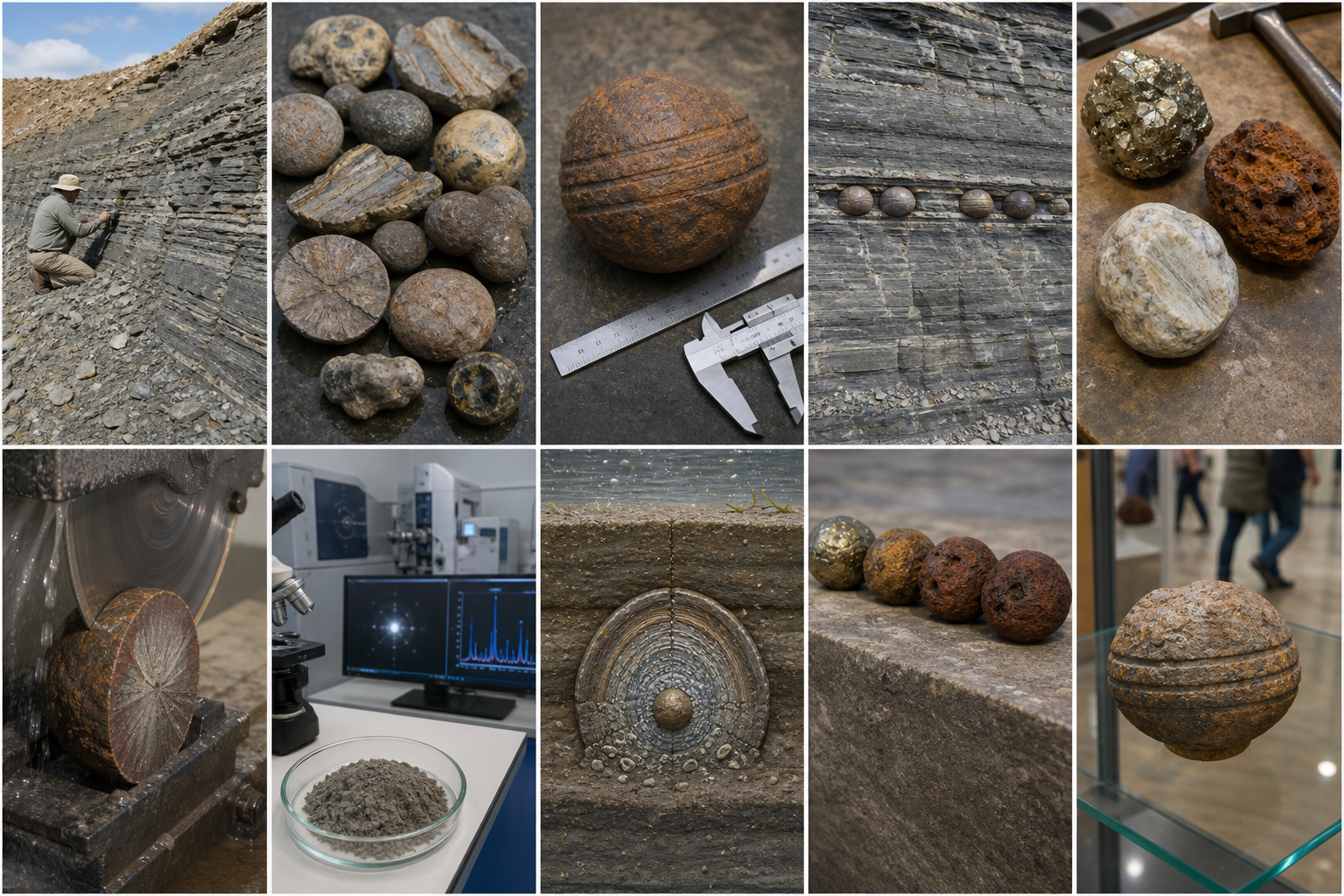
The quarry is the evidence scene. A specimen separated from its layer can be made mysterious; a specimen recorded inside its host rock retains its geological history.
I began at the mine, not the museum
The objects commonly called the Klerksdorp spheres are more precisely associated with pyrophyllite quarries near Ottosdal in South Africa's North West Province. Klerksdorp is the city whose museum helped make them famous, but the quarry context lies around Ottosdal. That geographic correction sounds small. It immediately separates where the objects formed from where a few examples were later displayed.
The host succession belongs to the ancient Dominion Group on the Kaapvaal Craton. Modern work at the University of Johannesburg describes the group as a Mesoarchaean volcano-sedimentary succession and studies extensive exposures of the Syferfontein Formation around Ottosdal. The rocks accumulated roughly 3.0 to 3.1 billion years ago and were later altered. Pyrophyllite-rich material quarried as “wonderstone” records that alteration.
Those dates apply to the geological succession and its transformation, not to a stamped manufacturing date on a loose ball. In this case the distinction does not rescue the artifact claim: examples have been observed within the ancient material, and early geological descriptions reported pyrite concretions in the deposits. But precise language matters. “Found in a three-billion-year-old formation” is evidence. “A three-billion-year-old manufactured sphere” has already assumed the conclusion.
A realistic sample is a family of imperfect forms. Flattened disks and fused nodules are not exceptions to hide; they reveal the growth process.
First audit: are they perfect spheres?
Popular accounts repeatedly describe “perfectly balanced metallic spheres.” Photographs are usually framed around the roundest example, often from one angle. A sphere seen in a two-dimensional image is difficult to measure, and three conspicuous grooves make its apparent symmetry feel engineered. The claim becomes stronger as the sample becomes smaller.
Paul V. Heinrich examined five Ottosdal objects obtained from collectors familiar with the Wonderstone mines. His report documents spheres, flattened spheres, disks, and clusters in which two to four bodies grew together like mineral bubbles. The studied pieces were not precision bearings. Their observed shapes lie within the range of concretions found in sedimentary settings around the world.
This is not an appeal to ugliness. Nature can produce forms more regular than these. Crystals develop planar faces and repeated angles because atomic structures constrain growth. Surface tension makes droplets round. Mineral precipitation around a central zone can expand outward in several directions and create a sphere or an oblate body. Symmetry is a property that needs a mechanism, not automatic proof of intention.
Observation: the population includes markedly non-spherical and intergrown forms.
Result: selective photographs exaggerated regularity. A natural-growth model predicts the full range better than a factory model does.
The famous three-groove form is visually powerful, but calipers would first reveal whether the body is truly spherical and whether each groove has constant depth and spacing.
The grooves are not cuts floating outside the rock
Three parallel bands are the feature most often offered as a maker's signature. The word “groove” encourages us to imagine a rotating tool. A geological description begins more cautiously: shallow circumferential depressions occur on some specimens, not all, and the bodies grew within laminated material.
Bruce Cairncross explained that such grooves can reflect sediment laminae. When a concretion grows outward through layers that differ slightly in grain size, permeability, or chemistry, its growth rate can slow where it meets a finer lamina. The result is a narrow depression around the part of the body intersecting that layer. Several closely spaced laminae can produce several parallel bands.
The crucial prediction is contextual. If a lathe cut the grooves after a ball was made, there is no reason for the grooves to align with layering in the host. If laminae controlled growth, the bands should correspond to planes in the surrounding rock, and multiple concretions in the same narrow horizon may share their orientation. A quarry photograph reported in the geological discussion shows cavities and objects concentrated in a narrow layer rather than distributed like lost manufactured goods.
Even after extraction, the hypothesis can be tested. Micro-CT imaging could map whether internal fabrics change at each external band. Petrographic sections through a groove could show host laminae meeting the concretion, a pause in crystal growth, later mineral fill, or a genuine abrasion surface. Tool manufacture predicts repeated cut geometry and microscopic striations. Layer-controlled growth predicts mineral continuity and sedimentary correspondence.
The strongest evidence is spatial: several bodies occupying one laminated horizon. The surrounding layer is part of the object’s biography.
Second audit: what does “metallic” mean?
“Metallic sphere” sounds like an alloy. In mineralogy, however, metallic describes luster—the way a surface reflects light. Pyrite has a metallic luster, but a pyrite crystal is not a machined steel component. Hematite may appear dark, reddish, earthy, or metallic depending on form. Goethite can create rusty brown surfaces. A visual adjective cannot substitute for composition.
The examined Ottosdal objects do not share one exotic material. Heinrich reports X-ray diffraction and petrographic results identifying hematite and wollastonite in selected specimens, while earlier geological observations identified pyrite concretions in the pyrophyllite. The variation is informative because the mine has a history of metamorphism, silica-rich fluids, and near-surface weathering.
Fresh pyrite concretions can persist below the most oxidized zone. Near the surface, oxygen-bearing water alters iron sulfide. Pyrite may be replaced by goethite, hematite, and material broadly called limonite while the body's external shape is retained—a pseudomorph. The change can also produce a porous, friable interior. A pale wollastonite nodule has a different route: carbonate material interacting with silica-rich fluids during metamorphism can form wollastonite.
| Observed material | Geological route | Why it may look unusual |
|---|---|---|
| Pyrite | Iron sulfide precipitates as a concretion within sediment before later alteration. | Brassy metallic luster encourages comparisons with manufactured metal. |
| Goethite / hematite | Oxidation replaces an earlier iron-rich body while preserving much of its form. | Rusty shell, dark surface, and porous interior can be mistaken for a corroded casing. |
| Wollastonite | Carbonate concretion reacts with silica-rich fluids during metamorphism. | Pale fibrous mineral differs sharply from the darker iron-rich examples. |
Pyrite, oxidized iron minerals, and wollastonite do not point to one engineered alloy. They record different mineral reactions within the same altered succession.
I opened the sphere
A machine part has an architecture. Its interior might contain uniform cast metal, a void, an axle, a separate shell, a weld, or a machined bore. A concretion has a growth fabric. Cut specimens from Ottosdal show radial or fibrous internal patterns, boundaries between intergrown bodies, and textures consistent with mineral replacement.
The distinction is more powerful than a polished exterior. A radial structure means crystals or replacement fronts were organized around a center and extended outward. Two fused spheres preserve interference where adjacent growth fields met. Those are not decorative features added to an object. They are a history frozen through its volume.
To make the test harder, I asked what an advocate of manufacture should be able to predict before a specimen is cut. If the grooves came from a tool, cut faces ought to expose a homogeneous manufactured substrate beneath them or repeated depth independent of mineral fabrics. If the object is a concretion, cut faces should reveal radial organization, mineral replacement, porosity related to oxidation, and continuity between the external bands and the growth environment. Published sections support the second set.
A cut face is harder to mythologize. Radial internal fabric and intergrowth expose a mineral body that developed outward, not a hollow mechanism assembled from parts.
The laboratory trail
A persuasive artifact case would publish measurements: three-dimensional roundness, alloy chemistry, microstructure, machining marks, and provenance for every tested sample. Instead, the most repeated extraordinary claims arrive through unnamed technicians, retellings, or statements detached from reports. The geological work is less theatrical but more inspectable.
X-ray diffraction identifies crystalline phases from their characteristic diffraction patterns. Petrographic microscopy reveals mineral textures and relationships in thin section. These methods do not merely pronounce an object “natural.” They show what it is made of and how its minerals are arranged. Heinrich's selected specimens were cut, photographed, examined petrographically, and sampled for X-ray diffraction; host pyrophyllite was also analyzed.
A stronger modern survey would go further. Portable X-ray fluorescence could screen many museum and collector specimens without cutting them. Raman spectroscopy could distinguish iron oxides and sulfides on small areas. Micro-CT could render internal structures in three dimensions. Scanning electron microscopy could search groove surfaces for tool striations while energy-dispersive spectroscopy mapped elements. Stable-isotope analyses on suitable carbonate relics might constrain fluid sources.
Most important, every result should remain tied to a specimen number and collection location. A scientifically impressive spectrum from a souvenir of uncertain origin does not establish what occurs in the Ottosdal layer. Chain of custody is not bureaucracy added to the mystery; it is what prevents an ordinary mineral nodule, a replica, and an actual in-situ specimen from becoming one imaginary category.
Diffraction and microscopy identify mineral phases and growth textures. A result becomes meaningful only when it remains linked to a documented specimen.
How a concretion can acquire an equator
The word concretion describes a localized mineral mass that grows within sediment or sedimentary rock when dissolved material precipitates and cements grains. Growth may begin around an organic fragment, a mineral grain, or a small chemical zone. It need not have one visible nucleus. If transport and chemical conditions are similar in all directions, the cementation front can expand approximately spherically.
The host sediment is not uniform. Thin layers differ in particle size, pore space, organic content, and fluid flow. Where outward growth crosses a restrictive lamina, the reaction front may advance more slowly. Above and below it, growth proceeds faster. That differential produces a waist. Repeat the change in adjacent laminae and the body acquires parallel depressions.
Burial, hydrothermal alteration, and metamorphism then modify both host and concretion. Minerals recrystallize. Silica-rich fluids participate in new reactions. Later uplift and weathering bring the rock near the surface. Softer pyrophyllite is quarried or erodes away, while the more resistant nodule emerges with its shape emphasized. Oxidation changes pyrite to iron oxides and hydroxides, sometimes leaving a brittle, rusty body that resembles a corroded artifact.
This sequence is not a story invented to match a single sphere. The Geological Society of South Africa's discussion places pyrite and goethite concretions within the Dominion Group pyrophyllite deposit, and broader geological literature documents concretions ranging from spherical to oblate, discoidal, lumpy, and intergrown. The form follows chemical growth interacting with layers.
Formation model: precipitation expands around a center, while a finer or less permeable lamina slows the front and leaves a circumferential depression.
Third audit: the NASA and zero-gravity story
One persistent claim says a specimen was so precisely balanced that NASA—or a NASA-connected institution—concluded it could only have formed in zero gravity. This sounds testable, so I looked for the report: laboratory name, specimen identifier, measurement protocol, tolerance, author, date, and publication. The chain dissolves.
Heinrich traced versions of the statement to correspondence involving the California Space Institute and a second-hand report. The institute was described inaccurately as making gyroscopes for NASA. The quoted assessment was characterized as a misunderstanding in transmission. No technical report demonstrating perfect balance or zero-gravity manufacture accompanies the claim.
Even the physics is backwards as a shortcut. A sphere does not require zero gravity. Natural droplets, concretions, spherulites, accretionary lapilli, and crystals acquire regular forms under terrestrial conditions through forces and growth laws operating at their scale. If someone proposed a microgravity origin, mineral textures and geological emplacement would still need to explain how the object entered a narrow ancient layer with related concretions.
Fresh pyrite can oxidize through goethite to hematite-rich material while preserving the original body. A changed mineral is not evidence of a metal casing.
Did one sphere rotate by itself?
A museum anecdote describes a displayed sphere slowly changing orientation in a glass case. In retelling, movement becomes internal power or an unexplained energy source. But the observation lacks isolation from ordinary mechanical inputs. Display cases are not inertial laboratories.
The object was not a precision sphere on a frictionless plane. A slightly uneven nodule resting on glass can creep when the case is not perfectly level. Footsteps, traffic, doors, cleaning, and daily vibration supply repeated small impulses. Temperature changes can also alter contact and support. Other objects in a case reportedly moved as well, which points away from a unique mechanism inside one specimen and toward the shared environment.
The experiment is simple. Level the shelf with a calibrated instrument, place fiducial marks around the specimen without touching it, record continuous time-lapse video, and mount accelerometers on the case and floor. Repeat on vibration isolation and reverse the shelf's slight tilt. If motion follows vibration and slope, the mystery is mechanical. If it persists under isolation, then inspect the object for magnetic response or shifting internal mass. No extraordinary inference is needed before those controls.
A display case transmits footsteps and building vibration. A slow change in orientation becomes evidence only after slope and motion are measured.
Evidence ledger
| Observation | Supports natural concretion | Supports manufactured artifact |
|---|---|---|
| Objects occur in a narrow geological horizon | Strongly: mineral growth was tied to a sedimentary layer. | Weakly: would require many objects to be emplaced without disturbing the ancient rock. |
| Population includes disks, irregular forms, and fused clusters | Strongly: variable growth and competing centers predict these forms. | Poorly: no function or production sequence explains the full population. |
| Radial internal fabric | Strongly: records outward mineral growth or replacement. | Poorly: no assembled components or manufacturing microstructure. |
| Pyrite, hematite/goethite, and wollastonite | Strongly: fits diagenesis, metamorphism, and weathering. | Poorly: not a consistent engineered alloy. |
| Parallel circumferential grooves on some examples | Moderately to strongly: lamina-controlled growth is testable in context. | Visually suggestive, but no documented tool marks or standardized geometry. |
| NASA / perfect-balance story | Neutral as physical evidence; the report is untraceable. | Unsupported without a laboratory record and identified specimen. |
My verdict
The conclusion does not make the objects ordinary. They preserve chemical reactions in some of Earth's oldest surviving crust. Pyrite formed or replaced material in ancient sediment; later heat and fluids transformed the host; weathering converted some iron sulfide to oxides while retaining shape. A small nodule therefore records several chapters of deep time in one hand-sized object.
The real mystery was created by subtraction. Remove the quarry layer, the irregular specimens, the cut faces, and the mineral analyses. Keep one round example in a glass case. Add “three billion years” and “NASA.” The remaining image feels impossible because the evidence that explains it has been cropped away.
Putting the context back does more than debunk a rumor. It reveals why geology is capable of producing forms that resemble design. Repeated natural rules act for long periods inside structured material. The result can have symmetry, bands, and polish without a maker. The sphere is not a machine from before humanity. It is a mineral reaction that learned the shape of its layer.
Sources and technical reading
- Paul V. Heinrich, “The Mysterious ‘Spheres’ of Ottosdal, South Africa” — specimen shapes, cut interiors, X-ray diffraction, mineralogy, grooves, and the history of fringe claims.
- Geological Society of South Africa, Geobulletin: Bruce Cairncross on pyrophyllite, wonderstone, and the “Cosmic Cannonballs” — deposit setting and concretion mineralogy.
- Dóra Edit Paprika, University of Johannesburg doctoral research on the Dominion Group at Ottosdal — modern volcano-sedimentary and alteration context.
- University of Johannesburg: new details on the Syferfontein Formation — updated regional stratigraphy and tectonic history.
- Yoshida and coauthors, review of concretion formation and preservation — broader mechanisms and weathering resistance of concretions.
- New Mexico Bureau of Geology and Mineral Resources: “What is a Concretion?” — authoritative overview of shapes, sizes, nuclei, and mineral precipitation.
- U.S. Geological Survey: mineralized concretions in the Monterey Formation — comparative evidence for spherical-to-lenticular bodies, layered interiors, and relationship to sediment lamination.
- L. T. Nel, H. Jacobs, J. T. Allen, and G. R. Bozzoli, Wonderstone, Geological Survey of South Africa Bulletin 8 (1937) — early description of the Ottosdal pyrophyllite deposits and pyrite concretions, cited through the later geological studies above.
Image note: all ten visuals are original editorial reconstructions made for this article. They illustrate the evidence and proposed processes; they are not photographs of specific museum specimens.