The first mistake is calling it rustless. The Iron Pillar of Delhi has a dark weathered skin, patches of corrosion, and a buried portion that has suffered far more than the shaft above ground. It is not stainless steel and it is not untouched by oxygen. Its achievement is subtler: more than fifteen centuries of atmospheric exposure have produced an unusually stable, slow-growing protective layer instead of the destructive rust expected on a massive ancient iron object.
I followed the pillar as a material biography. Its inscription records an act of devotion and royal memory. Its weld lines record teams of smiths. Its slag particles remember bloomery furnaces. Its microscopic surface records rain, drying, phosphorus, and time. No single ingredient solves the case. The answer exists in the sequence.
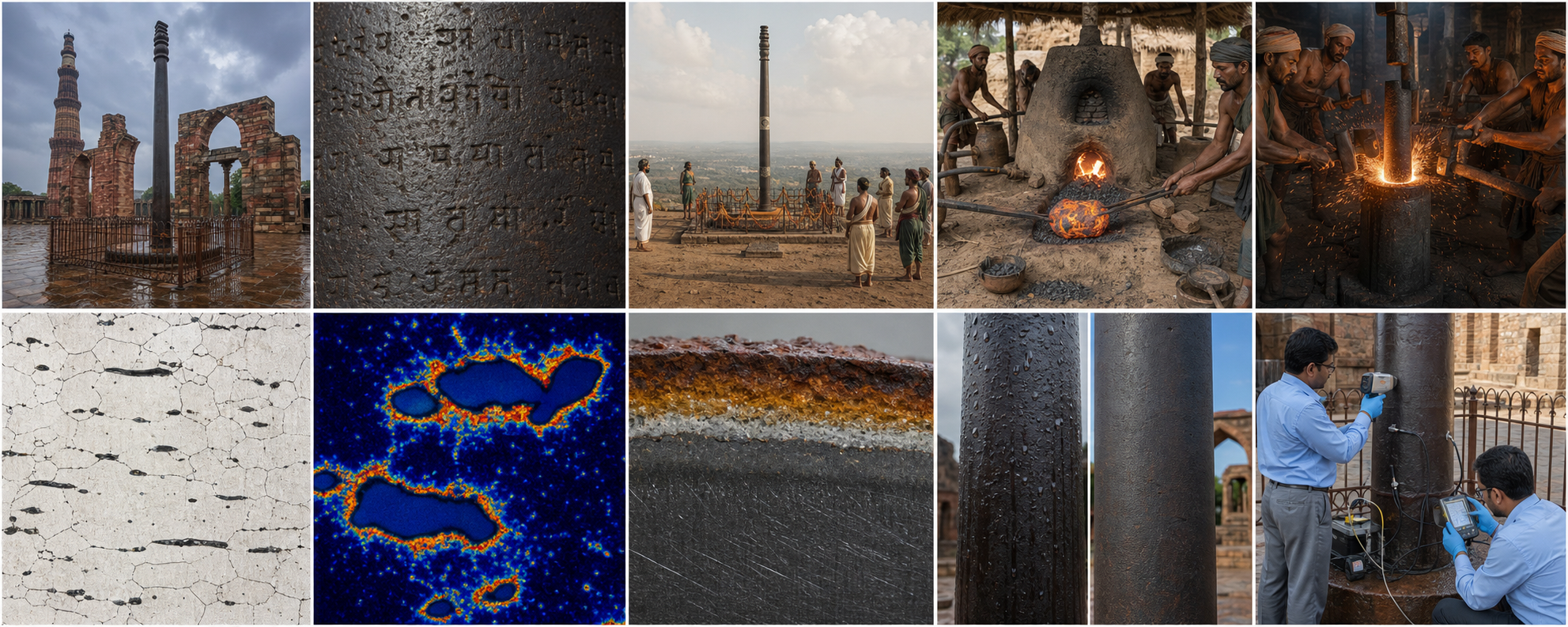
The pillar in the Qutb complex after rain. Its surface is a protective patina, not the flawless shine of modern stainless steel.
The monument now standing in the wrong chapter
Today the pillar rises in the courtyard of the Quwwat-ul-Islam mosque within Delhi's Qutb complex, a UNESCO World Heritage property managed by the Archaeological Survey of India. It stands among monuments associated with the early Delhi Sultanate, yet the iron shaft is several centuries older than those surroundings.
The monument is approximately 7.2 metres long and weighs more than six tonnes. Part of that length is below the pavement. The shaft tapers upward and ends in a capital that once supported another element. Its size encourages the modern visitor to imagine a single pour of molten iron. That image belongs to a later foundry world. The pillar is wrought iron assembled by solid-state forging and welding.
The location also encourages a second false assumption: that the pillar was designed for this courtyard. Its oldest inscription describes a royal devotee and a standard of Vishnu erected at a place called Vishnupadagiri. Researchers have proposed that this sacred hill was Udayagiri in central India, closely connected with Gupta-period royal and Vaishnava activity. The identification is persuasive to some specialists but remains a historical reconstruction, not a surviving transport invoice.
Raking light reveals the inscription as part of the metal surface. Epigraphy dates the monument independently of corrosion science.
The inscription gives the metal a purpose
The Sanskrit verses in Gupta Brahmi praise a king named Chandra, celebrate military victories, associate him with devotion to Vishnu, and refer to the erection of a Vishnu standard on Vishnupada. The ruler is widely taken to be Chandragupta II, who reigned around the late fourth and early fifth centuries CE. The paleography and political description place the monument in that broad Gupta-period setting.
This matters because corrosion resistance must be measured against a credible exposure history. The pillar did not simply appear in Delhi sixteen centuries ago and remain in one microclimate. If it originally stood elsewhere and was later transported, the surface experienced more than one environment. Udayagiri, if correct, would add a central Indian phase before the Delhi phase.
The inscription also explains why so much labor could be invested in an impractical mass of iron. This was not an oversized structural column ordered because timber had failed. A monumental standard joined metallurgy to royal authority and religious dedication. The technical feat was part of the message.
Historical reconstruction of the pillar as a Vishnu standard on a sacred hill. The precise original setting is debated and the image is not presented as a recovered scene.
From ore to bloom: iron before the pillar
Ancient Indian furnaces did not need to melt six tonnes of iron in one vessel. Bloomery reduction operated below iron's melting point. Charcoal created heat and a reducing atmosphere that removed oxygen from ore. The product was a spongy bloom containing metallic iron, slag, charcoal, and unreduced material.
Smiths consolidated that bloom while hot. Repeated hammering expelled some liquid slag, closed voids, and welded iron particles together. The resulting wrought iron was not chemically uniform. Elongated slag inclusions remained inside the metal, and the composition reflected ore, furnace operation, charcoal, and refining practice.
Phosphorus is central to the later surface chemistry. Analyses have reported the pillar's iron at roughly a quarter percent phosphorus on average, with low sulphur and manganese compared with many modern irons. Ancient ironmaking practice could retain phosphorus because it did not use the lime-rich fluxing routes that remove it in many later processes. The smiths did not need to understand phosphate electrochemistry to produce a phosphorus-rich iron.
A bloomery yields a hot, spongy mass rather than a stream of cast iron. Consolidation begins with slag-rich material that must be repeatedly worked.
The construction mystery is larger than the corrosion mystery
To make a shaft of this mass, smiths joined many consolidated pieces. Heated iron was brought to a plastic condition, surfaces were prepared, and hammer blows forced them into contact until solid-state bonds formed. New material was added in stages. The process is forge welding, not casting.
The logistics are easy to underestimate. Temperature falls rapidly when a large workpiece leaves the fire. Too cold and a weld fails; too hot and iron burns. Crews had to coordinate furnace tending, handling, positioning, and hammering. As the shaft grew, its thermal mass made reheating and manipulation harder. A single bad interface could become a structural weakness.
Surface evidence, macrostructure, and metallographic study support repeated forge welding of iron blooms. Some researchers describe horizontal stages or lumps added progressively. Exact workshop choreography cannot be recovered, but the manufacturing family is clear. The pillar is a built object whose internal heterogeneity later participated in its corrosion behavior.
Forge welding demanded coordinated teams and repeated heating. The shaft was accumulated as solid iron, not poured from one impossible crucible.
The slag inclusions are not defects erased from the story
Under a metallographic microscope, wrought iron reveals ferrite grains, elongated slag particles, and boundaries created by working. A modern engineer may first see impurities. For the pillar, those features are both manufacturing evidence and chemical actors.
Slag inclusions create local electrochemical differences. Early atmospheric attack can be more active near these particles. That sounds harmful, and initially it can be. Yet corrosion liberates and redistributes phosphorus toward the metal-scale interface. The same heterogeneous structure that promotes local reaction helps concentrate an element needed for the protective film.
This is why “pure iron does not rust” is an inadequate explanation. The pillar is relatively high-purity iron in the sense of low alloying additions, but it contains slag and significant phosphorus. Pure iron still corrodes. The decisive question is what corrosion products form, how porous they are, how strongly they adhere, and whether they slow further transport of water and oxygen.
Metallographic reconstruction: pale ferrite crossed by elongated slag inclusions and weld-related structure. Ancient processing remains visible at the microscopic scale.
Phosphorus changes the direction of rust
Ordinary red rust can be porous and poorly adherent. Water and oxygen pass through it, fresh metal continues to react, and flakes detach. A protective patina behaves differently. It becomes compact enough to reduce the supply of reactants and adheres well enough to remain in place.
R. Balasubramaniam's detailed characterization identified a mixture of iron oxyhydroxides, magnetite, and iron hydrogen phosphate hydrate in the Delhi pillar scale. His model begins with relatively rapid early corrosion around slag-bearing iron. Phosphorus becomes enriched at the interface. In that environment, a compact amorphous layer containing δ-FeOOH is favored near the metal.
Over repeated wetting and drying, phosphate phases develop and crystallize. A thin iron hydrogen phosphate hydrate layer forms close to the metal-oxide interface. Its low porosity and compactness reduce the rate at which corrosive species reach fresh iron. As the barrier matures, the corrosion rate falls.
The chemical name is less important than the feedback: some corrosion must occur to build the products that suppress later corrosion. The pillar protects itself by rusting in a particular way.
Materials-analysis reconstruction: phosphorus becomes concentrated around slag-bearing reaction zones and at the growing metal-scale interface.
The protective film is a layered archive
The pillar's scale is not one uniform coat. Closest to the metal lies the most consequential compact region. Above it are mixed amorphous and crystalline oxides and oxyhydroxides exposed to the atmosphere. Dust, salts, handling, pollution, and biological material may affect the outermost surface.
The 2000 Corrosion Science study reported crystalline iron hydrogen phosphate hydrate, α-, γ-, and δ-FeOOH, and magnetite among the scale constituents, with amorphous iron oxide and oxyhydroxide components. Later microprobe work examined phosphorus distribution and the interface more closely. Different techniques emphasize different phases, so the film should not be reduced to one popular word such as “misawite.”
Nor is the layer an applied varnish whose recipe was lost. It is an emergent product of metal composition, inclusions, atmospheric water, oxygen, time, and exposure cycles. Ancient smiths intentionally made and joined the iron; the atmosphere completed the protective system.
Conceptual cross-section of the dark patina: iron substrate below, a compact inner barrier, phosphate-rich material, and weathered outer corrosion products.
Delhi's climate is an accomplice, not the sole inventor
Environmental explanations preceded detailed surface chemistry. Delhi's periods of dryness limit the time during which an electrolyte film remains on the metal. Large mass and thermal behavior can reduce condensation patterns. Historically lower pollution meant fewer aggressive sulphur compounds than in an industrial atmosphere. These factors matter.
Yet “dry climate” alone cannot explain the material selectivity. Ordinary iron exposed nearby does not automatically acquire the same stable film. The pillar also experiences monsoon rain. The more complete model makes environment and composition cooperate. Wet periods allow electrochemical reactions and ion movement. Dry periods promote transformation and crystallization of corrosion products while interrupting continuous attack.
The alternating cycle is therefore productive. Continuous immersion would create different chemistry; constant extreme aridity would slow both corrosion and formation of a mature protective scale. The pillar's exposure provided enough water to build a barrier and enough drying to stabilize it.
Monsoon wetting supplies the electrolyte; drying interrupts attack and assists transformation of the protective products. The cycle is part of the mechanism.
Why “it has never rusted” fails the physical evidence
The shaft carries corrosion products—that is the protective film. Earlier examination found the below-ground section covered by thicker rust and affected by deep pitting. Soil retains moisture and salts differently from open air, and oxygen gradients create new cells. A mechanism successful above ground need not work below it.
Surface damage and localized corrosion also exist. Visitors once followed a tradition of embracing the pillar, transferring sweat and oils; a barrier now limits direct contact. Atmospheric pollution has changed since the preindustrial centuries. Conservation therefore cannot rely on the monument's reputation for invulnerability.
Calling the pillar rustless erases the process that makes it scientifically valuable. It survived not because corrosion was absent, but because corrosion produced a tenacious barrier faster than destructive attack could consume the metal.
| Popular explanation | What it misses | Evidence-weighted view |
|---|---|---|
| “It is perfectly pure iron.” | Pure iron can corrode; the pillar contains phosphorus and slag inclusions. | Composition and heterogeneity drive formation of a protective interfacial scale. |
| “Delhi is too dry for rust.” | Delhi has monsoon wetting, and the pillar visibly has corrosion products. | Alternating wet/dry cycles help create and stabilize the barrier while limiting continuous attack. |
| “Ancient Indians invented stainless steel.” | Stainless steels rely mainly on chromium-rich passive films; the pillar has no equivalent chromium alloy system. | This is phosphorus-rich wrought iron protected by iron oxyhydroxide and phosphate-rich corrosion products. |
| “The pillar was cast in one piece.” | Bloomery furnaces produced solid blooms, not a six-tonne liquid pour. | Multiple iron masses were consolidated and forge-welded into a shaft. |
| “It has never rusted anywhere.” | The patina is rust chemistry, and buried portions suffered heavier corrosion and pitting. | Above-ground atmospheric corrosion became exceptionally slow after a protective layer developed. |
How I would monitor the next century
Conservation should measure change without turning the monument into a laboratory coupon. High-resolution 3D photogrammetry can track pits and surface loss. Portable X-ray fluorescence can map elemental variation, although surface readings must be interpreted carefully. Raman spectroscopy and X-ray diffraction can monitor corrosion phases at selected points. Electrochemical impedance measurements can estimate barrier performance with minimal intervention.
Environmental sensors should record surface temperature, relative humidity, time of wetness, particulate pollution, chlorides, sulphur compounds, and rainfall. The data should be aligned with repeat measurements of the same marked surface zones. A century-scale monument deserves a monitoring system that distinguishes a temporary wet-season change from a long-term acceleration.
Digital mapping could also test the manufacturing model. Weld bands, slag-rich regions, inscriptions, damage, and corrosion hot spots can be layered on the same 3D geometry. If localized corrosion correlates with inclusions, water paths, or past handling, conservation decisions become more precise.
Non-destructive monitoring can connect alloy chemistry, patina condition, and changing Delhi exposure without removing significant material.
My verdict: an ancient process, not an impossible alloy
The explanation does not reduce the accomplishment. It relocates the wonder from a secret formula to a chain of expertise. Ancient miners selected and reduced ore. Furnace workers controlled charcoal and air. Smiths consolidated blooms, judged welding heat by color, coordinated hammers, and built a shaft heavier than many teams could move. Inscribers and patrons transformed it into a political and religious monument. Later environments transformed its surface.
No one stage had to predict the final corrosion paper. The smiths' process generated a composition and microstructure that, under the right exposure, favored protection. Modern materials science names the phases; it does not retroactively create the achievement.
The pillar survives because history and chemistry remained attached. The inscription tells us why people raised it. Welds tell us how. Rust tells us why it remains. The mystery is not that iron escaped nature, but that human manufacture and atmospheric reaction found an unusually durable agreement.
Sources and technical reading
- UNESCO World Heritage Centre: Qutb Minar and its Monuments — present heritage setting, integrity, and management.
- R. Balasubramaniam, “On the corrosion resistance of the Delhi iron pillar,” Corrosion Science 42 (2000) — detailed scale characterization and passive-film model.
- Author-hosted full paper on the pillar's corrosion resistance — rust phases, slag role, phosphorus, and wet/dry mechanism.
- Indian National Science Academy: “Influence of Manufacturing Methodology on the Corrosion Resistance of the Delhi Iron Pillar” — forging method and surface preparation.
- National Metallurgical Laboratory repository: T. R. Anantharaman, “The Iron Pillar at Delhi” — dating, fabrication, mass, and historical metallurgical assessment.
- National Metallurgical Laboratory repository: “The Delhi Iron Pillar and its iron” — forge welding, chemical composition, and early explanations.
- R. Balasubramaniam, Delhi Iron Pillar: New Insights — inscription, Chandra, proposed Vishnupadagiri location, metallurgy, and corrosion.
- M. K. Ghosh, “The ‘rustless’ iron pillar at Delhi,” Corrosion Science 10 (1970) — composition, above- and below-ground contrast, climate, and oxide-film evidence.
- Smithsonian Museum Conservation Institute bibliography record — preservation-science reference to passive-film growth and phosphorus.
Image note: the ten illustrations are original editorial reconstructions made for this article. The ancient workshop and original sacred-hill scenes are interpretive; the microscopy and film cross-sections visualize published mechanisms rather than reproduce particular figures.