On the summit, the wall looks burned. In the hand, it looks geological. Angular fragments of local stone are locked inside a dark, bubbled glass. Quartz grains survive beside material that once flowed. Timber has vanished except where char remains in slots. The evidence is not a castle struck by an unknown weapon; it is a stone-and-wood rampart exposed to a sustained fire hot enough to make some minerals melt.
I worked backward from that glass. First: what exactly melted? Second: how could an open-air wall hold about 1,140°C in its core? Only then did I ask the question that made Scotland's vitrified forts famous—whether the fire built the wall, destroyed it in war, or closed it deliberately after its inhabitants had left.
A hillfort is an enclosed summit, not a medieval stone castle. Its rampart combined earth, local rubble, and a large internal timber structure.
The phenomenon is a population, not a single impossible ruin
Scotland contains at least sixty confirmed vitrified hillforts according to recent University of Stirling research, with additional debated sites and related examples elsewhere in Europe. Vitrification occurs across different periods from the Iron Age into the early medieval era. It is not a unique technology belonging to one lost people and it is not a chronological marker by itself.
The name can mislead. A “vitrified fort” has not become a seamless glass ring. Vitrification ranges from thin fused skins and isolated clinkers to substantial masses where rubble is welded by silicate melt. Some stones crack or redden without melting. Others soften along grain boundaries. A few minerals survive inside glass that formed from lower-melting components.
This variability is evidence. If one exotic heat source swept uniformly across a site, a more uniform thermal signature might be expected. Patchy vitrification instead reflects differences in fuel, airflow, timber distribution, wall collapse, exposure time, and the mineral composition of each stone.
Partial vitrification at close range: unmelted rock fragments remain inside a vesicular silicate glass. The wall did not need to become wholly liquid.
I separated sintering, welding, and melting
Three physical changes are often compressed into the word “melted.” Sintering joins grains without complete melting as hot surfaces diffuse and bond. Welding occurs when partial melt fills contacts and solidifies between stones. Vitrification produces a glassy phase when silicate melt cools too quickly, or with the wrong chemistry, to crystallize fully.
A rock is a mixture of minerals, so it does not behave like pure ice with one clean melting point. Quartz, feldspar, mica, amphibole, and clay-derived minerals respond at different temperatures. The first melt appears at the solidus; complete liquid would require reaching the higher liquidus. Between them, crystals and melt coexist.
Amanda-Jane Dolan's experimental and petrological work calculated a minimum melting temperature of approximately 1,140°C for rubble at Dun Deardail, with similar values at Craig Phadrig, the Torr, and Knockfarrel. The observed textures fit partial melting. The temperature is extreme for a domestic hearth but achievable within a well-fueled, insulated structure.
The rampart acted as a composite structure: masonry faces held a rubble core crossed by horizontal and transverse timber beams.
The timber lacing was a heat-delivery system before anyone meant it to be
Excavation at Dun Deardail found slots for substantial horizontal timbers, in places preserving charred wood. Timber lacing tied the stonework together during the wall's useful life. During a conflagration, the same network carried fire into the rampart.
An ordinary bonfire against the outside of a bare stone wall loses heat to the air. The outer face radiates rapidly, wind changes the flame, and surface stones can spall while the core stays cooler. A timber-laced wall behaves differently. Burning beams penetrate the rubble. Their channels draw or redirect hot gases. Stone and collapsed debris insulate the interior. As the faces fail inward, fuel and hot rubble become contained.
Dolan's research found that timber lacing allowed heat to move from the outer burning zones into the core. The core could remain above the rock's solidus even after the exterior had cooled below it. This solves the spatial puzzle: the hottest region need not be the visually brightest exterior flame.
Sustained vitrification requires more than ignition. Fuel must remain in contact with the wall and the burn must be maintained while the rampart begins to collapse.
The fire needed time, fuel, and control
Early experiments repeatedly demonstrated the difficulty. Wallace Thorneycroft and V. Gordon Childe obtained limited vitrification in the 1930s. A later television experiment led by Ian Ralston produced only small vitrified samples. In 2001, Roddy Mainland built and fired another timber-laced section. None reproduced the scale seen at the strongest archaeological examples.
Failure at small scale does not show that ancient vitrification was impossible. It reveals the boundary conditions. A short experimental wall leaks heat from its ends. Modern safety limits may shorten the burn. Wet fuel and Highland weather suppress temperature. A full rampart contains vastly more timber, rubble, and thermal mass. Collapse can seal the hottest material beneath debris.
Petrological work from multiple forts nevertheless warns against an easy answer. A 1978 study concluded that simply burning an ordinary timber-laced wall could not explain sustained reducing conditions and temperatures that may have lasted days at some sites. Fuel and combustible fill may have been packed within the structure. The fire was a process, not a spark.
Thermal reconstruction: timber channels bring heat inward while collapsed stone insulates the glowing core from a cooler exterior.
The thin section is the fire's thermometer
Archaeologists cannot place a probe in an Iron Age blaze, but melted rock preserves phase changes. In thin section, glass records former liquid. Rounded or corroded crystal edges show reaction with melt. Vesicles record trapped gas. Flow bands reveal movement before cooling. Newly crystallized minerals constrain temperature and cooling conditions.
Geochemical analysis tests whether glass came from the adjacent stones. If melt chemistry corresponds to local rubble, in-situ partial melting is supported. If it does not, investigators must consider imported low-melting material, clay, soil, slag, or contamination. Studies generally find no need for a mysterious flux selected from elsewhere, although soil and organic debris may have joined the mixture.
Charcoal provides a second thermometer and a clock. Species identification can reconstruct fuel choice. Radiocarbon dates anchor the destruction event, provided samples are securely associated and the old-wood effect is considered. Archaeomagnetic and thermoluminescence approaches have also been attempted, but dating vitrification has produced uncertainties and contradictions at some sites.
Petrographic reconstruction: surviving crystals, dark glass, bubbles, and flow textures preserve a thermal sequence that the naked eye cannot resolve.
The hill beneath the fort chose how much glass could form
Builders mainly used stone available close to each hillfort. Dolan found material generally sourced within about one kilometre and only a few lithologies used at each site. That practical choice made local geology a controlling variable.
Granite, pelitic schist, basaltic rock, and sandstone have different solidus temperatures, melt viscosities, and glass-forming tendencies. A wall built from feldspar- and mica-bearing rock may generate melt under conditions that only crack a refractory sandstone wall. Two communities could build and burn similar structures yet leave very different archaeological signatures.
A 2017 materials study modeled a wide range of European fort compositions and concluded that local geology strongly controlled the feasibility and degree of vitrification. The result changes site comparison. Absence of glass is not proof of absence of fire, while dramatic glass is not proof of a uniquely hotter weapon.
Comparable timber-laced ramparts can direct heat similarly.
Fuel and duration may still vary across the wall and between events.
Mineralogy changes when melt begins, how it flows, and whether it cools as glass.
Laboratory firings reveal why local stones respond differently. Geology decides whether a shared thermal history leaves glass, cracks, or little visible change.
Did melting strengthen the wall?
The construction hypothesis has an intuitive appeal: fused rubble resembles mortar. Experiments and mechanical analyses show that vitrification can strengthen some samples, and calcium-rich glass at Scottish sites may resist erosion well. A wall with fused zones can survive as conspicuous conglomerated masses long after loose rubble spreads downslope.
But increased strength in a laboratory sample does not prove that Iron Age builders deliberately fired an intact defensive circuit. Heating also cracks stones, consumes the timber frame, distorts faces, and causes collapse. The wall may be stronger as a surviving lump yet useless as a vertical defense. Preservation strength and military strength are different measurements.
Stratigraphy carries more weight. Scotland's national archaeological framework notes a broad consensus that vitrified walls resulted from deliberate, premeditated destruction of timber-framed ramparts. No clear stratigraphic evidence demonstrates that vitrification was a construction stage followed by rebuilding and normal use. Widespread intense firing is also difficult to attribute to accident.
The strengthening experiments remain valuable. They explain why vitrified remains endure and why early investigators could imagine a construction technology. They do not, by themselves, establish the intentions of the people who lit the fire.
Experimental walls usually produce limited fusion. The gap between a small trial and an archaeological rampart exposes the importance of scale, insulation, and duration.
Three motives survive the physical test
| Hypothesis | Expected archaeological signature | Assessment |
|---|---|---|
| Accidental fire | Unplanned distribution, possessions trapped in destruction, variable ignition, no evidence of preparation. | Possible at an individual site, but sustained high temperature and repeated examples make it a weak general explanation. |
| Enemy destruction | Deliberate firing after capture, damaged entrances, weapons or trauma, abandoned goods, no subsequent repair. | Physically possible. Maintaining the burn would advertise domination, but material signs of combat are not universal. |
| Planned decommissioning or ritual closure | Goods removed beforehand, organized burning, final event at the end of use, limited evidence of hurried flight. | Fits Dun Deardail's scarcity of finds and controlled thermal requirements, but motive cannot be observed directly. |
| Constructional firing | Vitrified phase incorporated into a functioning rebuilt rampart, planned fuel arrangement, use after firing. | Can produce strong material, yet currently lacks convincing stratigraphic support as the normal explanation. |
Dun Deardail looks cleared before it burned
Three seasons of excavation recovered remarkably few portable objects. Absence can result from limited trench area, poor preservation, short occupation, or earlier disturbance, so it cannot prove an evacuation. Combined with the scale of the fire, however, it suggests the fort may have been cleared before its rampart was burned.
That sequence weakens a sudden domestic accident. It also complicates a surprise enemy attack, which might trap possessions. The remaining possibilities include an orderly abandonment, the deliberate destruction of a captured but already emptied stronghold, or a communal closing act performed by the occupants.
“Ritual” must not become a label for anything unexplained. A closure interpretation should predict spatial pattern: controlled access, selected deposits, treatment of entrances, feasting debris, or repeated practices at comparable sites. Dun Deardail offers a suggestive cleared-and-burned sequence, not a transcript of the ceremony.
Interpretive scene of planned closure: the fort is empty before the wall burns. Archaeology supports clearance as a possibility but cannot identify the watchers or their beliefs.
Why warfare is not an automatic answer
A conqueror could burn a captured rampart to prevent reuse, create a public spectacle, or mark victory. Yet vitrification appears to require labor after ignition. Fuel may need to be added along the circuit. Wall sections must burn long enough for the core to reach partial-melting temperatures. That is demolition work, not merely battle damage.
Evidence of deliberate destruction therefore does not tell us whose intention it was. The same thermal signature can be created by enemies decommissioning a fort and by inhabitants ceremonially ending it. Weapons, bodies, hurried hoards, smashed entrances, repair sequences, and regional political change must decide between those histories. Many sites do not preserve enough of that record.
Chronology also resists one grand event. Vitrified forts span different centuries. There was no single invasion that burned them all, no one secret corps of specialists, and no universal ritual demonstrable at every site. Vitrification is a repeated outcome produced within timber-laced architecture under different social circumstances.
The excavation that could narrow the verdict
A future project should sample a rampart continuously from outer face through core to inner face, not collect only spectacular glass. Every specimen needs three-dimensional provenience. Magnetic susceptibility, portable X-ray fluorescence, petrography, electron microscopy, and microprobe chemistry can map the thermal gradient.
Charred timbers should be identified by species and dated individually. Dendrochronology may work where ring sequences survive. Short-lived plant material avoids old-wood problems. Bayesian radiocarbon modeling can relate construction, occupation, repair, and destruction. Soil micromorphology can distinguish an intentionally prepared fuel bed from ordinary occupation sediment caught in collapse.
Mechanical tests should compare unburnt rubble assemblies, sintered contacts, and strongly vitrified masses. The question is not simply “is glass stronger?” but whether a real rampart remains stable after its timber has burned and its stones have expanded, fractured, and slumped.
A trench through the rampart can connect charred timber slots, glassy rubble, collapse direction, and datable material within one stratigraphic record.
My reconstruction and verdict
I reconstruct Dun Deardail's final fire as a managed destruction rather than an instantaneous catastrophe. The fort had been cleared of much of its portable material. Fuel already existed in the timber framework, but sustaining the necessary temperature likely required a long burn and perhaps added combustibles. As the beams burned, heat traveled inward. Faces fractured and fell. Rubble insulated the core, where local pelitic material began to melt near 1,140°C. The collapsing mass restricted oxygen, changed melt chemistry, and held heat. When it cooled, glass welded some stones while others remained only scorched or cracked.
The remaining mystery is social, not thermal. Archaeology can reproduce mineral phases and model heat flow. It can show that the wall was emptied and burned. It cannot easily hear the words spoken before the first beam caught fire.
That uncertainty is worth keeping. A scientific explanation of melting does not oblige us to invent a motive. The glass answers how the rampart died. The people who chose the fire remain just beyond the edge of the trench.
Sources and excavation records
- Forestry and Land Scotland: The Dun Deardail Project — excavation program, construction date, fire, and public research summary.
- The Archaeology of Dun Deardail — full project booklet, experimental history, trenches, rampart evidence, and interpretations.
- Amanda-Jane Dolan, Processes of Vitrification in Scottish Iron Age Hillforts, University of Stirling PhD — nine-fort geology, approximately 1,140°C minimum at Dun Deardail, timber-lacing heat transfer, and closure hypothesis.
- Scottish Archaeological Research Framework: vitrified walls — national synthesis and consensus on deliberate destruction.
- Highland Archaeological Research Framework: Dun Deardail case study — dates, excavation results, timber slots, and unresolved questions.
- “Local geology controlled the feasibility of vitrifying Iron Age buildings” — open-access materials study of composition, melting, and site variability.
- “Friendly fire: Engineering a fort wall in the Iron Age,” Journal of Archaeological Science — experimental evidence on strength after vitrification.
- Youngblood and coauthors, “Celtic vitrified forts,” Journal of Archaeological Science 5 (1978) — geochemical and petrological evidence for sustained high-temperature partial melting.
- Highland Historic Environment Record: Dun Deardail — protected status, dimensions, survey, and excavation record.
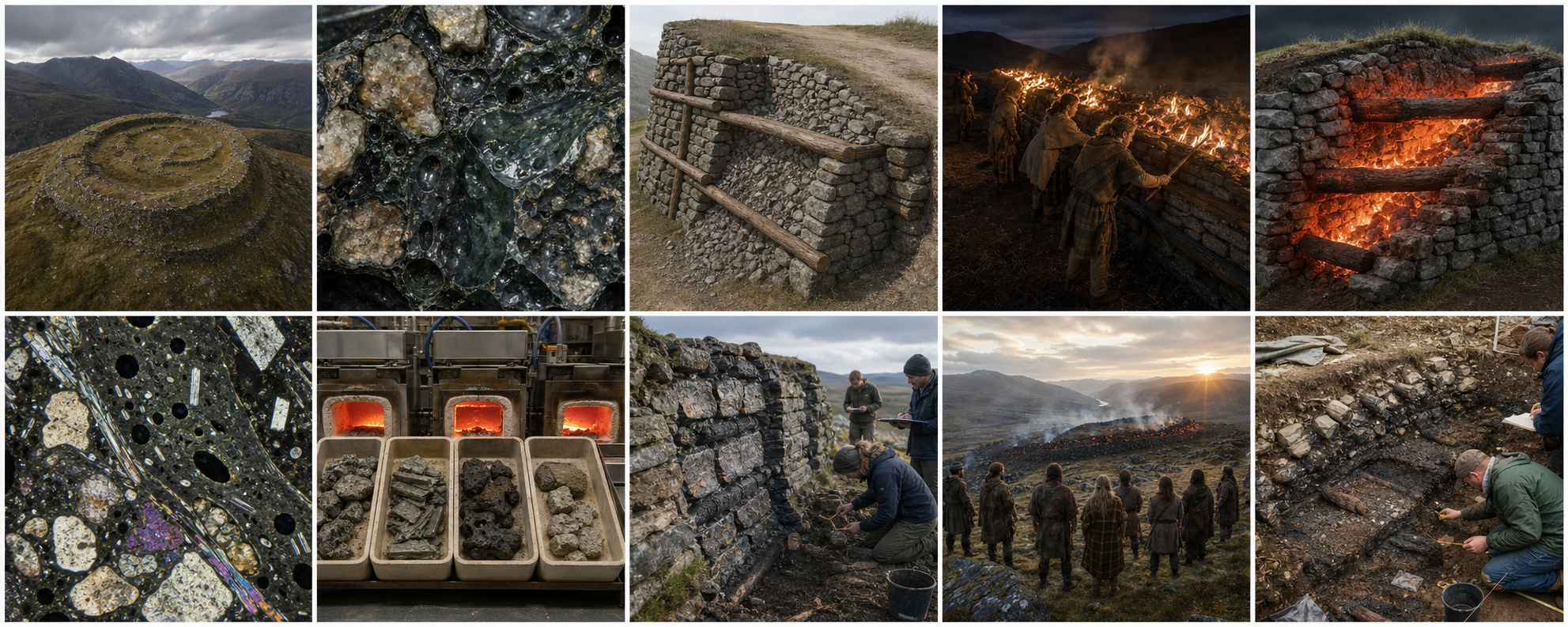
Image note: the ten illustrations are original editorial reconstructions. The nighttime burn and closure scene are evidence-led possibilities, not depictions of a witnessed event; microscopy and thermal views visualize published processes rather than reproduce figures.