The skull arrived before its history did. In 1992, an unsolicited parcel reached the Smithsonian Institution. Inside was a 31-pound carving of milky quartz, almost ten inches high, accompanied by an unsigned letter. The letter said the object had been bought in Mexico in 1960 and was Aztec. No excavation record followed it into the building. No field photograph, soil sample, export permit, or chain of owners connected it to an ancient site.
I treated that empty space as the beginning of the investigation. A crystal skull can be old as quartz and young as sculpture. To determine which history belongs to the carving, I followed two trails that cannot be produced by legend: the paperwork left by people who owned and sold it, and the microscopic marks left by tools that shaped it.
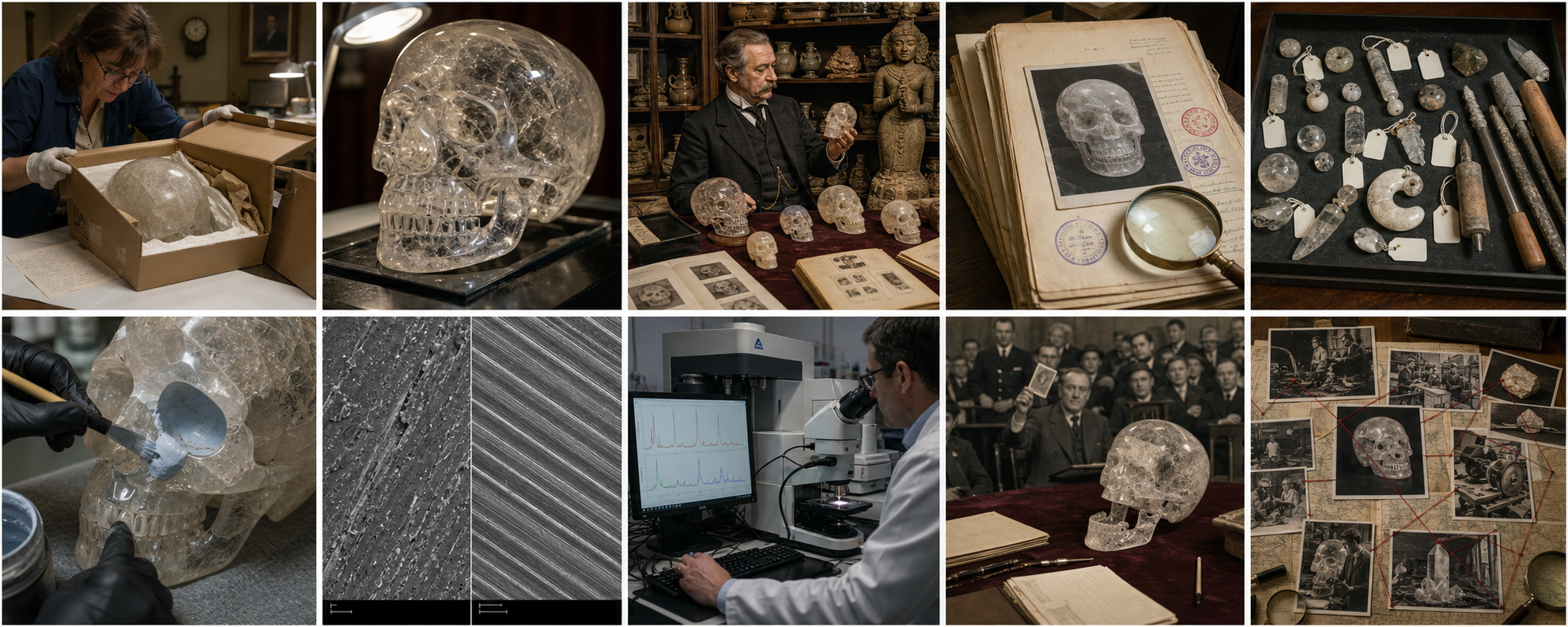
Reconstruction of the Smithsonian parcel in 1992. The physical object was impressive; its archaeological documentation consisted of an anonymous claim.
Two clocks occupy the same object
Rock crystal is transparent or translucent quartz. The crystal itself formed through geological processes long before any human carved it. Dating the mineral does not date the skull. A museum must therefore separate the geological clock from the manufacturing clock.
The manufacturing clock is read through context and technology. Context asks where the object was excavated, what lay beside it, which layer contained it, and whether independent records existed before it entered the art market. Technology asks how grooves were cut, how surfaces were ground, what abrasives were used, and whether those techniques belong to the claimed period.
The Smithsonian's 2008 statement is blunt: none of the crystal skull specimens made available for scientific study has been authenticated as pre-Columbian, and no archaeologist has excavated one from an archaeological site. That does not prove that ancient Mesoamericans never carved quartz. They did work hard stone, and genuine rock-crystal ornaments survive. It means the category “life-size Aztec or Maya crystal skull” lacks the one form of evidence that could anchor it securely: a controlled ancient context.
Material: quartz.
Form: human skull.
Claimed culture: Aztec, Maya, Mixtec, Toltec, or other—depending on the seller and specimen.
Secure archaeological context: none for the famous skulls examined.
Date of carving: must be established from tool marks and documentary history, not the age of the mineral.
Quartz magnifies its own fractures and inclusions. Those internal features record mineral growth; the teeth and polished anatomy record a much later lapidary process.
The skulls are a category assembled by collectors
Small crystal skulls began circulating among dealers and museums in the nineteenth century, a period when European and North American demand for Mexican antiquities expanded rapidly. Collectors wanted portable objects that looked unmistakably exotic. A skull satisfied that desire. Quartz added rarity, optical drama, and the suggestion of ritual power.
One central figure in the documentary trail is Eugène Boban Duvergé, a French antiquities dealer and student of Mexico. Jane MacLaren Walsh and Brett Topping's archival research places Boban at the center of the market through which “Aztec crystal skulls” acquired stories, buyers, and institutional legitimacy. The point is not that every owner consciously participated in a fraud. Dealers, artisans, collectors, and curators can turn uncertain objects into established types through repeated description.
A crucial episode occurred in 1885, when the large skull later associated with the British Museum was offered to Mexico's Museo Nacional and rejected as a modern object. The skull passed through commercial hands and the British Museum purchased it in 1897, at that time treating it as genuine pre-Columbian work. The rejection did not end the object's career. Once an impressive artifact enters a major collection, its display can become evidence in the public mind even when its label later changes.
A nineteenth-century dealer could display genuine antiquities, uncertain objects, and contemporary carvings side by side. Market proximity is not archaeological association.
I built an ownership timeline before touching the microscope
An artifact with no excavation context can still possess a traceable modern life. Auction catalogues, invoices, letters, museum registers, photographs, customs records, and published descriptions place it at specific dates. The absence of an object from early accounts also matters, although it must be used cautiously.
The British Museum skull's paper trail becomes visible in the late nineteenth century, precisely when European lapidary workshops had rotary equipment capable of shaping large quartz carvings. The Smithsonian skull has a different biography. Its donor said it was bought in Mexico in 1960; researchers concluded that it was probably made shortly before that purchase. The two pieces need not share one workshop or one decade to share the status of post-Columbian manufacture.
The Mitchell-Hedges skull requires a separate timeline. Later stories said Anna Mitchell-Hedges found it at the Maya site of Lubaantun in British Honduras, now Belize, in the 1920s. Yet the object was documented in the possession of London dealer Sydney Burney and was sold at Sotheby's in 1943 to F. A. Mitchell-Hedges. The auction record is contemporaneous; the temple-discovery story emerged later. An archival date cannot tell us who carved the skull, but it can falsify a claimed chain of discovery.
| Specimen | Claimed ancient identity | Documentary anchor | Scientific or historical conclusion |
|---|---|---|---|
| British Museum life-size skull | Pre-Columbian Mexican, often called Aztec | Offered and rejected in Mexico in 1885; acquired by the museum in 1897 after commercial circulation | Rotary-tool evidence and archival history support nineteenth-century European manufacture. |
| Smithsonian large milky skull | Aztec; allegedly purchased in Mexico in 1960 | Mailed anonymously to the institution in 1992 with an unsigned letter | Modern tool and abrasive traces; probably made shortly before the 1960 purchase. |
| Mitchell-Hedges detachable-jaw skull | Found at Lubaantun by Anna Mitchell-Hedges | Owned by Sydney Burney and sold at Sotheby's to F. A. Mitchell-Hedges in 1943 | The auction trail contradicts the later excavation narrative; no controlled find record supports it. |
An archive converts reputation into dates. Acquisition files can expose decades between a claimed excavation and the first verifiable appearance.
Ancient Mesoamerican lapidaries were real—and that matters
A bad authenticity argument says ancient artisans could not work hard stone. They could. Mesoamerican lapidaries shaped jadeite, obsidian, quartz, and other difficult materials using patient abrasion, sawing, drilling, and polishing. Genuine pendants, beads, ear ornaments, vessels, and small carvings exist in excavated collections. Denying that skill replaces one myth with another.
The correct comparison is technological, not patronizing. Researchers examine securely provenanced ancient objects to establish the marks produced by available tools and abrasives. Hand-held stone, wood, reed, and cord tools used with loose abrasive leave grooves whose walls, cross-sections, and direction changes reflect a slow, irregular process. A rotating metal or diamond-bearing wheel produces different, highly regular signatures.
Scale also enters the analysis. Ancient rock-crystal pieces from secure contexts tend to be much smaller than the famous life-size skulls. That is not an absolute prohibition; a culture can occasionally make an unusually large work. But an exceptional size increases the need for exceptional documentation. It cannot replace it.
Securely excavated quartz ornaments and documented lapidary tools form the comparison collection. Authenticity is tested against these objects, not against assumptions about ancient ability.
The non-destructive cast that captured a machine
A priceless or fragile museum carving should not be dragged beneath an electron microscope or cut for convenience. Conservators instead make high-resolution silicone impressions of selected worked surfaces—the tooth divisions, eye sockets, drilled cavities, or polished recesses. Once cured, the flexible cast carries a negative copy of microscopic topography and can be examined without placing the original at risk.
Margaret Sax, Jane Walsh, Ian Freestone, Andrew Rankin, and Nigel Meeks combined this approach with optical microscopy, scanning electron microscopy, Raman spectroscopy, X-ray diffraction, and inclusion studies. Their peer-reviewed 2008 paper compared the British Museum and Smithsonian skulls with securely provenanced Mesoamerican lapidary material.
The casts made a hidden chronology visible. Uniform, parallel striations and the geometry of cut features indicated rotary tools on the large skulls. The Smithsonian notes that its skull had been carved with modern stone-working tools. The British Museum's own collection record says incised lines forming the teeth appeared more likely to have been cut with a jeweller's wheel than with techniques available to Aztec lapidaries.
Silicone impression material copies the topography of a tooth groove or eye socket, allowing high-magnification study without cutting the sculpture.
What a tool mark remembers
A tool mark is not merely a scratch. Its cross-section records the shape of the working edge. Repeated lines record the motion of the tool. Embedded particles may identify the abrasive. Overlapping phases reveal whether rough shaping, fine grinding, and polishing occurred in sequence.
Under the scanning electron microscope, hand abrasion on documented ancient objects appears comparatively irregular. The tool and loose abrasive shift. Pressure varies. A worker changes direction to reach a recess. Modern rotary equipment can leave arcs or straight parallel bands with consistent spacing, along with sharply controlled channels in teeth and facial details.
The inference does not depend on a single line. Researchers sample multiple features and compare the pattern with experimental and archaeological references. A scratch added during cleaning would cross a surface locally. Manufacturing marks organize the anatomy: eye sockets, nasal openings, teeth, and polished planes all reveal the same tool family.
Irregular abrasion, variable groove morphology, and traces consistent with hand-driven tools plus loose abrasive.
Regular rotary signatures, wheel-cut features, and in at least one case evidence of modern industrial abrasive technology.
Microscopic contrast: irregular hand abrasion at left, uniform rotary striations at right. The difference is a record of motion, not a judgment based on style.
Quartz chemistry cannot certify an Aztec workshop
Quartz is silicon dioxide, but natural rock crystal contains inclusions and defects that reveal how it formed. Fluid inclusions—microscopic pockets trapped during crystal growth—can be studied for phase behavior and chemistry. Solid inclusions can identify associated minerals. Raman spectroscopy and X-ray diffraction help characterize the material and abrasive residues.
Provenance is rarely as simple as matching one spectrum to one mine. Quartz deposits can share features, historical trade can move raw material, and museum surfaces accumulate contamination. The 2008 study did not discover a chemical label saying “made in Germany.” Instead, material evidence constrained possible raw-material sources while technological marks and archives established the manufacturing era. The conclusion was cumulative.
This is an important safeguard. A block of quartz from Mexico would not make the carving pre-Columbian. A nineteenth- or twentieth-century artisan could use Mexican quartz. Conversely, imported quartz could have reached an ancient workshop. Raw-material origin and carving date are separate questions. Only a chain of independent evidence can join them.
Spectroscopy and inclusion studies characterize the quartz and residues. Material origin cannot, by itself, date the act of carving.
The detachable jaw and the story that arrived late
The Mitchell-Hedges skull is visually exceptional because its lower jaw is separate and articulated. Its craftsmanship is why it dominates popular accounts. Yet craft quality cannot establish archaeological provenance. The precise question is not whether an artisan could make it, but when the object first appears in verifiable records.
The 1943 Sotheby's sale places it in London's art market and transfers it from Sydney Burney to F. A. Mitchell-Hedges. Later accounts moved the object backward to a temple excavation in the 1920s and gave Anna Mitchell-Hedges the moment of discovery. No field diary, excavation photograph, or contemporary site report substantiates that scene. The transaction predates the detailed legend attached to the family.
Claims of lights, visions, healing, curses, computer failures, or encoded knowledge present another evidentiary problem. They are not archaeological measurements, and they do not appear as documented Mesoamerican traditions accompanying an excavated skull. They accumulate around a famous object through exhibitions, books, private demonstrations, and retelling. The legend is culturally real as a twentieth-century phenomenon even when its ancient attribution fails.
The 1943 London auction is a fixed documentary event. It contradicts the later claim that the same skull had remained a family-held excavation discovery since the 1920s.
Why museums accepted them
It is tempting to turn mistaken attribution into a story about foolish curators. That would misunderstand nineteenth-century collecting. Museums were growing quickly, field archaeology had not yet standardized modern provenance requirements, national collections competed for striking objects, and the antiquities market supplied more material than specialists could investigate. Scientific instruments capable of reading microscopic tool marks did not exist.
Institutions also inherit classifications. Once one skull is catalogued as Aztec, a similar object can be judged by resemblance to it. The first questionable example becomes the reference for the second. Dealer narratives pass into catalogues, catalogues into scholarship, and display labels into public memory.
Correction is therefore part of museum knowledge, not an embarrassment external to it. The British Museum's record now openly discusses modern-tool evidence. Smithsonian researchers exhibited their large skull as a case study in scientific investigation. An object can lose an ancient date and gain a richer documented role in the history of collecting, markets, forgery, and public belief.
The final evidence board connects workshops, dealers, archives, and laboratories. No single clue solves the case; their convergence dates the category.
My finding: the mystery was manufactured twice
They were manufactured once in quartz and a second time in narrative. The first manufacture required remarkable lapidary skill: selecting a large crystal, planning around fractures, grinding anatomy, cutting teeth, and achieving optical polish. The second manufacture converted that craftsmanship into Aztec prophecy, Maya ritual, Atlantis, curses, and extraterrestrial memory.
The scientific verdict does not identify every carver. Workshops rarely signed objects made for a market eager to believe. The British Museum skull is best placed in nineteenth-century Europe; the Smithsonian skull was probably carved shortly before its 1960 purchase in Mexico. Other skulls require individual examination. “Crystal skull” is a visual category, not proof of one maker or date.
What changed my view was not a dramatic test that made the quartz glow. It was the alignment of quiet evidence. A rejected sale in 1885. A museum acquisition in 1897. An auction in 1943. An anonymous parcel in 1992. Under magnification, a wheel repeating the same motion through a tooth. The skull did not reveal an ancient secret. It preserved the technology and appetite of the modern world that created it.
Sources and collection records
- Smithsonian Institution, “Mysterious Crystal Skull on Exhibit for the First Time” — dimensions, 1992 donation, context problem, and research overview.
- Smithsonian, “The Truth about Crystal Skulls” — SEM finding and modern stone-carving tools.
- Sax, Walsh, Freestone, Rankin, and Meeks, “The origins of two purportedly pre-Columbian Mexican crystal skulls” — Smithsonian bibliographic record for the peer-reviewed 2008 study.
- Journal of Archaeological Science article — combined archival, lapidary, mineralogical, and microscopic evidence.
- British Museum collection record for the life-size crystal skull — acquisition history and jeweller's-wheel assessment.
- Jane MacLaren Walsh, “Legend of the Crystal Skulls,” Archaeology — dealer history, museum collecting, and the Mitchell-Hedges record.
- Smithsonian Libraries: Walsh and Topping, The Man Who Invented Aztec Crystal Skulls — archival biography of Eugène Boban and the market category.
- Metropolitan Museum of Art: Mexican rock-crystal pendant — comparative evidence that authentic Mesoamerican quartz working is real but materially and contextually distinct.
- Mexico's Secretaría de Cultura: research on ancient lapidary art — cultural and technological context for genuine pre-Hispanic stone working.
Image note: the ten illustrations are original editorial reconstructions created for this investigation. They visualize documented procedures and settings but are not photographs of the named skulls or archival records.