The anonymous author did not choose paper because paper could be ignored. He chose the center of the road. In Philadelphia, a pedestrian waiting for the signal might look down and find a small field of colored letters fused into worn asphalt. The message named a historian, a movie, the resurrection of the dead, and Jupiter. By the time anyone noticed, thousands of tires had already printed it more firmly into the street.
I approached the Toynbee Tiles as a distributed archive rather than a code with one magic solution. Every surviving object could answer a different question. Material revealed manufacture. Wear recorded installation. Geographic clusters exposed travel. Changes in lettering separated periods and possible imitators. A newspaper column, radio recollections, and a documentary investigation supplied a paper trail. Together they lead close to an author—but not across the final evidentiary gap.
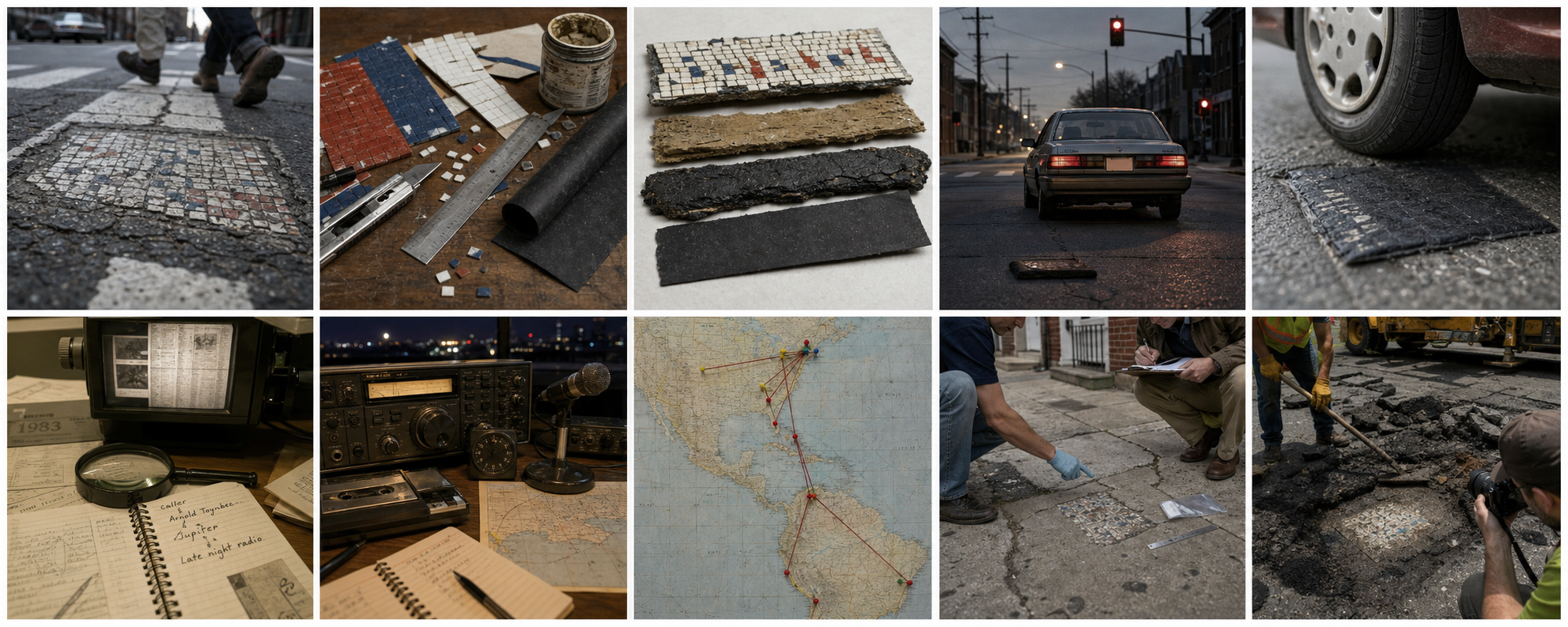
A Toynbee-style mosaic is easy to miss at walking height. Traffic, crosswalk paint, repairs, and shoes all become part of its changing surface.
The object before the legend
Toynbee Tiles are not ceramic plaques installed by a city crew. The classic examples are small mosaics made primarily from thin, pliable linoleum, usually around the size of an American license plate, set directly into asphalt. Early tiles were often plain white rectangles with red, blue, black, or colored inset letters. Later works acquired borders, tiny images, marginal messages, and sprawling statements.
The central inscription appears in variants, but its durable skeleton is short:
IN MOVIE 2001
RESURRECT DEAD
ON PLANET JUPITER
The phrase is not a cipher in the conventional sense. There is no substitution alphabet waiting to turn it into ordinary prose. It is a compressed citation: a private theory expressed as four signposts. “Toynbee” points toward historian Arnold J. Toynbee. “2001” points toward Stanley Kubrick's 1968 film. Resurrection supplies the aim; Jupiter supplies the destination.
Hundreds of tiles or tile records have been catalogued across Philadelphia and other cities. Philadelphia is the unmistakable center of gravity, while older examples were reported along the eastern United States, in parts of the Midwest, and in South American cities including Santiago, Buenos Aires, and Rio de Janeiro. Many no longer exist. Repaving destroyed some; traffic slowly erased others; photographs are now their only physical record.
Thin linoleum, a sharp knife, ruler, adhesive, asphalt compound, and tar paper form a practical workshop. The medium was handmade but engineered for traffic.
The manufacturing method was hidden in plain sight
For years, observers described the plaques as if they had been melted into the road by a secret municipal process. The actual technique is more ingenious and less industrial. In 2000, researcher Justin Duerr reported finding a newly installed tile at 13th and Arch Streets in Philadelphia. It was enclosed inside layered tar paper and held together with adhesive. The mosaic itself was flexible linoleum, and the package was bonded to the street with road-sealing compound.
A large Pittsburgh tile supplied an unusual second witness: fragments of its own side text appeared to describe fabrication. Researchers could make out references to linoleum, summer heat, and asphalt crack filler. The instructions were incomplete because the tile had failed to set cleanly, but they agreed with the freshly found Philadelphia package.
The likely sequence begins at a table. The maker cuts letters and borders from thin floor covering, sometimes warming the material to make precise knife work easier. The pieces are assembled into a mosaic with glue and asphalt compound. Tar paper covers the face and may back the packet, producing a low, black rectangle that blends with the road surface.
The package is then placed on warm asphalt. Vehicle tires do the heavy work. Repeated pressure forces the flexible layers into the road while sunlight softens the binder. The upper tar paper protects the design during its vulnerable first days, then abrades away. When the lettering becomes visible, the tile is already seated.
An exploded reconstruction of the surviving evidence: colored mosaic, flexible base and adhesive, asphalt compound, and sacrificial black paper.
A printing press operated by traffic
This method solves three logistical problems at once. Installation can take seconds rather than minutes. The black package is visually inconspicuous. Most importantly, the maker does not need heavy tools at the intersection. The public unknowingly finishes the work by driving over it.
The street becomes both printing press and display case. Each tire compresses the message; each later tire erodes it. Hot summers help the piece settle, while freeze-thaw cycles, snowplows, buses, and resurfacing determine how long it survives. A tile close to a crosswalk may be noticed and photographed; one centered in fast traffic may be legible only from a stopped vehicle.
The construction also explains stylistic choices. Large block letters survive abrasion better than fine script. High contrast remains readable after dirt fills the cuts. Highway tiles can stretch letters along the direction of travel, compensating for the viewer's shallow angle and speed. These are not random eccentricities. They are adaptations to an unforgiving medium.
A flat packet behind a car at a red light illustrates the documentary team's deployment hypothesis. No authenticated photograph captures the original maker in the act.
The hole-in-the-car-floor theory
How could someone place objects in busy intersections across many cities without being seen kneeling in traffic? The 2011 documentary Resurrect Dead: The Mystery of the Toynbee Tiles proposed a memorable answer. Witness accounts described a person with experience modifying cars, including removing floor sections. Investigators suggested that a packet could be dropped through an opening beneath a vehicle stopped at a red light.
The idea fits the physical method. A low black bundle could fall onto the road in the seconds before the light changed. The driver's body would remain inside the car; following traffic would begin compression immediately. Route clusters and older highway placements are consistent with distribution by automobile.
But the car-floor scenario must be labeled correctly. The fresh packet and tar-paper mechanism were observed. A modified-car skill and witness recollections were reported. The act of dropping an original tile through a floor opening was reconstructed, not filmed. Other quick-placement methods are possible. A strong inference is not the same as direct evidence.
Traffic transforms the package: tires seat it, heat bonds it, and abrasion removes the protective paper until the mosaic emerges.
The archive has layers of time
The idea appears in print before the best-documented tiles. In March 1983, Philadelphia Inquirer columnist Clark DeLeon reported a telephone conversation with a man using the name James Morasco. The caller described an organization devoted to a theory connecting Toynbee, the scientific re-creation of dead people, and a colony on Jupiter. The tiny column did not describe street tiles, but its conceptual vocabulary closely anticipates them.
Researchers associated with Resurrect Dead date the earliest tile phase to approximately the mid-1980s. Plain, license-plate-sized designs appeared in Philadelphia and then in cities such as New York, Baltimore, Pittsburgh, and several South American locations. Through the 1990s, borders and colors became more elaborate, and side texts expanded into complaints about the media, instructions, political statements, and appeals to join a movement.
After about 2001, the geography and form changed. The research archive at ToynbeeIdea.com describes most reported works from 2001 through 2013 as concentrated in Philadelphia and its suburbs, with numerous smaller “index card” tiles that could be placed on foot. Some later mosaics are stylistically close to early work; others belong to identifiable copycat traditions, especially the House of Hades name.
A clean chronology is difficult because discovery date is not installation date. A mosaic may remain covered by tar paper, unnoticed, or undocumented. Streets are resurfaced at different intervals. Online photographs often lack precise coordinates or provenance. The responsible timeline therefore groups designs by material, lettering, message, and location rather than treating every internet sighting as an equally dated artifact.
Microfilm and the 1983 date anchor the idea before the major tile record. The column is a conceptual match, not a photograph of an installation.
What “Toynbee” contributes to the message
Arnold J. Toynbee was a British historian known for large-scale studies of civilizations. The tile phrase is sometimes paraphrased as if Toynbee published a plan to resurrect humanity on Jupiter. He did not. The documentary researchers instead traced the reference to a passage in Toynbee's autobiographical writing Experiences, where he considered the implications of a hypothetical future science capable of reconstructing a person from physical constituents.
The anonymous theorist appears to have taken that philosophical possibility literally. If a person's body and pattern could be reassembled, physical resurrection might replace a supernatural afterlife. Jupiter, imagined as vast enough for the total human dead, became the site of a manufactured heaven.
This is the tiler's synthesis, not a conventional reading of Toynbee. It also does not come directly from 2001: A Space Odyssey. Kubrick's film sends a mission toward Jupiter and ends with astronaut Dave Bowman transformed into the enigmatic Star Child, but it never lays out a program for rebuilding every dead person. The tile compresses the historian and film into a third idea that belongs to its author.
| Phrase fragment | Probable reference | What the tile maker added |
|---|---|---|
| Toynbee idea | A philosophical speculation about scientific reconstruction of a human being | Conversion of a thought experiment into a literal resurrection project |
| Movie 2001 | Kubrick's Jupiter mission and transformation imagery | Treatment of the film as confirmation or visualization of the project |
| Resurrect dead | The proposed technological goal | A physical, materialist afterlife rather than automatic spiritual survival |
| Planet Jupiter | The film's destination and an enormous imagined world | Location for a colony intended to hold humanity's reconstructed dead |
Late-night radio, a microphone, and a cassette recorder represent the pre-internet communication trail described by researchers, not a verified recording session.
The message existed in other media
The street was not necessarily the campaign's first platform. The 1983 caller said he represented a Minority Association. Investigators found related documents and accounts of attempts to contact newspapers and talk programs. Shortwave listeners also recalled unusual broadcasts promoting themes associated with the tiles, though surviving recordings and complete logs are limited.
David Mamet's one-act play 4 A.M. introduced another striking parallel: a caller to a late-night radio show speaks about Toynbee, the movie 2001, and bringing the dead back on Jupiter. Mamet stated that he invented the material, so the play does not prove authorship or direct borrowing. It does show that a similar cluster of words circulated through broadcast culture and dramatic writing.
The sequence suggests an author trying channels and finding them insufficient. A phone call becomes a tiny newspaper item. A broadcast vanishes when the receiver is switched off. Editors can decline a manifesto. Asphalt cannot reject a submission. Once the anonymous messenger learned to let traffic install his work, the city itself became a durable publication system.
The distribution is a route problem: Philadelphia at the center, eastern U.S. corridors around it, and exceptional South American placements that demand travel or cooperation.
The map behaves like travel, not magic
A location map initially makes the campaign look impossible. How does a solitary Philadelphia voice appear in distant American cities and across South America? The temptation is to infer a secret organization. Yet the map is not evenly global. It follows transportation corridors, major city centers, and places a traveler could reach.
Researcher Steve Weinik's map and archive document more than 600 tiles or reported locations across dozens of cities, but that catalogue includes destroyed works, stylistic periods, and pieces whose attribution may vary. Older original-style examples form the broadest range. Later post-2001 patterns contract strongly toward greater Philadelphia, apart from isolated exceptions and acknowledged imitators.
The distribution can be produced by repeated journeys over years. A person need not visit every city in one campaign. Tiles are portable, preassembled, and quick to place. South American examples could reflect personal travel, employment, shipping routes, help from an associate, or copying. Geography narrows possibilities; it does not identify a passport.
For attribution, routes work best when combined with style. Consistent letter shapes, recurring colors, identical side-text vocabulary, comparable material layers, and age all strengthen a common-source judgment. A dot on a map alone is weak evidence.
The strongest authorship hypothesis
Resurrect Dead and its researchers developed a circumstantial case pointing to Philadelphia resident Severino “Sevy” Verna. This name is already part of published reporting, but repeating it requires care: the investigation did not obtain a confession, direct installation footage, fingerprints with a public chain of custody, or a court-tested finding.
The case combines several strands. A South American tile reportedly contained a Philadelphia address that guided researchers toward a South Philadelphia rowhouse. Small “proto-tiles” or experimental fragments appeared on nearby streets. People familiar with the resident described science-fiction interests and mechanical skills relevant to the work. Accounts of modified vehicles offered a possible explanation for fast road placement. The voice and ideas associated with earlier media efforts were also linked by the filmmakers to the same orbit.
Each strand has limitations. An address can identify a target, relative, organization, or provocation rather than the maker. Nearby tests can be made by someone else. A skill is not a fingerprint. Memories gathered decades later are vulnerable to suggestion. Most importantly, Verna denied involvement when approached, and the filmmakers' published account remains an attribution rather than a demonstrated fact.
Investigators document small pavement fragments near a rowhouse. Proximity is meaningful circumstantial evidence, but it cannot substitute for direct attribution.
Why “James Morasco” does not close the case
The 1983 caller's name looked like a solution because the words appeared before the tiles. Later reporters located men named James Morasco in Philadelphia, including an elderly carpenter whose family said he knew nothing about the campaign. The age, biography, and continued appearance of tiles made a simple identification doubtful.
The documentary researchers concluded that “James Morasco” may have been an alias or displaced identity. That interpretation can reconcile the newspaper record with another author, but it is still an interpretation. The column confirms that somebody presented the Toynbee-Jupiter resurrection scheme under that name in 1983. It does not authenticate the caller's legal identity, and it does not connect his hands to a surviving tile.
This distinction prevents a common investigative mistake: treating the first searchable name as the culprit. The useful evidence is the continuity of the idea, not the certainty of the signature.
One artist, several phases, and many successors
The classic tiles share enough formal habits to support a principal original maker: recurring syntax, unusual capitalization, limited palette, repeated border devices, and a consistent obsession expressed across decades. Yet the medium became reproducible once researchers documented the technique. Later artists created their own asphalt mosaics, sometimes honoring the original and sometimes using unrelated messages.
House of Hades is the best-known parallel identity. In 2022, Steve Weinik told the Philadelphia Inquirer that House of Hades works found in Scranton belonged to a different artist using the same medium, with no known connection to the original creator. Treating those pieces as new activity by the first tiler would corrupt both chronology and authorship.
Copying also changes the cultural meaning. The original campaign functioned as pre-internet mass communication by someone unable or unwilling to use conventional gatekeepers. A later artist works after the method, mystery, documentary, and online community already exist. The physical grammar may match, but the communicative situation does not.
The street is a hostile archive
Asphalt preserves by consuming. The tile survives because it becomes part of the roadway, and it disappears for exactly the same reason. Tires polish the surface. Water enters cracks. Winter expands them. Utility cuts divide designs. A resurfacing machine can erase in seconds what endured for twenty years.
Philadelphia's preservation debate illustrates the contradiction. A 2015 Inquirer report said paving agreements required contractors to stop and notify a Streets Department engineer when encountering a Toynbee Tile, while the city explored saving one or two if removal could be made fast and affordable. Other jurisdictions classified tiles as vandalism or pavement defects and removed them.
Extraction is difficult. A mosaic cannot simply be peeled up after years of compression. Its cultural object is a composite: colored linoleum, binder, adjacent asphalt, cracks, tire polish, and location. Cutting out a slab saves material but removes context. Leaving it in place preserves context but guarantees further wear.
Road repair and documentation meet at the same patch of asphalt. Preservation may require cutting out the street, while in-place survival guarantees continued erosion.
My verdict: the method is solved, the message is reconstructed, the signature is missing
The Toynbee mystery can be divided into three verdicts. First, the physical method is substantially solved. Flexible linoleum mosaics were assembled with adhesive and asphalt compound, protected by tar paper, quickly placed, and pressed into warm roadways by traffic. The newly found package, construction text, and observed wear agree.
Second, the message is understandable without pretending it is coherent science. The author combined a Toynbee thought experiment with the Jupiter and rebirth imagery he perceived in 2001, then proposed a technological afterlife: rebuild every dead human on another world. The tiles are propaganda for that private synthesis.
Third, authorship remains one step short of proof. The case advanced by Justin Duerr, Steve Weinik, Colin Smith, and filmmaker Jon Foy makes Severino Verna the leading published hypothesis for the original Philadelphia campaign. Address clues, nearby tests, interests, skills, routes, and witness accounts form a compelling pattern. No public confession or decisive forensic link completes it, and the named person denied involvement.
What evidence could still move the case
A confirmed workshop archive would be decisive: original stencils, unused letter sets, dated route notes, receipts for distinctive linoleum, photographs before installation, or correspondence matching side texts. Provenance would matter as much as the objects. Materials discovered anonymously after decades could themselves be imitations.
Scientific comparison may help without becoming television forensics. Microscopy could group binder and flooring compositions. Tool marks could reveal shared cutting habits. High-resolution image analysis could quantify letter forms across documented originals and separate periods more rigorously. These methods would establish production families; identifying a person would still require a reliable link between a family and a source.
The existing archive also needs conservation. Original-resolution photographs, exact coordinates, first-observed dates, resurfacing history, dimensions, material notes, and attribution confidence should accompany every record. “Seen somewhere in 1998” is folklore. A georeferenced photograph with contemporaneous notes is evidence.
The last anonymous edition
The most revealing part of the case may be its medium. A person with an idea that conventional media would not carry built a publication system from flooring scraps, crack filler, traffic, and red lights. The distribution network was the road network. The press was the weight of strangers' cars. The archive was temporary by design, yet it outlived broadcasts and phone calls that left almost no trace.
That ingenuity does not validate the resurrection theory or excuse the ugliest marginal texts. It explains why the work endured as a mystery. The author made each passerby both audience and unwitting printer, then removed the byline.
What remains is not an undeciphered command from Jupiter. It is a human campaign whose material logic can be reconstructed almost completely. We can see how it was made, why it survived, what idea it promoted, and which evidence points toward an author. The one thing the asphalt never accepted was a signature.
Sources and research trail
- ToynbeeIdea.com, “How” — Justin Duerr's 2000 fresh-tile observation, linoleum and tar-paper construction, Pittsburgh instructions, traffic-setting method, and car-floor hypothesis.
- ToynbeeIdea.com, “What” — style periods, early-city distribution, changing materials, and post-2001 concentration.
- ToynbeeIdea.com, “Why” — the researchers' reconstruction of the message as a material resurrection and Jupiter-colony proposal.
- ToynbeeIdea.com, “Who” — the research team's explicit separation of documents, second-hand accounts, and inference, and its acknowledgement that the artist never confirmed the work.
- WHYY/PBS, “RESURRECT DEAD: A Philadelphia Mystery” — public-television profile of the tiles, their pliable linoleum medium, Justin Duerr, and filmmaker Jon Foy.
- Sundance Institute, 2011 Film Festival awards — official record of Jon Foy's Documentary Directing Award and description of the investigation.
- National Council on Public History, “The Toynbee Tiles: Viral Exhibitry from the Pre-Internet World” — public-history analysis of message, medium, media gatekeeping, ephemerality, and copycat context.
- The Philadelphia Inquirer, “Toynbee tiles have popped up in Scranton” — current distinction between original work and House of Hades, the documentary's attribution hypothesis, denial, and lack of confirmation.
- The Philadelphia Inquirer, “As Toynbee Tiles dwindle...” — catalog scale, highway-letter adaptation, city preservation efforts, and losses to repaving.
Image note: all ten visuals are original editorial reconstructions. The vehicle-placement, radio, route-map, and rowhouse panels represent documented hypotheses or investigative methods; none depicts an identified person committing an act.