The first Naga fireball I tried to reconstruct did not rise from the Mekong. It rose from the horizon. That difference is almost impossible to judge from one crowded riverbank at night. A bright point appears above black water; the far shore disappears; cheers begin before any delayed report reaches the audience. The eye supplies an origin at the surface because the cultural story, the camera frame, and the dark geometry all point there.
This does not mean that witnesses saw nothing. People along the Thai–Lao Mekong have reported red, pink, or orange lights that ascend and vanish around the end of Buddhist Lent. The annual gathering at Nong Khai is a living religious and civic event, not merely a puzzle set for outsiders. The Naga legend gives the night meaning whether or not a serpent physically launches luminous spheres.
My task was narrower: could the available observations establish self-luminous objects emerging from underwater? I separated sighting from source, legend from mechanism, and festival from controlled field conditions. The evidence supports real lights but not a single exotic process. Human pyrotechnics, tracer or flare events, ordinary festival illumination, distance errors, and selective counting can account for the strongest documented cases. A natural gas explanation remains chemically imaginable but empirically weak. The result is a mixed light phenomenon held together by one powerful calendar.
On the Thai bank, one red point appears above a black river while the far shore nearly vanishes. The sighting is real; its distance and launch point are not yet measured.
One light, three possible horizons
Stand near Phon Phisai after sunset and look east across the Mekong. The river can span hundreds of metres. On a dark night, water and far bank merge into one field. A light above a boat, behind the Lao bank, or fired from land can appear to begin at the waterline. Without a visible reflection extending to the source, the vertical angle alone does not determine range.
A witness usually describes the event in image coordinates: “It came from the river, rose straight up, and disappeared.” Those words report appearance, not surveyed geometry. To convert them into a trajectory, an investigator needs compass bearing, angular elevation over time, an identified horizon, camera position, focal length, and ideally a second view from a known baseline.
Local descriptions commonly say the lights are thumb- to egg-sized, silent, smokeless, and visible for several seconds as they reach tens or hundreds of metres. Apparent size without distance cannot provide physical diameter. A distant flare, a closer firework ember, and an even closer small lamp can occupy the same angular size. Exposure bloom turns a point into a disk whose width depends on camera settings.
Two cameras separated along the bank can intersect bearings to locate a light. A single camera preserves direction but cannot recover distance from an empty night sky.
The triangulation that the mystery still needs
A controlled test is straightforward in design. Place at least two calibrated cameras several hundred metres apart on the Thai bank, synchronize clocks to better than a video frame, survey their coordinates and horizon azimuths, and keep wide fields of view. A third station on the Lao side would be even stronger. Record audio separately and log every known firework, boat, aircraft, and military signal.
When both cameras capture the same light, their bearing lines can be intersected. If the lines meet over mid-channel and the altitude begins below the visible water surface, the underwater claim gains support. If they meet on or beyond the far bank, perspective explains the river origin. If the lines are nearly parallel, the object is distant and cannot be assigned to the channel.
The protocol must run on the festival night and on matched control nights before and after it. Weather, river level, moon phase, crowd density, and nearby activities should be logged. Repetition only on a religious holiday is evidence about scheduling; it is not automatically evidence about lunar or biological causation.
Public counts—sometimes tens, hundreds, or thousands—rarely supply this chain. Teams may count from multiple towns and merge reports. Two groups can count the same light. One bright event can disappear behind a tree and reappear as a second. A cheer travels along the bank and prompts observers to scan the expected region, increasing both detection and imitation.
The Naga tradition belongs to ritual, art, and community memory. Respecting that meaning does not require treating a painted serpent as a measured physical mechanism.
The calendar is religious before it is scientific
The fireballs are associated most strongly with Wan Ok Phansa, the full-moon end of the three-month Buddhist rains retreat, usually in October. In local Buddhist narrative, the Naga honors the Buddha's return from the Tavatimsa heaven after teaching his mother. Candles, offerings, illuminated boats, processions, almsgiving, races, dance, and Naga imagery make the river a ceremonial landscape.
The Tourism Authority of Thailand describes the annual lights and the end-of-Lent gathering as central features of Nong Khai. The Thai government's festival listing places events from Nong Khai municipality through Sri Chiang Mai, Phon Phisai, and Rattanawapi. The geography is a long corridor, not one instrumented pool.
Official promotion establishes where and when people gather. It does not certify a natural mechanism. Festival materials use the language of faith and mystery because they are cultural and tourism documents. A scientific article must translate those statements into testable claims without stripping away their social value.
Did the tradition always look this large?
Reports of “ghost lights” and river lights predate the modern tourism boom, but the scale, branding, and concentration of the festival changed in recent decades. Erik Cohen's anthropological study, “The Postmodernization of a Mythical Event”, traces how a local phenomenon became a major pilgrimage and media spectacle.
As attendance grows, the observation environment changes. More cameras detect more ordinary lights. More boats, fireworks, lanterns, stages, vehicles, and security units create more lights. Vendors and tourism authorities benefit from a successful night. Skeptics arrive expecting a hoax; believers arrive expecting a blessing. Both groups are primed to classify ambiguous points quickly.
The event's calendar also gives potential human sources perfect notice. Anyone wishing to celebrate, entertain, prank, honor the tradition, or sustain visitor interest knows the date and viewing direction. Natural processes do not read lunar festival posters; people do.
A useful observation station logs bearing, time, river stage, weather, sound, exposure, and known activity. A count without those fields is a memory aid, not a physical explanation.
I rebuilt the sighting form
Most accounts lead with color and number. I would lead with metadata. For every light, the observer should log exact time; GPS position; compass azimuth; first and last elevation; apparent motion; duration; color; change in brightness; visible trail; smoke; sound and its delay; reflection; camera focal length; exposure; and whether another station recorded the same event.
Classification must occur after the night. Calling a point a “Naga fireball” while entering data embeds the conclusion. Neutral labels—L001, L002, and so on—allow analysts to compare trajectories without knowing which events drew the loudest cheers.
Continuous wide video is more valuable than a zoomed clip that starts after the cheer. The full frame preserves shore lights and launch context. Raw files preserve timestamps and exposure. Infrared can show hot exhaust or a warm projectile; spectroscopy may separate combustion emissions; acoustic arrays can locate reports; radar can test a moving projectile.
The absence of smoke in a compressed night video is weak evidence. Thin smoke can be invisible against darkness. The absence of sound is also weak across a wide river. At 700 metres, sound arrives roughly two seconds after light. Crowd noise, music, traffic, and cheering can mask a brief report.
The sediment-gas hypothesis needs a complete chain: gas production, concentration, release, ignition, stable luminous ascent, and a schedule matching the observations.
The phosphine story has chemistry but no field bridge
The most repeated natural explanation invokes methane and phosphine generated by decaying organic material in river sediment. Gas bubbles supposedly rise, ignite on contact with air, and float upward as luminous balls. This proposal sounds scientific because its chemical names are real.
Phosphine is indeed hazardous and flammable. The U.S. Centers for Disease Control and Prevention describes it as a colorless, toxic gas that can ignite spontaneously, especially when impurities are present. PubChem lists concentration-dependent flammability and notes its garlic or decaying-fish odor in impure material.
But the proposed Mekong mechanism must do much more than name a combustible gas. It must show production at the site in sufficient concentration; transport through oxygenated water without dilution; release as coherent parcels; reliable ignition at the interface; a flame that survives rapid mixing; buoyant ascent for several seconds; little smoke, odor, or heat at the shore; and strong concentration on one festival date.
Methane bubbles from sediment do not normally become silent red spheres climbing a hundred metres. A burning gas jet follows its fuel source; a detached flame needs a fuel-rich parcel and controlled mixing. Turbulence stretches and extinguishes small flames. Wind should alter direction. If river chemistry is responsible, measured gas flux, sediment temperature, dissolved oxygen, phosphorus species, and event timing should correlate.
I found no accessible peer-reviewed field dataset demonstrating that chain at the reported sites. Laboratory flames prove possibility under prepared conditions, not occurrence in the Mekong. The gas hypothesis is therefore not “the scientific answer.” It is an unverified mechanism with several missing links.
A distant tracer or flare can appear to rise from black water when the opposite bank is invisible. Light arrives first; the gun report can arrive after a cheering crowd has filled the soundscape.
The far-bank test and the 2002 footage
In 2002, Thai television station iTV investigated from the Lao side. Its report showed Lao soldiers firing tracer rounds while spectators across the river reacted to lights. A later Bangkok Post account summarizes the footage and the public backlash. TIME's contemporary report records that the documentary attributed the fireballs to AK-47 tracer rounds, while Lao officials and local leaders objected.
The footage is strong for one limited claim: at least some lights perceived from Thailand as Naga fireballs could be produced by activity on the opposite bank. The crowd response synchronizes source and classification. The geometry explains the apparent emergence from the river.
It is not a universal proof. Showing soldiers fire on one night does not establish that every historic report, every location, and every visual type is a tracer. Some lights may be flares, rockets, fireworks, lanterns, boat pyrotechnics, aircraft, or unrelated distant sources. The iTV result is a demonstrated member of the set, not necessarily the entire set.
Tracer ammunition also has diagnostic behavior. A luminous projectile should follow ballistic motion, eventually fall, and may leave a streak in long exposure. A near-vertical shot can look like straight ascent for its bright portion; if its tracer compound extinguishes near the apex, the falling path is dark. Perspective can hide horizontal motion when the trajectory aligns toward or away from the viewer.
The key lesson is methodological. Investigators crossed the river. Once they occupied the alleged background rather than staring into it, a source became visible.
Ok Phansa fills the Mekong with fireboats, lanterns, rockets, fireworks, stage lights, and reflections. The observation field is visually rich before any unexplained light appears.
A festival is the worst laboratory and the best social record
Festival programs include illuminated boat processions, floating lanterns, firecrackers, light-and-sound performances, and other displays. The Thailand Foundation's description of Ok Phansa notes fireboats and thousands of light sources in celebrations along the Mekong. Some districts separately hold rocket festivals at other times, so pyrotechnic knowledge is ordinary in the region.
These sources do not all imitate the canonical object. Fireworks often explode, lanterns drift, and rockets leave smoke. Yet distance, cropping, exposure, and partial visibility can remove those distinctions. A flare seen only after its launch trail fades may appear as a clean orb. A reflection can make a shore light seem to originate in mid-channel.
Counts should therefore separate scheduled displays, authorized fireworks, unauthorized pyrotechnics, and candidate anomalies. If observers announce only a total “fireball” number, the dataset mixes causes before analysis begins.
The festival is nevertheless invaluable for understanding belief. A hundred thousand people do not gather only to measure photons. They gather to participate in a story, visit family, make offerings, watch boats, eat, remember, and see the river become sacred. The cheer is part of the event even when its trigger came from a flare.
The television investigation changed the debate because it recorded a source and a distant audience at once. Its limit is equally important: one demonstrated source does not classify every sighting.
Why the exposé did not dissolve the tradition
The iTV report produced anger, threatened legal action, protests, and an apology. Outsiders sometimes describe that reaction as refusal to accept evidence. The deeper conflict was over who had authority to define the event. A national broadcaster framed a valued regional tradition as deception at a moment when tourism and local dignity were intertwined.
Cohen's analysis shows that controversy itself modernized the festival. The 2002 feature film Mekhong Full Moon Party, investigative television, skeptical commentary, and official promotion drew larger audiences. Debunking became another layer of publicity.
A tradition can absorb exposure because its value is not exhausted by a mechanism. People who accept human involvement may still regard the lights as offerings to the Naga. A firework can be technologically manufactured and ritually meaningful. The binary “miracle or fraud” misses that third category.
For physical investigation, however, meaning cannot substitute for provenance. If a human launches a light as an offering, it remains a human-launched light in the trajectory dataset. Respect comes from accurate categories, not from withholding observation.
Frame-by-frame analysis can test trajectory, bloom, horizon, and audio delay. It cannot recover a missing second camera or a launch point cropped out before recording began.
What the videos can actually prove
Many online clips show small points against a dark field. Compression replaces subtle brightness with blocks, autofocus pulses, and digital stabilization shifts the horizon. Zooming makes hand tremor look like object motion. Saturation hides the core structure that could distinguish a projectile from a diffuse glow.
A useful clip begins before appearance and continues after disappearance. It retains shoreline reference lights, original frame rate, audio, metadata, and full resolution. Analysts can plot pixel position against time, correct camera movement from fixed lights, and estimate angular acceleration. A ballistic tracer should decelerate upward under gravity; a powered rocket may accelerate; a lantern follows wind; a star or aircraft changes differently.
Color is unreliable in saturated sensors. A red tracer, orange flare, white firework, and lamp can all render as the same red-orange disk after exposure and white-balance processing. The reported lack of falling motion is also ambiguous if luminosity ends before descent.
Public video does support the existence of airborne lights. It does not consistently show the water breaking, bubbles, steam, underwater illumination, or a reflection beginning at the launch point. The most extraordinary part of the traditional description is often outside the frame.
Four mechanisms weighed without forcing one answer
| Mechanism | What it explains | Expected signature | Assessment |
|---|---|---|---|
| Tracer rounds or signal flares | Red-orange ascent, festival timing, far-bank origin, some crowd-synchronized footage | Ballistic path, delayed report, heat, possible trail, source on land | Demonstrated for at least some events |
| Rockets, fireworks, lanterns, boats | Abundant lights, smoke hidden by distance, multiple locations and durations | Launch flashes, drift or burst, scheduled activity, reflections | Likely contributes substantially |
| Methane/phosphine combustion | Would connect sediment, water, and flame naturally | Measurable gas flux, ignition chemistry, wind response, heat and combustion products | Not demonstrated in the required field chain |
| Unknown natural plasma or electrical discharge | Could in principle produce luminous motion | Electromagnetic, meteorological, spectroscopic, and repeatable instrumental signals | Speculative; no adequate dataset |
The calendar test
If sediment gas accumulates because of temperature, pressure, river level, or lunar tide, events should correlate with those measured variables. Wan Ok Phansa moves within the solar calendar. The mechanism should sometimes peak on nearby nights when physical conditions match better, and instrumented monitoring should capture the shift.
If human activity dominates, sightings should peak when crowds assemble, viewing areas face cooperating communities, and festival programs operate. Counts may drop during restrictions, border enforcement, storms, or years when organizers alter activities. They may migrate between districts as tourism attention moves.
Reports do occur outside the main night, but the evidence is less systematically catalogued. That makes the control period essential. A camera network operating for thirty consecutive nights could establish whether similar lights are truly exclusive, merely more noticed, or actively produced on the holiday.
The decisive experiment is quiet: paired cameras and sensors watching before, during, and after the festival, with every known light source logged rather than excluded by assumption.
My proposed field campaign
I would deploy six synchronized stations across three Thai sites and, with official cooperation, mirrored stations in Laos. Each would carry a wide low-light camera, telephoto camera, microphone array, weather sensor, compass reference, and GPS-disciplined clock. At least one spectrograph and thermal camera would cover each sector.
Observers would record continuously for two weeks before and after Ok Phansa. Civil aviation, river traffic, festival pyrotechnics, and authorized military activity would be logged. Teams classifying video would be blinded to date and crowd reaction. Candidate events would receive triangulated coordinates and altitude profiles before cultural labels.
Gas hypotheses would be tested independently with sediment cores, dissolved-gas sampling, flux chambers, and safe laboratory analysis. No open-flame experiment should be attempted on an inhabited riverbank; phosphine is acutely toxic and explosive. A natural-source claim should be based on measurement, not a dangerous demonstration.
The campaign might find several causes. That would not be failure. “Naga fireballs” is a human category defined by appearance and occasion. Nature and technology are not obliged to supply one mechanism for every object placed inside it.
Verdict: the river is a stage, not yet a source
I accept the testimony that people see ascending lights. I reject the stronger claim that current public evidence demonstrates luminous bodies emerging from underwater. The origin point is usually inferred from a dark, compressed perspective. The available clips lack the baselines and controls needed to recover range.
The 2002 far-bank footage proves that human projectiles can be classified by the Thai-side audience as fireballs. Festival programs supply many additional light sources. Their scheduling explains the calendar more directly than a gas process tuned to a religious date. The phosphine story names real chemistry but does not establish production, ignition, ascent, or timing in the Mekong.
My best reconstruction is plural. Some canonical sightings are distant tracer or flare events; others are fireworks, rockets, lanterns, boats, aircraft, or reflections. Witness expectation and crowd cueing unite them. A small remainder may be genuinely unclassified because the data are insufficient, not because an unknown mechanism has been demonstrated.
Sources and further reading
- Tourism Authority of Thailand, Nong Khai and Naga Fireballs
- Royal Thai Government portal, Naga Fireball Miracle of Faith
- Thailand Foundation, Ok Phansa and Mekong fireboat traditions
- Phon Phisai municipality, local description of the phenomenon and legend
- Erik Cohen, “The Postmodernization of a Mythical Event,” Tourism Culture & Communication
- ASEAN Journal of Religious and Cultural Research, debate over Naga Fireballs
- Bangkok Post retrospective on the 2002 iTV investigation
- TIME, contemporary report on the 2002 controversy
- U.S. National Library of Medicine PubChem, phosphine properties and hazards
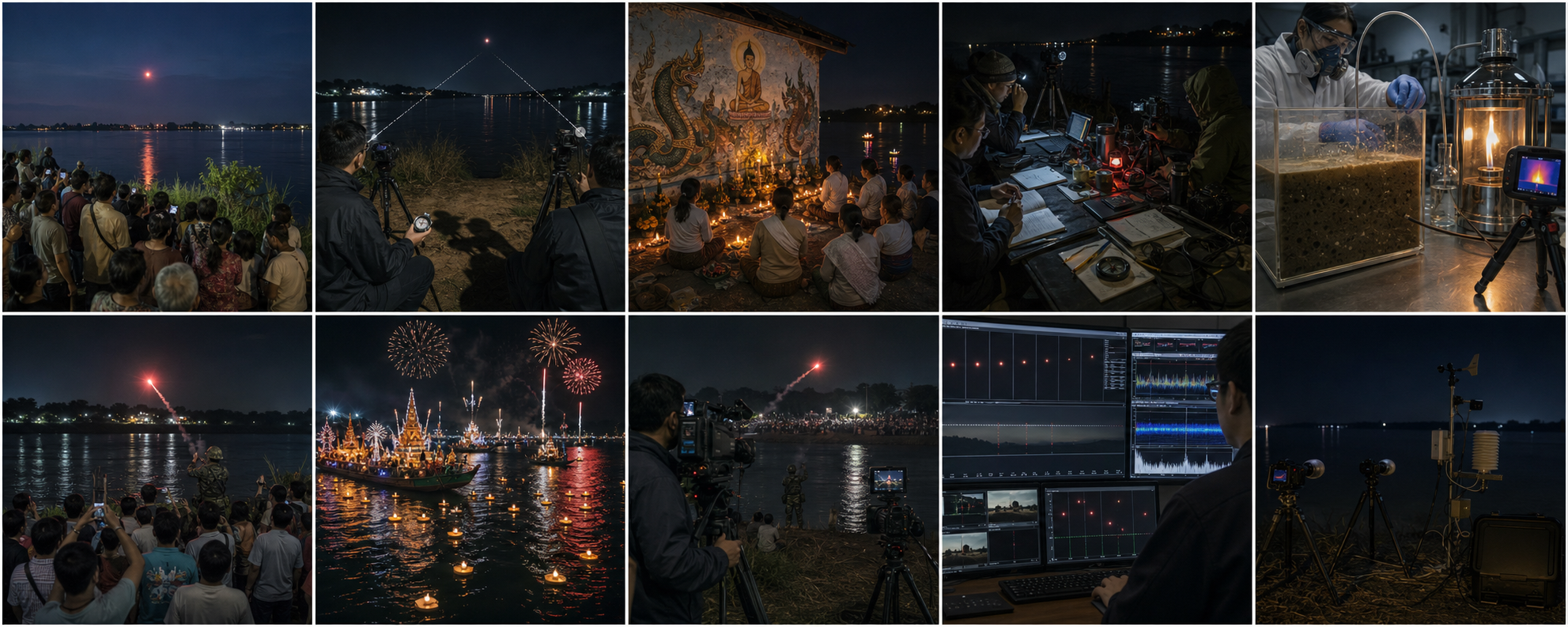
The ten illustrations are original editorial reconstructions created for this analysis. They depict observation methods, cultural settings, and proposed mechanisms; they are not documentary photographs of a specific fireball event.