Bengal Delta Case File · Historical Acoustics · Evidence Reconstruction
The Barisal Guns: A Sound Without a Single Source
A cannon boomed somewhere beyond the mangroves. No flash followed, no battery answered, and no wreckage was found. The enduring mystery is not merely what made that sound. It is whether nineteenth-century observers were hearing one phenomenon at all.
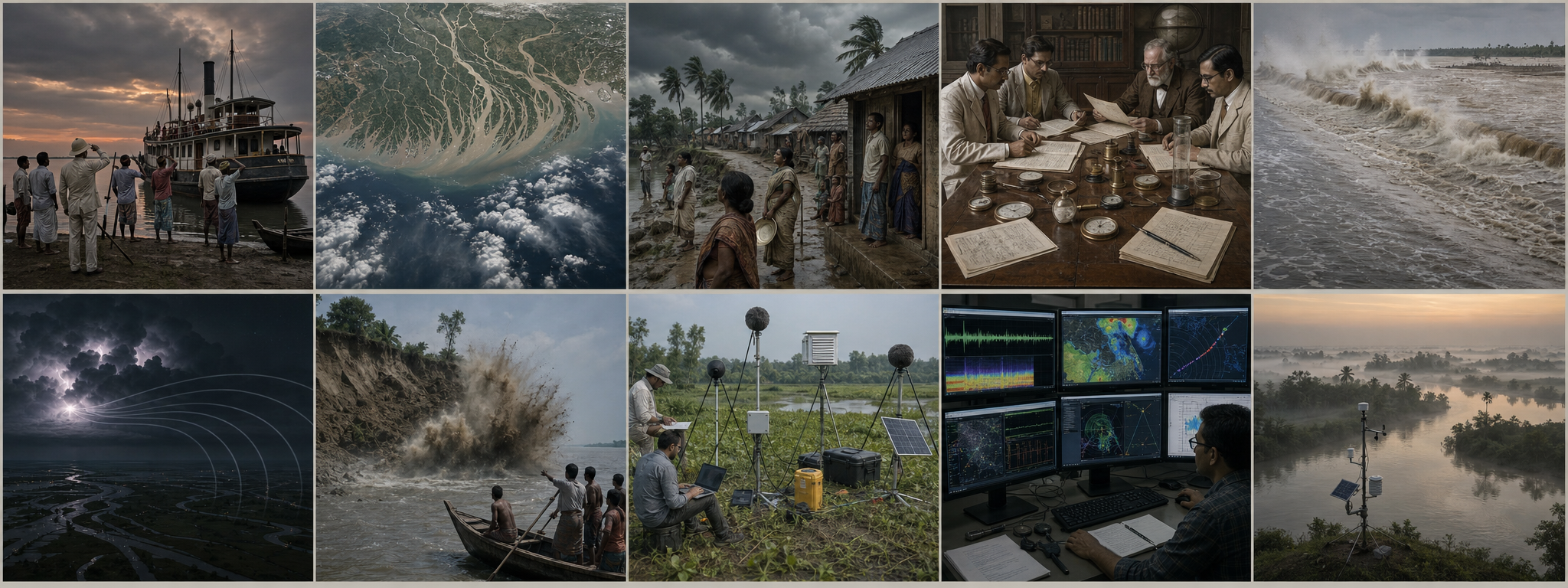
Original reconstruction 1/10 — A river steamer pauses in the Bengal delta while passengers and boatmen turn toward a boom with no visible source.
The steamer had settled for the night in a narrow channel. Its engine was quiet. Beyond the rails lay miles of wet grass, tidal creeks and dark tree lines. Then a report rolled out of the south: not the long speech of ordinary thunder, according to the witness, but a muffled detonation like a distant cannon. Sometimes it came alone. Sometimes two or three followed. It sounded far away, yet its apparent distance changed.
That scene comes from the observational tradition behind the Barisal Guns, cannon-like noises reported in and around the old Bakarganj district of Bengal, now in southern Bangladesh. The reports entered learned-society proceedings in the nineteenth century and caused a lively exchange in Nature in the 1890s. They were compared with the Belgian mistpouffers, Italian brontidi, German lake gunshots and the so-called Seneca Guns of North America.
The comparison is tempting. A name gives scattered noises a common identity. But a name can also hide differences. Some Barisal accounts say the sound came from the sea; others give another bearing. Some link it with rain; others describe calm weather. Some insist on triplets; an earlier committee summary records single, double and irregular volleys. Those contradictions are usually treated as defects in the story. I think they are the most valuable evidence in it.
1. First, locate the mystery correctly
Original reconstruction 2/10 — The Ganges–Brahmaputra–Meghna delta is not one shoreline but a moving network of rivers, islands and coastal channels.
Modern summaries often imagine a single town hearing a single noise from a fixed patch of water. The historical geography is untidier. “Barisal” became the convenient label, while reports ranged through a broad alluvial region: Barisal or Bakarganj, Khulna, Noakhali, Dacca-area locations and river routes between them. The nineteenth-century district and the modern city are not interchangeable. Nor was the shoreline fixed. Channels migrated, banks failed, islands accreted and the coast opened toward a storm-prone bay.
This matters because sound direction judged by ear is weak evidence, especially for low-frequency, reflected or refracted sound. A listener beside water may confidently point toward the apparent arrival direction rather than the source. A boom that reaches the listener after being bent through a temperature layer can arrive from the horizon. Echoes from cloud bases, water, vegetation or built surfaces can create a second report. A river channel can also provide a relatively quiet acoustic corridor at night.
The name should therefore be treated as a reporting category: unexpected explosive sounds in a wide delta. It is not yet a physical diagnosis.
2. What the oldest reports actually preserve
References to cannon-like sounds in the delta appeared in the Proceedings of the Asiatic Society of Bengal by the late 1860s and in correspondence during 1870. By the 1880s the Society tried something more disciplined: observers were asked to return forms describing time, place, weather, direction and character. Lieutenant-Colonel J. Waterhouse summarized material for the Society in 1888. This is an important transition from anecdote to a primitive network, but it was still a network without synchronized clocks, calibrated microphones or a shared definition of an event.
Original reconstruction 3/10 — Villagers listen during heavy pre-monsoon air, when ordinary background noise falls and distant low frequencies can dominate.
Waterhouse quoted a district account in which the sounds were heard like cannon fire in Bakarganj and parts of neighboring districts, especially around the beginning of the rains in May and June. At Barisal they were said to come from the south or southwest, often with a southerly wind and before rain. They might last a minute or continue for one or two hours, separated by minutes. Evening and night were common, though the writer sensibly suggested that people may simply notice them more when other noise has subsided.
A later description associated with Henry S. Schurr became famous because it was much more regular. A 1900 Popular Science Monthly summary says the sounds were heard most often from February to October, before, during or just after heavy rain, and that they came in triplets. The interval within a triplet was described as regular; on one occasion many triplets were counted in succession. The report was like heavy guns at a distance and was said to have a double quality or echo.
Now set that beside the committee material: single reports, doubles, five or six close reports and long irregular gaps also occur in the broader archive. One observer’s beautifully patterned subset cannot silently replace the whole record.
| Reported feature | What it supports | What it cannot prove |
|---|---|---|
| Cannon-like onset | An impulsive source or a sharply arriving low-frequency wave | Literal artillery, explosion or supernatural “gun” |
| South or southwest bearing | Possible Bay of Bengal, coastal or southern storm source | A precise source location; hearing direction can be distorted |
| Rain or pre-rain association | Thunder, surf state, bank failure and unusual sound propagation | That every event had the same weather |
| Night or evening reports | Low ambient noise and stable near-surface air | A uniquely nocturnal mechanism |
| Triplets in one series | A repeating source, echo geometry or selective observation | Universal triplets across all Barisal reports |
| No felt earthquake | Weakens a large nearby seismic event | Exclusion of small shallow events or nonseismic sources |
3. The investigation already contained its own error bars
Original reconstruction 4/10 — Historical investigators compare forms, watches, compasses and rain observations, but lack synchronized instruments.
The Asiatic Society’s circular was scientifically serious for its time. It was also vulnerable to four forms of distortion.
Clock error
Two observers could hear the same distant event and write different times, or hear unrelated events and appear synchronized. Household clocks were not a precision array. Without accurate common time, triangulation by arrival difference was impossible.
Vocabulary error
“Like a cannon” describes resemblance, not waveform. One listener may call a low thunderclap a gun; another may reserve that word for a sharp crack. Translation among Bengali speech, administrative English and later summaries added another filter.
Selection error
Once the Barisal Guns became known, observers preferentially recorded sounds that matched expectation. A remembered triplet is more narratively satisfying than an isolated thump. Regularity can be amplified by the archive even when nature is irregular.
Location error
An apparent direction is not a bearing measured by an array. Refraction can return sound to the ground from above; reflection can move its apparent origin; multiple paths can make one event sound like two. The old forms tell us what people perceived. They do not supply the source coordinates.
4. Test the shore before invoking the sky
Original reconstruction 5/10 — A long monsoon swell breaks almost simultaneously along a low delta coast, producing a large low-frequency impulse.
One early proposal was surf. During the monsoon, long swells can strike a broad section of coast. If a wave front breaks nearly together along kilometers of shoreline, many impacts may merge into one low boom. Low frequencies lose less energy than high frequencies, and a listener far inland may hear the result without hearing the ordinary hiss and crash of the beach.
The hypothesis earns several points. Reports often seemed to arrive from the south, where the bay lay. The rainy season changes sea state. Coastal sounds can travel unexpectedly under favorable atmosphere. A sequence of large swell groups could produce repeated reports.
But “surf” alone is too simple. The reported area extended far inland. Not every account agreed on season or direction. The sharp cannon resemblance and sometimes rapid spacing demand an unusually coherent impact, not routine breaking waves. Most importantly, no historical observer synchronized a boom at Barisal with measured swell at a particular coastal segment.
Surf is therefore a plausible source candidate, especially for some south-bearing monsoon events. It is not a demonstrated universal answer.
5. Thunder can arrive without its storm
Original reconstruction 6/10 — Distant thunder is bent back toward the delta beneath a temperature inversion, crossing the visual horizon before reaching listeners.
This is the mechanism that best organizes the largest part of the record: a real impulsive source far away, most often thunder or another loud event, carried by anomalous atmospheric propagation.
Thunder is an acoustic shock produced when lightning rapidly heats and expands air. Normally its higher frequencies fade quickly, and ordinary refraction can bend sound upward, leaving a ground-level listener in a quiet zone. Under a temperature inversion—warmer air above cooler air—sound speed increases with height and rays can bend downward again. Wind gradients can reinforce or oppose that bending. A listener far from the storm may receive a narrow low-frequency arrival while seeing no lightning and no cloud overhead.
The U.S. National Oceanic and Atmospheric Administration explains that inversion conditions can return thunder waves toward the ground and make them much louder. Modern infrasound research likewise shows that the atmosphere contains changing acoustic waveguides. They create shadow zones, unexpected arrivals and misleading back-azimuths. The source can be ordinary; the path is extraordinary.
This model explains several Barisal traits at once:
- A boom can come from the horizon without a visible nearby source.
- Rain association is expected because convective storms supply thunder, while nearby skies may remain quiet.
- Nighttime stable layers can favor long-range propagation and lower local background noise.
- One lightning complex can create several impulses; multipath arrivals can add an apparent echo.
- Different listeners may report different directions because wind and temperature structure bend the path.
It also explains why the “guns” could disappear for years from a place without any geological machinery switching off. The required source, atmosphere and listener geometry do not align every day.
6. The ground and river remain in the suspect list
Original reconstruction 7/10 — An alluvial bank collapses into floodwater, testing a local source that can resemble a heavy report.
The delta itself is noisy. Saturated banks slump. Large masses of sediment fall into channels. Timber breaks. Gas can vent from mud. Boats, distant blasting and later industry add their own impulses. An observer after dark may see none of these sources.
Bank collapse was discussed early because the alluvial rivers continually undercut their margins. A substantial failure can make a heavy splash and transmit vibration through water and saturated soil. Yet it is usually local, should often leave visible disturbance, and does not naturally explain widespread southward bearings or the recurring rain-linked cannon metaphor.
Seismic sound is physically real. The U.S. Geological Survey notes that small, shallow earthquakes can produce audible booms even when people feel little or no shaking. High-frequency ground motion couples into the air near the source. The delta and the active regional tectonic setting make seismicity impossible to dismiss in principle.
But historical Barisal reports rarely provide the paired evidence needed: a measured ground signal, common arrival times across stations and an acoustic waveform. Repeated triplets linked with heavy rain are not a natural fingerprint of one shallow earthquake process. A seismic mechanism may explain individual reports; the archive does not justify turning it into the answer for all of them.
Excellent sound match; poor universal fit. No matching battery or operation was found for the classic remote accounts, though ordinary human sources could contaminate later reports.
Good geographic and seasonal fit for part of the record; weakened by distance, inconsistent directions and absence of synchronized wave observations.
Common in a monsoon delta and locally explosive; too limited to explain the whole reported region and repeated distant bearings.
Known to make booms without strong felt shaking; unverified for historical events and weak on rain/triplet patterns.
Can produce enormous unexplained reports; too rare to carry a long recurrent seasonal tradition.
Best overall fit to horizon arrival, weather, night audibility, intermittency and echo-like repetition; not retrospectively provable for each event.
7. The triplets do not solve the case
The most dramatic clue is the claim that the guns “always” came in threes. Three suggests mechanism: perhaps three waves, three reflections, three underground fractures, three ritual shots. It is also exactly the kind of clean pattern that should make us return to the raw archive.
The broader nineteenth-century material is not uniformly triplet-based. It contains singles, doubles and volleys. Schurr’s detailed observations can still be accurate for his place and period. A particular distant source could repeat three times. A direct arrival and one or two refracted paths could be perceived as a patterned sequence. A listener primed to count groups could divide a longer irregular series into threes.
What we cannot do is elevate one observer’s regularity into a law of Barisal acoustics. If the entire phenomenon truly operated in stable triplets, a modern array could test spacing, spectrum and direction immediately. The historical evidence instead warns that “the Barisal Guns” had already become a composite before scientists tried to explain it.
The cleanest clue may be the least representative clue. A mystery becomes harder, not easier, when later retellings erase its irregular observations.
8. A modern experiment would treat every boom as unknown
Original reconstruction 8/10 — A synchronized microphone, infrasound, seismic and weather array is deployed across the delta.
The old investigators asked the right human questions. A decisive project would add instruments and refuse to label an event until the records agree.
- Deploy at least three synchronized acoustic stations. GPS time would allow arrival-time differences to estimate a bearing and, with enough geometry, a source region.
- Record audible sound and infrasound. A sharp blast, thunder, surf and a bank collapse have different spectral envelopes and durations, even when witnesses call each a cannon.
- Co-locate broadband seismometers. Ground-first arrivals would support a shallow earthquake, collapse or nearby blast; air-only arrivals would favor an atmospheric or distant surface source.
- Measure the atmosphere vertically. Surface weather alone is insufficient. Radiosondes or high-resolution models must capture wind and temperature layers along the entire path.
- Cross-check lightning networks and weather radar. A storm beyond the visible horizon may be the actual “battery.”
- Check waves, tides, erosion and river stage. Cameras and gauges at candidate coastal and river sites would test surf and bank-failure proposals.
- Check aircraft, ships, quarrying and controlled explosions. Human activity is the first exclusion, not an embarrassing afterthought.
- Publish negative matches. The unexplained residue matters only after ordinary sources have been removed with the same rigor.
Crucially, the system should not seek “the Barisal Gun waveform.” It should build clusters. Thunder-like events may form one cluster, local collapses another and unidentified short impulses a third. A named folklore category can split into several physical populations.
9. How one ordinary boom becomes impossible artillery
Original reconstruction 9/10 — A modern analyst compares acoustic waveforms with radar, lightning, ship and seismic records instead of trusting resemblance alone.
Imagine lightning inside a storm over the Bay of Bengal. The flash is below the visual horizon. Its acoustic pulse rises through warm, humid layers. Most of the energy escapes, but a low-frequency portion enters a favorable wind and temperature gradient. It bends downward and touches the delta far away.
The first listener hears a dull report. A second path, reflected or refracted differently, arrives moments later and is heard as another gun or an echo. A separate lightning channel provides a third pulse. In Barisal the sky overhead appears quiet. The sound seems to come from the southern horizon. Because a cannon is the closest familiar analogue, the witness records a cannon.
Another night, a riverbank fails near a boat and produces a similar word in the ledger. Months later, long swell creates a coastal impulse. These events have different sources but converge in human description. The archive then groups them by the word gun. Researchers inherit a category created by perception rather than physics.
This reconstruction is not a claim that every report was distant thunder. It shows how the strongest family of evidence can emerge without a hidden cannon, a submarine volcano or a supernatural agency. The mechanism needs no new physics. It needs a loud source, a selective atmosphere and a listener who cannot see the first two.
10. What remains genuinely unresolved
Three questions survive honest analysis.
First, how large was the real core? We know the tradition was not invented from nothing: multiple witnesses and institutional records exist. We do not know how many reports describe independent events, how many retell the same event or how many were drawn into the category after the name became famous.
Second, did one recurrent source dominate a particular place? Schurr’s patterned triplets may preserve a stable local source or propagation geometry. The surviving summaries do not contain enough instrument-quality detail to identify it.
Third, why did reports apparently become rarer? The source environment may have changed; settlement and transport noise may mask the sounds; observers may use new labels such as thunder, engine noise or sonic boom; or the historical archive may exaggerate the decline. Rarity today is not proof that the old events ceased.
Original reconstruction 10/10 — Dawn after rain: the landscape is quiet, while an unattended station waits for the next measurable event.
At dawn the delta looks incapable of artillery. Mist hangs above the channels. A pressure sensor clicks through its log. No brass gate has opened beneath the water; no ghost battery stands in the mangroves. Yet the silence does not retroactively explain the people who turned toward the horizon.
The right ending is narrower than “solved” and stronger than “anything is possible.” The sounds were real enough to merit investigation. The evidence for a single exotic source is weak. Established acoustics can reproduce the central paradox: a powerful report, heard far from a source that remains invisible to the listener. Historical data cannot assign that mechanism to every event, and the internal contradictions strongly suggest that no single assignment is appropriate.
Sources and further reading
- G. H. Darwin, “Barisàl Guns” and “Mist Pouffers,” Nature 52 (1895)
- D. G. F. Grant and G. B. Scott, “Barisal Guns,” Nature 53 (1896)
- T. D. La Touche, “The Barisal Guns and Similar Sounds,” Nature 53 (1896)
- H. S. Olcott, “The Barisál Gun,” Nature 53 (1895)
- Proceedings of the Asiatic Society of Bengal (1888), Waterhouse report and historical returns
- Popular Science Monthly (1900), contemporary summary of Henry S. Schurr’s observations
- U.S. Geological Survey, Earthquake Booms, Seneca Guns, and Other Sounds
- David P. Hill, “What Is That Mysterious Booming Sound?” Seismological Research Letters (2011)
- NOAA JetStream, The Sound of Thunder and inversion refraction
- U.S. Naval Research Laboratory Review (2013), atmospheric infrasound propagation and acoustic shadow zones
- Seismological Society of America, La Touche chronology and bibliography
- The Daily Star, “The Mystery of the Barisal Guns” (2018), Bangladesh historical overview
The ten illustrations are original editorial reconstructions created for this article. They visualize historical observation settings and testable physical hypotheses; they are not documentary photographs of a specific recorded boom. Confirmed facts and cited historical descriptions are separated above from the author’s reconstruction and verdict.