At first, the case seemed to have a center. Two bicycles lay beside a recreational trail near Meyers Lake in Evansdale, Iowa. Searchers gathered there. Divers entered the water. The lake was lowered. Maps, dogs, boats, volunteers and aircraft converged on the last physical objects that ten-year-old Lyric Cook-Morrissey and eight-year-old Elizabeth Collins had left behind.
But the center was false. The girls were not in the lake. On December 5, 2012, nearly five months after they vanished, hunters found their bodies in the Seven Bridges Wildlife Area in rural Bremer County. The Iowa Department of Public Safety places that discovery approximately twenty-five miles from the Black Hawk County location where the girls disappeared. The distance between those two places—not any publicly named suspect—is the part of the case I think deserves the hardest attention.
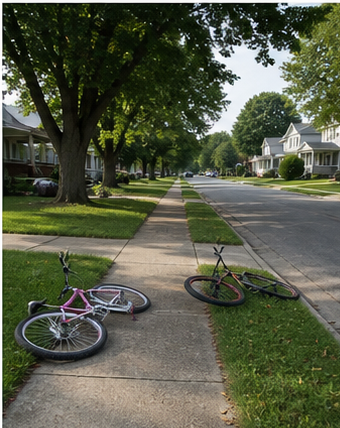
Editorial reconstruction: an ordinary Iowa neighborhood before an ordinary bicycle ride. The image contains no depiction of the victims and is not a photograph of the historical scene.
1. Begin with the ordinary, not the ominous
On Friday, July 13, 2012, Lyric and Elizabeth left for a bicycle ride in Evansdale. The official ten-year update issued by Iowa DPS states the essential fact without embellishment: the cousins went out riding and did not return. Contemporary reporting placed their departure shortly after noon. ABC News reported that they left Elizabeth's house at about 12:15 p.m., were seen at a nearby intersection around 12:23, and were seen again between roughly 12:30 and 1:00 near the lake road. Those times came through early reporting rather than a complete public police chronology, so I treat them as approximate.
That distinction matters. A timeline can look precise because it contains minutes, yet remain porous because the public does not know how each observation was tested. The safest account is therefore simple: the girls were mobile, together, and within a familiar part of Evansdale during the early afternoon. Their bicycles were later found near the recreational trail at Meyers Lake. Elizabeth's purse was also recovered there, according to multiple contemporary reports.
The ordinary setting changes the investigative problem. This was not a disappearance from a locked room or an isolated mountain trail. It began on a summer bicycle route inside a community. Any useful reconstruction must explain how a routine ride crossed into a situation in which two children could be controlled and removed before a search closed around the lake.

Editorial reconstruction of the trail-and-lake environment. It illustrates the public geography; it does not claim the bicycles were positioned exactly as shown.
2. The bicycles are a boundary marker
An abandoned bicycle is easy to read as a clue about destination: perhaps its rider entered the water, walked into the trees, or met someone nearby. I read the two Evansdale bicycles differently. They mark the point where self-directed travel probably ended.
Before that point, Lyric and Elizabeth controlled their own movement. A bicycle carries a child only as far and as fast as the child chooses to pedal. After the bicycles were left behind, the later discovery site required a movement of approximately twenty-five miles. That is not a continuation of the ride. It is a transfer into a different transport system.
This does not prove that the first contact occurred precisely beside the bicycles. The girls could have stopped voluntarily, been called over, walked a short distance, or encountered someone on another segment of the trail. Nor does it prove that the bicycles were deliberately arranged. What it does establish is an operational break: the machines that had carried the girls through town did not carry them to Seven Bridges.
Investigators later sought the driver of an older-model white full-size sport-utility vehicle reported near Meyers Lake along Arbutus Street on July 13. They explicitly said that the occupants were not then suspects or persons of interest; they might simply have held important information. That caution should be preserved. A vehicle description is not an identity, and a request for a witness is not an accusation. Still, the request shows why the road environment matters: a vehicle could belong either to the mechanism of the crime or to the missing witness who saw that mechanism.
The transfer problem
| Segment | What the public record supports | What remains unknown |
|---|---|---|
| Home to lake area | The girls traveled together by bicycle during the early afternoon. | The exact route and reliability of every reported sighting. |
| Lake contact zone | The bicycles and a purse were recovered near the trail. | The contact point, approach, words used, duration, witnesses. |
| Evansdale to Bremer County | The bodies were ultimately found about twenty-five miles away. | Vehicle, driver, route, timing, intermediate stops. |
| Seven Bridges site | Hunters found the bodies on December 5 in a remote wildlife area. | When they were placed there and the full forensic condition of the site. |
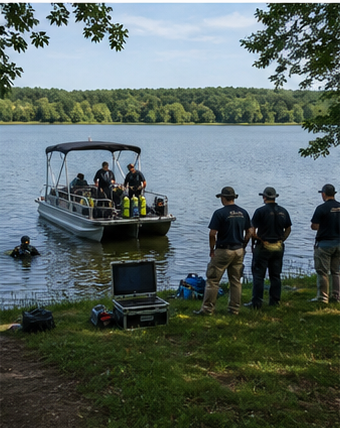
Editorial reconstruction of the water search, included to show how strongly the recovered bicycles pulled early resources toward the lake.
3. The lake became a necessary false center
The decision to search Meyers Lake was not a mistake. It was the responsible response to the available evidence. Contemporary Associated Press reporting described a nearly five-acre lake being drained while FBI tracking dogs and specialist resources joined the effort. Divers and sonar were used. Hundreds of volunteers searched the surrounding area. Authorities could not ethically ignore the possibility of an accidental entry into the water simply because abduction also seemed possible.
Yet a search has a psychological geometry. People, cameras and attention gather where objects are found. The bicycles gave the emergency a visible anchor. Every hour spent disproving the lake hypothesis was necessary, but every hour also revealed how efficiently two light objects could focus a community on one compact place while the girls themselves were elsewhere.
I do not conclude that the offender intentionally placed the bicycles to stage an accident. The public evidence does not establish that. They may simply have remained where the girls were forced to leave them. The more defensible conclusion is weaker: whether planned or not, the abandoned bicycles generated ambiguity. Water, trail, neighborhood and road all remained possible directions at once.
The lake did not conceal the girls. It concealed the shape of the problem by offering too many plausible explanations for why the bicycles had stopped there.
On July 20, one week after the disappearance, the case was publicly classified as an abduction. Early statements expressing hope that the girls were alive must be understood in their time: investigators were protecting possibilities while evidence was still developing. Later discovery transformed the interpretation, but it should not be projected backward as if searchers knew in July what December would reveal.
Editorial reconstruction of a volunteer command table. The documents are deliberately unreadable and do not reproduce investigative records.
4. A community search creates two clocks
Once a disappearance is reported, two clocks begin. The first is operational: calls, canvasses, aerial searches, interviews, warrants, tips and laboratory work. The second belongs to the offender: the shrinking opportunity to move, clean, alter or conceal evidence as public attention expands.
In Evansdale, the operational clock accelerated quickly. Volunteers swept the area. The lake was searched and drained. Local, state and federal agencies joined the investigation. The official 2022 update described a long-term team involving the Bremer County Sheriff's Office, the Iowa Division of Criminal Investigation and the FBI, supported by intelligence analysts in Omaha and Des Moines. By then the case file had accumulated nearly 2,000 leads, including 117 tips in the preceding ten months alone.
The size of a file can be mistaken for progress. Two thousand leads are not two thousand equally promising doors. Each must be compared with nonpublic facts, checked against time and geography, and either developed or set aside. The investigative advantage is that a genuine tip may contain a detail never released. The disadvantage is that publicity produces enormous volumes of sincere but low-information reports.
“Probably” is essential. Public sources do not disclose the investigators' definitive window, and the bodies' condition may have complicated timing. I am not assigning a minute. I am identifying the interval with the greatest explanatory power.
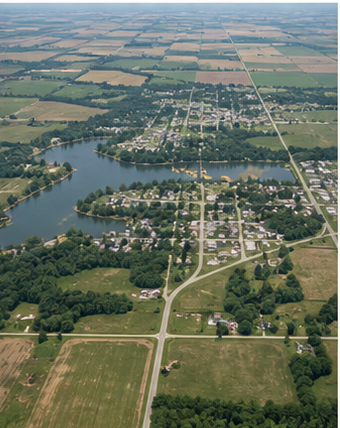
Editorial aerial reconstruction of the transition from a compact town lake to the rural road network. It is not a route map.
5. Twenty-five miles is not just distance
A straight measurement between two points tells little about a crime. The useful question is what the distance required someone to know and do. The official figure—approximately twenty-five miles—crosses a county boundary and joins two very different landscapes: an accessible recreational area in Black Hawk County and a remote wooded wildlife area in Bremer County.
For the offender, the transfer created costs. Two children had to be controlled. A vehicle had to be accessible without attracting decisive notice. Roads had to be chosen. The destination had to offer privacy. If the bodies were left at Seven Bridges soon after the abduction, the offender also had to believe that the site would not be discovered immediately. If they were moved later, the offender accepted an even greater logistical risk. The public record does not tell us which happened.
In 2015, after consultation with national experts, investigators publicly emphasized Seven Bridges and people familiar with it. Evansdale Police Chief Kent Smock said authorities had no doubt that the responsible person or persons were familiar and comfortable with the area. That is a meaningful official assessment, not proof that the offender lived nearby. Familiarity can come from hunting, fishing, employment, family visits, former residence, recreation, maintenance work or repeated travel.
The transfer therefore suggests a dual familiarity: enough knowledge of Evansdale's lake-and-trail environment to exploit or intercept a routine ride, and enough confidence in Seven Bridges to select it as a secluded endpoint. One person could possess both. Two people could divide those roles. The evidence made public does not permit a responsible choice between those models.
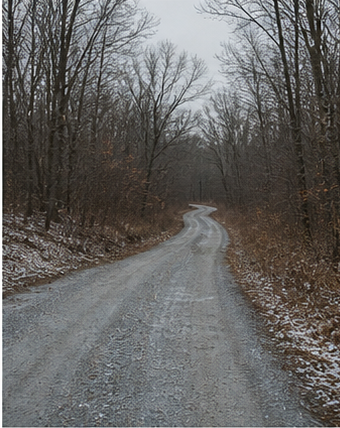
Editorial reconstruction of a remote gravel access road in late autumn. The image is environmental, not a representation of the recovery site.
6. The recovery site changed the case
On December 5, hunters discovered two bodies in the Seven Bridges Wildlife Area. Authorities searched the 125-acre county-owned area and roadside ditches along 270th Street. On December 10, the Iowa state medical examiner confirmed that the remains were Lyric and Elizabeth. Five months of uncertainty ended in identification, but the central criminal questions remained.
The causes of death have not been released publicly. That silence is not an empty space that internet theories are entitled to fill. In 2024, KCCI reported that authorities continued to withhold the information because it is something the killer would know. A withheld fact can test confessions, evaluate tips and distinguish direct knowledge from repetition. Publishing guesses would weaken rather than strengthen an evidence-led account.
The site itself contributed a different kind of evidence: access, terrain, seasonality and discovery conditions. Hunters found the girls in December, not casual summer visitors in July. That does not prove the bodies were present throughout the entire interval. It does show that the area could resist ordinary discovery long enough for weather, vegetation and time to affect what investigators later recovered.
Three meanings of the five-month interval
First, concealment. The place was sufficiently secluded that the girls were not found despite an immense public search focused elsewhere.
Second, forensic erosion. Heat, rain, animals, leaf fall, freezing conditions and time can damage biological and trace evidence. The precise effects depend on circumstances that are not public.
Third, behavioral confidence. Choosing such a site may indicate that the offender understood when and how people used it. This is the strongest inference, but even it remains probabilistic. A first-time visitor can get lucky; a familiar visitor can make mistakes.
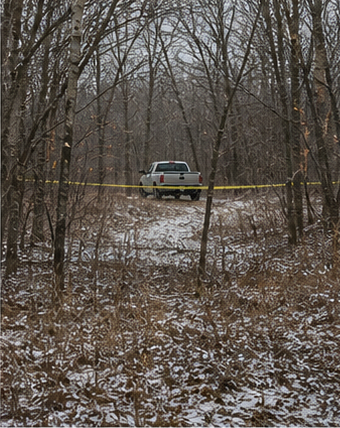
Respectful editorial reconstruction of winter woodland and a distant police perimeter. No victims, remains or violence are depicted.
7. What the woods can say without naming anyone
True-crime discussion often jumps from location to suspect. That leap is especially dangerous here. A wooded recovery site does not identify a hunter. A rural road does not identify a local resident. A white SUV report does not identify its owner as an offender. Location evidence first defines capabilities and habits, not names.
The Seven Bridges emphasis supports several restrained filters. A relevant person may have known the access roads, understood the site's seclusion, had reason to travel between the Cedar Valley and rural Bremer County, and possessed a schedule that allowed the movement. Investigators can compare those filters against vehicle history, device records, employment, family links, interviews and nonpublic forensic facts. Readers cannot perform that comparison from public fragments.
This is also why broad lists of “suspects” are low-value. A person may be suspicious in a general sense yet fail the geography, time, evidence and corroboration tests. Conversely, the right person may appear unremarkable until an old vehicle record, archived communication or overlooked witness statement connects both landscapes.
8. The white SUV is a witness request, not a conviction
In June 2013, investigators asked to speak with the occupant or occupants of an older-model white, full-size SUV, possibly similar to a Chevrolet Suburban or Ford Bronco, reportedly parked at or near Meyers Lake along Arbutus Street on the day the girls vanished. Their statement stressed that the people in the vehicle should not be considered suspects or persons of interest.
There are at least three logically distinct possibilities. The report could concern an irrelevant vehicle. The occupant could be a witness who saw something but did not recognize its importance. Or the vehicle could be connected to the transfer. Public evidence does not choose among them.
Vehicle memories are vulnerable to color, model and timing errors. “White SUV” is a broad category. Years later, an innocent person's vehicle may be sold, repainted or forgotten, while rumors harden an approximate description into a fictional license plate. The disciplined use of the clue is to preserve the original scope: identify and interview the occupant, compare their account with known facts, and avoid treating absence of identification as proof of guilt.
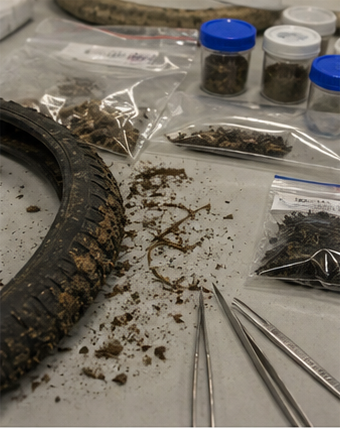
Editorial forensic still life. The objects illustrate categories of trace evidence; they are not Evansdale case exhibits.
9. The evidence ledger: what each item can carry
| Publicly known item | Potential evidentiary value | Limit |
|---|---|---|
| Two bicycles | May define the end of voluntary travel; may retain touch, fiber, soil or position information. | Public reporting does not disclose the usable forensic results or prove deliberate staging. |
| Elizabeth's purse | May help reconstruct what was left at the contact zone and whether possessions were abandoned abruptly. | Its exact condition, contents and placement have not been fully made public. |
| Lake search | Strongly reduces accidental drowning as an explanation and documents the early response. | A negative search does not reconstruct the abduction mechanism. |
| White SUV report | Could identify a witness, timeline point or transport opportunity. | The driver was not publicly designated a suspect; memory may be imperfect. |
| Seven Bridges site | Connects the crime to a secluded rural place and supports a familiarity inquiry. | Does not identify a particular local user or establish when the bodies arrived. |
| Withheld cause of death | Can authenticate a confession or tip and protect prosecutorial integrity. | Cannot responsibly be inferred from rumor. |
| Nearly 2,000 leads by 2022 | Provides a large archive for re-analysis, cross-linking and future comparison. | Volume is not quality; most leads may be unrelated or uncorroborated. |
The ledger reveals a case rich in context but poor in publicly disclosed individualizing evidence. We can describe movement and environment more confidently than identity. That asymmetry explains both the persistence of the investigation and the ease with which speculation outruns it.
10. One offender or more than one?
Controlling two children is more difficult than controlling one. That fact sometimes leads commentators to insist on multiple offenders. The conclusion is not necessary. One adult can use authority, deception, a vehicle, a weapon that is never used, or concern for one child to control the other. More than one offender is also possible. Without the girls' accounts, complete scene evidence or a confession, the number cannot be derived from difficulty alone.
The same caution applies to acquaintance. The girls might have entered a vehicle because they recognized the driver, because the driver created a plausible emergency, or because force or threat left no real choice. Familiarity with the recovery site does not tell us whether the offender was familiar to the victims.
I therefore keep three questions separate:
Was the contact planned? The timing and two-location structure are compatible with planning, but opportunity could have been exploited quickly.
Did the girls know the offender? Public facts do not answer this.
How many offenders were involved? The logistics allow one or more. No public evidence responsibly settles it.
Separating these questions prevents one assumption from quietly proving another. A planned contact need not involve an acquaintance. A lone offender need not have used overt violence at the trail. A remote recovery site need not mean a long-planned crime. Each proposition requires its own evidence.
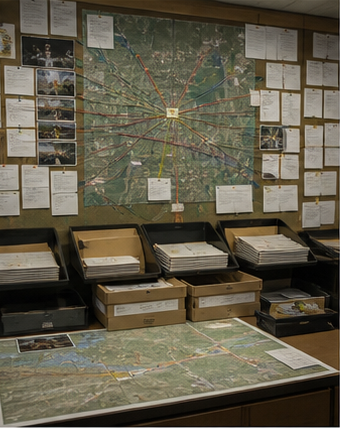
Editorial reconstruction of a cold-case review room. The routes and tip cards are fictional and deliberately illegible.
11. Why an old tip can become new evidence
The official 2022 update described investigators repeatedly evaluating both historical information and new submissions. That is not bureaucratic repetition. Old data change value when a new anchor appears. A vehicle sale once considered routine can matter after a model is confirmed. A phone number can matter after another account is identified. Two individually weak tips can become strong if they independently place the same person at both locations.
Modern analysis can also reorganize rather than replace old police work. Geographic-information systems can compare travel times and access routes. Digitized records can reveal repeated names or numbers. Improved laboratory techniques may recover more information from preserved material, depending on what exists and how it was stored. None of this guarantees that usable DNA is present, and no responsible account should promise a genetic-genealogy solution without official confirmation.
The value of the nearly 2,000 leads is therefore relational. A detail that looked insignificant in isolation may become a bridge between Meyers Lake and Seven Bridges. The most useful future tip would not merely name a disliked or strange person. It would explain a vehicle, a schedule, knowledge of the wildlife area, an unexplained behavior change, or a statement containing a fact that was never public.
12. What I reject
I reject the idea that the drained lake was wasted effort. It removed a dangerous alternative and established a stronger basis for abduction.
I reject the idea that a vehicle request equals a suspect announcement. Investigators said the opposite. Turning a witness request into an accusation destroys the precision the clue needs.
I reject suspect lists built from unrelated criminal histories. A bad past is not evidence of this crime. The relevant test is a corroborated connection to time, transport, both landscapes and nonpublic facts.
I reject invented forensic certainty. The public does not know the cause of death, the complete condition of the bodies, the full laboratory results or the exact chronology of the recovery site.
I reject the claim that the case is inactive simply because it is unsolved. The official record describes sustained local, state and federal review. Unsolved means the evidentiary threshold for an arrest and prosecution has not been met publicly; it does not mean the file is abandoned.

Editorial reconstruction of modern analytical tools. It represents possibilities for review, not a claim that a technological breakthrough has occurred.
13. My reconstruction
My reconstruction begins with an ordinary ride and ends with two distinct crime environments. Lyric and Elizabeth traveled through Evansdale under their own power. Somewhere in the lake-and-trail contact zone, that control ended. The bicycles remained; the girls entered a different movement system. Because the recovery site was about twenty-five miles away, a motor vehicle is the most practical explanation, though the public record has not identified it.
The transfer likely occurred before the community understood the scale of the emergency. The offender then used, or had already selected, a rural location that offered concealment. Investigators' later emphasis on familiarity with Seven Bridges makes prior comfort with the area more persuasive than random discovery, while stopping short of identifying a resident, hunter or worker.
The five-month interval damaged the public's ability to know what happened and probably complicated forensic recovery. It also created the case's most durable investigative advantage: only the offender and investigators know certain details about the deaths and placement. Those withheld facts can still discriminate truth from performance.
This conclusion is intentionally limited. It does not prove motive, relationship, number of offenders, exact route or time of death. But it ranks the evidence. The bicycles tell us where autonomous movement stopped. The lake search tells us what did not happen there. The twenty-five-mile separation requires transfer. Seven Bridges tells us what kind of destination the offender trusted. And the still-withheld details explain why a single accurate tip may be more valuable than another thousand names.
Sources and evidentiary notes
- Iowa Department of Public Safety, “Evansdale Murder Investigation Continues 10 Years Later” — official ages, dates, approximately twenty-five-mile distance, participating agencies, lead count and active tip review.
- KCCI, “Who killed Elizabeth Collins and Lyric Cook? 12 years later…” — 2024 status, no arrest and explanation for withholding the cause of death.
- The Gazette, December 6, 2012 — recovery search, size of the wildlife area and contemporary official statements before identification.
- ABC News, December 10, 2012 — medical examiner identification and summary of bicycle/purse recovery.
- ABC News, December 5, 2012 — contemporary chronology, lake search and initial recovery reporting.
- The Gazette, June 24, 2013 — older white SUV witness request and investigators' warning that the occupants were not suspects or persons of interest.
- CBS News / Associated Press, July 17, 2012 — early search, lake draining, tracking dogs and volunteer response.
- ABC News, July 21, 2012 — contemporary abduction classification and search posture one week after the disappearance.
- KCCI, January 2015 — investigators' public focus on people familiar and comfortable with Seven Bridges.
- KCRG, December 6, 2023 — continuing unsolved status and confirmation that causes of death remained undisclosed.
- The Gazette, July 13, 2021 — anniversary update, active tips and reward information at that time.
Method note: This article separates published facts from the author's inferences. Approximate sighting times come from contemporary reporting and are not presented as a complete police chronology. The generated editorial images illustrate environments and investigative concepts; they do not reproduce the victims, bodies, original exhibits or undisclosed crime-scene details.