In December 2022, a sixty-five-year-old Philadelphia mystery changed shape. The child once reduced to a label—“the Boy in the Box”—was publicly identified as four-year-old Joseph Augustus Zarelli. That announcement closed a question that had shadowed the case since 1957. It did not close the homicide.
I returned to the file because the identification is often described as though the entire mystery had been solved. It had not. A name can restore a person to history, reveal biological relatives, and give investigators a new map of records to examine. A name cannot, by itself, tell us who had custody of a child during his last days, who injured him, who carried a box into a winter wood, or who chose silence afterward.
My investigation therefore begins with two folders on the same desk. The first is the identity file: who was the child? The second is the accountability file: what happened to him, where did it happen, and who was responsible? For decades both folders were almost empty. Genetic genealogy filled much of the first. The second remains open.
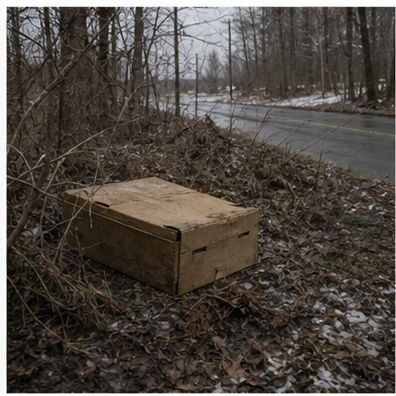
Editorial reconstruction: a winter roadside in the Fox Chase area and the closed container that began the investigation. No victim or human remains are depicted.
1. The first scene: an object before a person
In late February 1957, a cardboard box was found in a wooded part of the Fox Chase area of Northeast Philadelphia. Inside were the remains of a young boy. Contemporary and later accounts differ by a day on the precise discovery date, so I do not pretend that a disputed calendar square is more certain than the record allows. What is not disputed is the essential scene: winter ground, a container associated with a J. C. Penney bassinet, a multicolored blanket, and a child who had suffered severe mistreatment.
The location gave detectives a disposal site. It did not automatically give them the place where the fatal violence occurred. That distinction is basic and important. A body can be moved. Packaging can be carried. A roadside can be selected because it is familiar, because it is quiet, because it lies along a convenient route, or simply because an offender sees an opening. Treating the recovery site as the murder site would collapse several unknown journeys into one convenient assumption.
The physical condition of the child made the case a homicide investigation, but the most urgent operational problem was identity. Investigators could not reconstruct the final household, recent movements, medical history, school contacts, neighbors, or caregivers until they knew whom they were investigating. The child had no usable name in the file. Every ordinary question—where did he sleep, who last saw him, who should have reported him missing—stopped at that blank.
This is why the box mattered in two different ways. It contained potential trace evidence for the homicide file, yet it also became a public symbol for the identity campaign. The symbol was memorable, but it risked swallowing the child. In reviewing the case now, I use Joseph’s name wherever possible. The old label belongs to the history of the investigation, not to his identity.
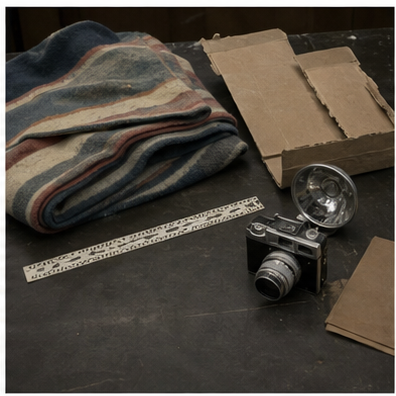
Editorial evidence study: blanket, cardboard fragments, scale and camera arranged to show how ordinary objects can carry very different investigative values.
2. What the 1957 evidence could—and could not—say
The blanket and cardboard box were not clues in the cinematic sense, waiting to reveal one address under a magnifying glass. They were mass-produced objects that might narrow a search only if their distribution could be connected to a purchaser, household, witness, or local record. The bassinet box offered a commercial trail, but a cardboard container may be reused, borrowed, discarded, or passed between people. The blanket might have been owned by the child’s household, taken from somewhere else, or chosen only for transport. Possession was not provenance.
Investigators also worked from Joseph’s estimated age, physical characteristics, condition, and postmortem presentation. Those observations could support a missing-child comparison, but only if the correct child had been reported missing, described accurately, and entered into a system that could be searched across jurisdictions. In 1957, there was no national digital network capable of instantly comparing an unidentified child in Philadelphia with every local welfare record, hospital ledger, family court file, school absence, or missing-person report.
That technological limitation is only half the problem. A search system cannot return a record that was never created. If the people responsible for a child’s care did not report him missing, or if he lived outside institutions that would notice a sustained absence, the identity campaign had to depend on someone recognizing an image, description, garment, blanket, or story. Silence was not merely a social failure surrounding the case; it was an information barrier built into the case.
Police circulated descriptions and images widely. Newspapers, posters, letters, calls, and tips produced an enormous amount of activity. Activity, however, is not the same as discrimination. Hundreds of messages can expand a file while making the true signal harder to recognize. Each lead has to be tested against age, chronology, geography, family records, and the physical evidence. A vague resemblance or an emotionally certain caller is not identification.
3. The city searched for a face
The early investigation was unusually public. The child’s image was distributed in the hope that a neighbor, relative, doctor, barber, shopkeeper, teacher, social worker, or acquaintance would recognize him. Investigators contacted institutions and pursued reports far beyond Philadelphia. The effort demonstrates something easy to miss when we look backward through the triumph of DNA: the case did not remain unsolved because no one tried to identify him.
The more revealing question is why recognition failed. One possibility is that the right observer never saw the material. Another is that the child’s appearance at death did not match the observer’s memory of him. A third is that the people who knew him best were unwilling, frightened, dependent, implicated, or otherwise unable to speak. A fourth is that his social footprint was so restricted that only a small circle could have recognized him with confidence.
Those possibilities are not interchangeable. They imply different lives before death. A child visible in school, church, clinics, shops, and a dense neighborhood produces a wide recognition network. A child kept largely within a home, moved between caregivers, or absent from formal enrollment produces a narrow one. The failed campaign therefore tells us something probabilistic: Joseph’s identifying network was either not reached, not able to recognize him, or not willing to respond truthfully. It does not tell us which of those conditions existed.

Editorial reconstruction: a 1957-era print and telephone room, where photographs, maps, files and incoming tips multiplied faster than they could be verified.
4. A long investigation is not one continuous investigation
It is tempting to imagine a cold case as a sealed box waiting unchanged on a shelf. In reality, a case lives through generations of investigators, changing storage practices, new laboratory methods, reorganized agencies, deteriorating paper, lost memories, deceased witnesses, and renewed public attention. Joseph’s file passed through all of those pressures.
Time damaged the accountability file. Witness memories faded. People who might have explained household arrangements died. Informal care, unrecorded movement, private violence, and family silence became harder to reconstruct. A question that could have been answered by knocking on a door in 1957 may have required a death certificate, property index, archived directory, census record, or descendant interview decades later—and even then might remain unanswered.
Yet time also improved the identity file. DNA science matured. Genealogical databases expanded. Digitized public records made family-tree research faster and more exact. Methods were developed to generate information from old, degraded biological material that earlier laboratories could not use. The same passage of years that erased living testimony created a technological route to Joseph’s name.
This opposing movement—social evidence decaying while molecular tools improve—is the central tragedy of the case. The breakthrough arrived when it could restore identity, but perhaps too late to recover every human fact that identity once would have unlocked.
Editorial memorial scene: an anonymous marker and two cropped investigators, representing decades in which the victim had a case number but no public name.
5. The preservation chain: 1957, 1998, 2019, 2022
Joseph was initially buried without his identity in a potter’s field. In 1998 his remains were exhumed as investigators attempted to use DNA methods that had not existed when he was found. He was later reburied at Ivy Hill Cemetery. A further exhumation in 2019 provided additional material for renewed analysis. Those dates are more than milestones; they show an evolving preservation strategy.
Each exhumation carried a scientific wager. Old biological material is finite. Sampling can consume material, and degradation may leave little usable DNA. Investigators must decide what to test now, what to preserve for improved methods, and how to prevent contamination. The value of a sample is not only what today’s laboratory can obtain from it but also what tomorrow’s laboratory might obtain if some is left.
The successful identification depended on more than a database search. It required physical custody of suitable material, laboratory work capable of producing a useful genetic profile from highly degraded DNA, genetic genealogy, documentary research, and confirmatory reasoning. If any link had failed—if the remains were lost, the sample unusable, the family trees misleading, or the vital record absent—the announcement in 2022 might never have occurred.
I regard this chain as the strongest evidence in the entire story of why archival discipline matters. A detective in 1957 could not foresee consumer genealogy databases. The people who protected the evidence did not need to predict the invention. They only needed to preserve the possibility that a future method might ask a better question.
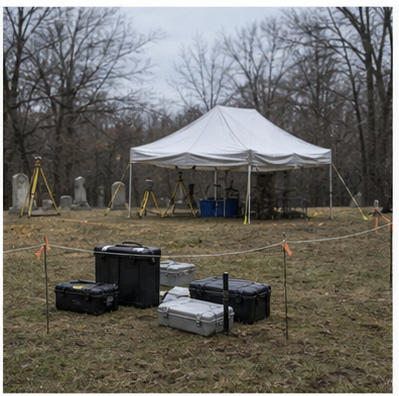
Editorial reconstruction: a controlled cemetery exhumation perimeter. The image shows logistics only; no remains or burial contents are depicted.
6. What forensic genetic genealogy actually produced
Investigative genetic genealogy is often compressed into a misleading sentence: DNA found the name. The real process is slower and more conditional. Traditional forensic profiles typically examine a limited set of markers useful for direct comparison. Genetic genealogy can examine hundreds of thousands of single-nucleotide polymorphisms, producing a profile that may be compared with data from users who have permitted such matching under the relevant service’s rules.
The computer does not display a final identity with a certainty stamp. It may return people who share segments of DNA with the unknown person. The amount and pattern of sharing suggest possible degrees of biological relationship. Genealogists then build family trees backward to common ancestors and forward through descendants, using obituaries, birth and death records, marriage documents, directories, newspapers, and other sources. They eliminate branches that do not fit sex, age, geography, chronology, or known family structure.
In Joseph’s case, the work reached relatives on both maternal and paternal sides and was reconciled with a birth record. Philadelphia police announced that the unidentified child was Joseph Augustus Zarelli, born January 13, 1953, a Philadelphia native. The achievement was substantial: researchers had turned degraded biological material into kinship leads, then turned kinship leads into one child documented in the historical record.
But notice the grammar of the result. The DNA associated Joseph with biological families. It did not identify the person who inflicted fatal harm. Kinship is a relationship of inheritance. Criminal responsibility is a conclusion requiring evidence about acts, opportunity, knowledge, causation, and intent. Confusing the two would convert every genetically related person into a suspect, including people who may never have met the child.
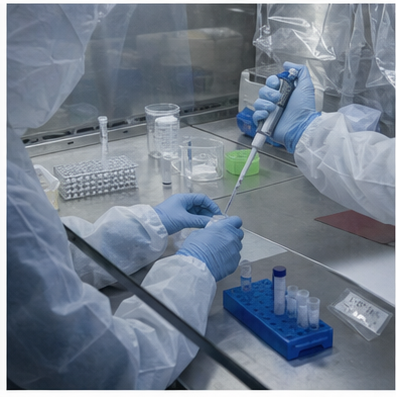
Editorial laboratory scene: careful processing of a small historic sample in a clean workspace, emphasizing the technical bridge between preservation and identification.
7. A lead is not a verdict
The distinction between a lead and proof is built into federal guidance on forensic genetic genealogy. Genealogical association can point investigators toward relatives and documentary branches. Traditional investigation must then test those leads. Reference samples, records, interviews, and independent corroboration are used to confirm identity or evaluate a person’s connection to an event.
This matters especially in a child homicide. A birth certificate identifies biological parentage as recorded at birth; it does not necessarily establish who provided daily care four years later. A shared surname does not establish a shared household. A household address does not establish who was present during an injury. Being alive at the relevant time does not establish opportunity. Opportunity does not establish an act. Each step needs its own evidence.
Philadelphia police said both of Joseph’s biological parents were deceased by the time of the announcement and noted that he had living siblings on both sides of his biological family. Authorities declined to release information that could expose those living relatives. That restraint is not an obstacle to good analysis; it is part of good analysis. Public curiosity cannot substitute for evidentiary relevance, and inherited proximity to a victim is not inherited guilt.
Police also said they had suspicions about who may have been responsible but would not publicly advance a theory they could not responsibly support. I follow the same rule here. Naming an uncharged deceased or living person from rumor would not solve the case. It would only replace the original blank with an accusation that readers cannot test.
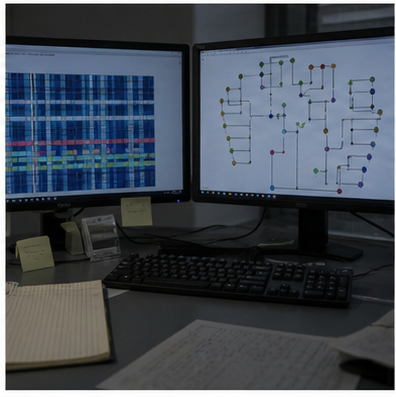
Editorial visualization: chromosome matches beside an abstract family network. It represents kinship analysis, not a suspect chart.
8. West Philadelphia and Fox Chase: the geography between life and discovery
Police indicated that Joseph had lived in the area of 61st and Market Streets in West Philadelphia. His remains were recovered in the Fox Chase area of Northeast Philadelphia. Those locations create a geographic interval that did not exist while he was unidentified. Before 2022, detectives had a disposal point without a confirmed home base. After identification, they could place his documented life on another part of the city map.
The distance is useful, but only if handled cautiously. It supports the inference that some form of transport was likely involved. It may help investigators search for vehicles, workplaces, family connections, former residences, institutions, or routine travel corridors linking the areas. It does not prove that the journey began at Joseph’s home, that one person made it, or that the most direct route was used.
I reconstructed the problem as a set of nodes rather than a single line: last confirmed household, possible place of injury, packaging source, vehicle access, disposal site, and the discoverer’s route. At present, several nodes are publicly unknown. Drawing one confident arrow across the city would hide those gaps. A good map should display uncertainty, not decorate it away.
The disposal site itself might reflect familiarity with Northeast Philadelphia, but familiarity has degrees. A person could know the location as a resident, worker, visitor, driver, customer, or someone following another person’s directions. The strongest geographic question is not “Who lived nearest?” It is “Whose documented movements, access, and timing connect the child’s final care environment to this specific landscape?”
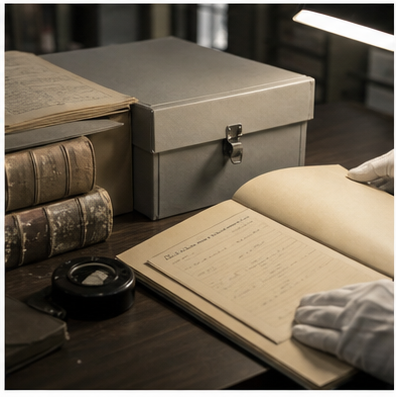
Editorial archive scene: ledgers, a document box and a vital-record folder. Documentary genealogy turned molecular relationships into a historically testable identity.
9. My two-column evidence ledger
To prevent the identity breakthrough from flooding every other question with false certainty, I sorted the major facts by the problem they can actually answer.
| Evidence or finding | Value to the identity file | Value to the homicide file |
|---|---|---|
| Historic biological sample | Made a genetic profile and kinship search possible. | Does not, by itself, show who caused the injuries. |
| Maternal and paternal genetic relatives | Narrowed family branches and supported the identification. | Creates possible sources of records and interviews, not automatic suspects. |
| Birth record | Linked the family-tree reconstruction to Joseph’s documented birth. | Records parentage at birth; it does not establish later custody or violence. |
| West Philadelphia association | Places Joseph within a real community rather than an unknown national pool. | Offers a starting region for household, institution, and travel research. |
| Fox Chase recovery site | Little direct identity value once Joseph is named. | Defines the end of the disposal journey and may preserve route or access clues. |
| Blanket and bassinet box | Could have prompted recognition in 1957; no public ownership chain is established. | May speak to transport and preparation if provenance or trace evidence can be recovered. |
| Severe injuries and malnourishment | Helped describe the unknown child but could not name him. | Establishes prolonged danger and fatal violence; timing and responsible person remain unresolved publicly. |
The ledger changes the tone of the case. Instead of asking one dramatic question—“Did DNA solve it?”—we can ask narrower questions that evidence can answer. DNA helped solve identity. The birth record anchored that identity. Geography reopened the search for a final care environment. None of those findings publicly identifies the killer.
10. What the name makes newly searchable
A named child leaves different documentary shadows from an unidentified child. Investigators can search hospital and pediatric records where they lawfully survive, baptismal or religious records, address directories, property files, welfare contacts, court documents, school enrollment, neighborhood photographs, employment records of adults in the household, and death or marriage notices that reveal extended networks. Even a negative record can define a boundary: no school enrollment at an expected age, no clinic entry after a certain date, no household listing where later accounts assumed one.
Yet absence must be interpreted carefully. Records from the 1950s may have been destroyed, never centralized, misspelled, filed under another surname, or kept by an institution that later closed. No record found is not equivalent to no event. The correct phrase is narrower: no surviving record located in the sources searched.
The name also lets investigators revisit old tips. A statement dismissed in 1957 because it could not be tied to an unknown child may look different when compared with Joseph’s family structure, address, age, and dates. Conversely, many famous theories can be rejected more confidently if their claimed child, household, or geography conflicts with the confirmed identity.
This is where identification can strengthen the homicide file without solving it. The new name acts as an index key. It allows old evidence to be sorted against a real life. The gain is not certainty; it is relevance.

Editorial geography study: a physical map joining West Philadelphia’s rowhouses to wooded Northeast terrain. The line marks an investigative interval, not a proven route.
11. The missing interval in Joseph’s life
The most consequential unanswered question is not the identity of his biological relatives. It is the structure of Joseph’s daily life close to his death. Who housed him? Who fed him? Who could observe his injuries or decline? Who had authority over medical care? Who owned or could obtain the blanket and box? Who had access to transportation? Which neighbors noticed a child and then noticed his absence?
These questions define what I call the custody interval. Public records can establish birth and biological relationship, while the recovery scene establishes death. Between them lies almost four years of changing households, relationships, and possible informal arrangements. Unless that interval is reconstructed, a family tree remains a genealogy chart rather than a crime timeline.
The child’s condition suggests that the danger was not limited to one invisible instant. That may mean there were opportunities for someone to notice, but opportunity depends on visibility. If Joseph was socially isolated, the potential witness pool may have been very small. If he moved between homes, responsibility and observation may have been fragmented. If adults used different surnames or gave inconsistent explanations, later documentary reconstruction becomes still harder.
I cannot choose among those scenarios from the public evidence. What I can say is that the final breakthrough will probably require a record or testimony that crosses the custody interval: a document placing Joseph in a specific home at a specific time, a credible witness account of his care, a contemporaneous letter or photograph, or physical evidence independently connecting a person to the preparation and disposal.
12. Three hypotheses, stated at the right level
Hypothesis A: the fatal violence occurred within Joseph’s regular care environment
This is the most direct explanation for severe abuse and malnourishment: someone with sustained access harmed him, and another person in or near that environment may have known. It fits the possibility that his disappearance was not reported because the reporting circle overlapped with the responsible circle. But the hypothesis does not identify a particular household member, and biological parentage alone cannot fill that gap.
Hypothesis B: Joseph was living in an informal or changed care arrangement
A child can be biologically connected to one family yet live with another relative, partner, institution, or informal caregiver. Such an arrangement could explain why a search focused on formal family records failed and why later genealogy identifies relatives without immediately reconstructing the final home. This hypothesis requires documentary or testimonial support; it should not be populated with names from internet lore.
Hypothesis C: the disposal involved someone other than the principal abuser
Transporting and concealing a body can involve an accomplice, a person pressured after the death, or someone who knows only part of what occurred. If more than one person was involved, silence may have arisen from different motives. This could also separate the geography of violence from the geography of disposal. No public evidence establishes that division, so it remains a structural possibility rather than a claim.
These hypotheses are deliberately about relationships and logistics, not named suspects. A hypothesis is useful when it tells us what evidence would confirm or weaken it. It becomes harmful when it merely gives rumor a formal-looking label.
13. What time erased, and what may still remain
After nearly seven decades, criminal prosecution may be impossible even if investigators form a persuasive theory. Relevant adults may be dead. Witnesses may be unavailable. A confession may never have been made or preserved. Records may have been destroyed under ordinary retention schedules. Trace evidence may be exhausted, contaminated, or unable to answer who deposited it and when.
Still, an evidentiary conclusion is not identical to a courtroom result. Investigators may be able to establish a historical account through converging records even when no living defendant can be charged. A household chronology, medical pattern, vehicle connection, and credible contemporaneous statement could together produce a responsible public resolution. The standard for accusing a person should remain high precisely because no trial may test the case.
Modern laboratories may also revisit preserved items with methods that distinguish biological sources more precisely than earlier testing. But forensic promise should not be exaggerated. Touch DNA on an old object can reflect innocent handling, manufacturing, storage, investigative contact, or contamination. A profile without context can create another family tree without explaining the crime.
The most valuable surviving evidence may therefore be hybrid: a molecular result connected to an independently documented time and place. Science can identify whose biological material is present. History and investigation must explain why it is there.
14. The ethics of looking into a family tree
Genetic genealogy extends an investigation beyond the people who voluntarily submit DNA. A database user may lead researchers to cousins, ancestors, descendants, and siblings who never chose to participate. Federal policy and scientific institutions recognize the privacy and civil-liberties concerns. Those concerns do not cancel the method’s value, but they demand restraint in use and reporting.
For readers, the practical rule is simple: a person can be part of the route to identification without being part of the crime. The living relatives whose genetic distance helped restore Joseph’s name are not public evidence of wrongdoing. Publishing their names, addresses, photographs, or speculative roles would punish people for a biological connection they did not choose.
The same discipline applies to deceased relatives. Death removes the risk of prosecution, not the obligation to distinguish evidence from allegation. An unsupported accusation can still harm descendants, distort the record, and crowd out better leads. The case has accumulated decades of stories. I include only details that clarify the confirmed investigative structure.
The moral achievement of the 2022 identification was to return individuality to a child. It would be a contradiction to use that achievement as permission to erase the individuality and innocence of every relative around him.
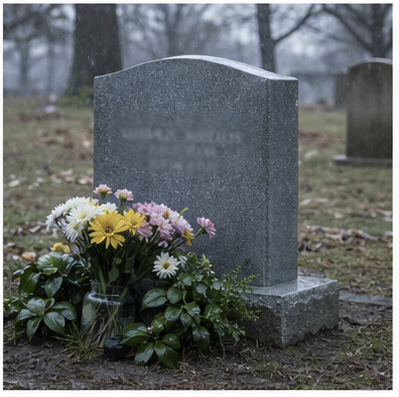
Editorial memorial: flowers at a newly named grave. The stone’s lettering is intentionally unreadable; the image honors identity without reproducing personal records.
15. A stone with a name—and a file still open
On January 13, 2023, the day Joseph would have turned seventy, a new grave marker bearing his name was unveiled at Ivy Hill Cemetery. The ceremony corrected the public language of the case. He was no longer an unknown child represented principally by the object in which he was found. He was Joseph Augustus Zarelli, born in Philadelphia, four years old when he died.
The named stone is an ending, but not the ending. It closes the administrative and human question of who was buried there. It does not record a place of fatal injury, a last reliable sighting, a caregiver chronology, or a responsible offender. Those blanks belong to the second folder.
Philadelphia’s later use of forensic genealogy in other unidentified-victim cases shows that Joseph’s identification also became a precedent. The lesson is larger than one case: preserve remains and evidence, revisit exclusions when technology changes, combine laboratory results with records, and treat a genealogical match as an investigative lead rather than a verdict.
My verdict
The identity mystery is solved. The homicide is not.
The strongest reconstruction is that Joseph’s name opened a new investigative corridor between a documented West Philadelphia life and the Fox Chase recovery site. That corridor should be examined through custody, household, medical, institutional, vehicle, and route evidence. Genetic kinship established who he was; it did not establish who cared for him during the final interval or who killed him.
I therefore reject every theory that treats a surname, birth record, or family branch as proof of guilt. The next defensible conclusion must come from converging evidence: a documented care arrangement, a credible contemporaneous account, independently verified movement, or contextual physical evidence. Until then, Joseph has his name back, while responsibility remains an open question.
Sources and further reading
- CBS Philadelphia — Philadelphia Police identify the child as Joseph Augustus Zarelli (Dec. 8, 2022)
- CBS Philadelphia — Identification announcement and investigative details
- The Philadelphia Inquirer — Live coverage of the 2022 identification
- The Philadelphia Inquirer — DNA advances and the identification
- The Philadelphia Inquirer — DNA databases, exhumations and genetic genealogy
- Identifinders International — Technical case summary from the genealogy team
- Associated Press — Joseph’s named gravestone unveiled on his seventieth birthday
- NBC10 Philadelphia — Later victim-identification initiative and current open-case status
- National Human Genome Research Institute — Investigative genetic genealogy explained
- U.S. Department of Justice — Interim policy and investigative role of forensic genetic genealogy
- U.S. Department of Justice — Interim Policy: Forensic Genetic Genealogical DNA Analysis and Searching
- FBI Law Enforcement Bulletin, May 1957 — Contemporary request for assistance in identifying the child