From April 8 to May 7, 1992, six people were killed in five small retail businesses across Indiana, Kansas and Missouri. The case acquired a highway name, a composite face and the aura of a roaming phantom. I rebuilt it from the stores outward. The strongest thread is not the nickname. It is the ammunition and firearm evidence that investigators used to connect otherwise separate homicide files.
The phrase “I-70 Killer” makes the crime series sound geographically obvious: one man, one interstate, one straight route. The actual map is less tidy. One double homicide occurred in Wichita, well south of Interstate 70. Several shops were near major roads rather than visible from the interstate. The offender may have used I-70 as a travel corridor, but the label is an investigative shorthand, not proof of where he lived, worked or slept between attacks.
My reconstruction separates three kinds of linkage. Forensic linkage asks whether the same weapon or ammunition marks connect scenes. Behavioral linkage asks whether the selection of small stores, clerk control, timing and rapid departure form a repeated method. Geographic linkage asks whether the locations reveal a base or merely a road system. Only after those columns are separated can the pattern be tested without making the pattern circular.
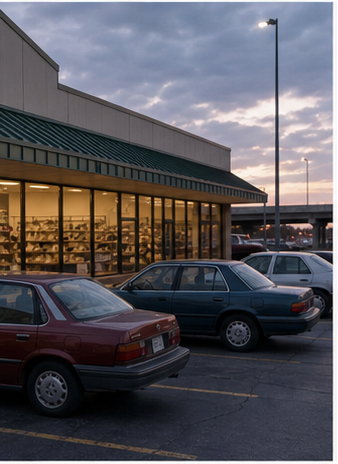
Editorial reconstruction: an early-evening suburban shoe-store exterior near an interstate. No victim, real storefront or exact scene is depicted.
1. April 8: Robin Fuldauer, Indianapolis
Robin Fuldauer, twenty-six, was killed while working at a Payless shoe store on Pendleton Pike in Indianapolis. Her homicide is the first confirmed scene in the 29-day sequence. A small retail unit offered the offender a particular environment: public access without an appointment, a clear view of staffing, predictable customer lulls, and a back area where a clerk could be moved out of sight.
The location matters as a business system more than as a single address. A shopper can enter without attracting notice, browse long enough to observe whether anyone else is present, and leave for a parking lot shared by many vehicles. In 1992, most such stores had no networked high-definition cameras, automated license-plate readers or persistent phone-location records. A witness might remember a man or car, but the scene produced far fewer involuntary digital traces than the same act would today.
The common claim that the series was motivated by robbery deserves care. Money was taken or disturbed at some scenes, yet the shootings were disproportionate to the small financial return available from specialty shops. Theft can be the objective, a secondary act, a staging device or simply what an offender does after gaining control. The fact that a cash drawer is open does not explain why a compliant clerk was killed.
Fuldauer’s case established the first physical comparison set: bullets, cartridge evidence, scene position, wound path, shop layout and whatever trace material was preserved. At that moment police had a homicide, not a known series. The series would emerge only when another laboratory result and another strangely similar store scene arrived from hundreds of miles away.
2. April 11: Patricia Magers and Patricia Smith, Wichita
Three days later, Patricia Magers, thirty-two, and Patricia Smith, twenty-three, were killed at La Bride d’Elegance in Wichita. Wichita Police list the case in the department’s Cold Case Unit material and describe both women as victims of the I-70 serial killer. This double homicide complicates any simple rule that the offender attacked one lone clerk. Two people were present, and the location was not on Interstate 70.
The bridal shop strengthens the behavioral pattern while weakening a literal highway interpretation. Like the first store, it was a specialized retail environment where a man could enter as a customer or companion without needing credentials. Clothing racks and fitting areas divided sight lines. A rear room allowed control away from the windows. But the offender had travelled far enough from the corridor that his route must be modeled through the larger interstate network, not one road number.
The presence of two victims is an important test. If the killer required a solitary woman matching a narrow physical type, this scene should have disrupted the plan. Instead, the attack continued. That suggests either that he did not detect the second person before committing himself, that the number of victims was less important than the business environment, or that the target criteria were broader than later summaries imply.

Editorial reconstruction: an empty bridal boutique and rear doorway after closing. The respectful scene illustrates store geometry without reenacting the crime.
For investigators, the Wichita homicides added a second jurisdiction and a double quantity of scene material. It also introduced a coordination problem. Witness statements, autopsy information, bullets, cartridges, retail records and suspect lists were controlled by different agencies under different state systems. Linking them required people to recognize similarity and laboratories to compare physical evidence across boundaries.
The double homicide therefore performs two roles in my reconstruction. It shows that the offender could continue when the scene was more complicated than expected. And it warns against mistaking the case name for a precise travel log. The series was regional, not confined to the shoulder of I-70.
3. April 27: Michael McCown, Terre Haute
After a sixteen-day gap, Michael “Mick” McCown, forty, was killed at Sylvia’s Ceramics in Terre Haute, Indiana. He was the only male among the six confirmed victims. Some accounts have speculated that the offender may have assumed a woman worked at a shop bearing a woman’s name, or may have initially perceived McCown from behind as female. That explanation is possible, but it is not needed to preserve the series. Ballistic evidence is stronger than a theory about mistaken identity.
McCown’s inclusion changes the victim-selection question. The stable target may have been a store type rather than a specific appearance: small, quiet, independently staffed, near an efficient route, with a clerk who could be isolated. If the offender arrived intending to attack the person on duty, discovering a man may not have mattered. The killing may reveal flexibility, not error.
Terre Haute also brings the sequence back into Indiana and near I-70. A naive map might read Indianapolis → Wichita → Terre Haute as random backtracking. A work schedule, family obligation, sales territory, delivery circuit, military assignment, trucking route or recurring leisure trip could produce exactly that movement. The offender did not need to be a long-haul driver. He needed reliable access to transportation and a reason—or freedom—to cover long distances without drawing concern.

Editorial reconstruction: a modest ceramics-shop counter with pottery and an inventory pad, emphasizing the ordinary workplaces selected by the offender.
The sixteen-day pause should not be described as cooling-off psychology with false precision. It may reflect opportunity, travel, employment, money, illness, family presence, law-enforcement attention or nothing more than unrecorded behavior. If investigators can discover where a candidate was obligated to be on April 8, April 11, April 27, May 3 and May 7, the gaps become more useful than a personality label. A schedule can be checked; a generalized profile cannot.
4. May 3: Nancy Kitzmiller, St. Charles
Nancy Kitzmiller, twenty-four, was killed at a Boot Village store in St. Charles, Missouri. St. Charles authorities later became a leading force in renewing the multi-agency investigation. Regional Crime Stoppers states that ammunition recovered at the scenes was matched by the FBI laboratory. That is the backbone of the series: independently recovered firearm evidence bearing sufficiently corresponding characteristics to link the cases.
A ballistic link is powerful because it does not depend on memory or narrative resemblance. A firearm can leave microscopic toolmarks on bullets and cartridge cases. Examiners compare class characteristics and finer marks, historically through comparison microscopes and increasingly with digital imaging. Modern systems such as ATF’s NIBIN can generate leads between evidence from different places, though a database correlation is not itself the final laboratory confirmation.
The evidence also has limits. It can support that the same gun was used; it does not automatically identify who held it. A firearm can be sold, stolen, shared or transferred. A rare make or configuration may narrow the search, but rarity is not uniqueness. Without recovery of the weapon or a documented chain to a person, the marks connect scenes more securely than they connect a name.
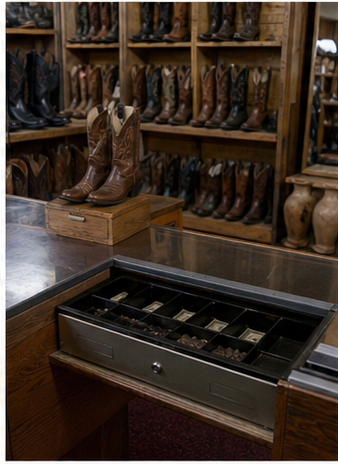
Editorial reconstruction: a boot-store counter and cash drawer. Small financial transactions may be part of the method without fully explaining the motive.
Kitzmiller’s scene gave the investigation another shop near the regional road network and another short window for arrival and departure. A shared parking area can conceal a vehicle in normal commerce. The offender’s greatest advantage may have been that nothing about entering a shoe or boot store appeared abnormal until the moment of control.
5. May 7: Sarah Blessing, Raytown
Four days later, Sarah Blessing, thirty-seven, was killed at the Store of Many Colors in Raytown, Missouri. A nearby witness saw a man associated with the store around the relevant time and contributed to the description used in composite sketches. The Raytown scene is the last homicide publicly confirmed in the 1992 sequence.
Witness evidence is both essential and fragile. A person seen entering or leaving near the time of a murder may be the offender, an ordinary customer or someone whose timing is remembered incorrectly. Lighting, distance, stress, divided attention and later exposure to a sketch affect recall. A composite is a visual recording of a witness’s recollection filtered through an artist and interview—not a photograph.
The witness account becomes stronger when aligned with scene timing and behavior: a person enters during the narrow window, a sound is heard, the person departs immediately, and the clerk is then found. Yet even strong situational identification can be poor at predicting how the same man would look thirty years later. Hair changes, weight changes, faces age, and the original feature choices may contain error.

Editorial reconstruction: a view from a neighboring storefront as an unidentifiable man leaves a small shop. The figure is symbolic and not a likeness.
The abrupt end after May 7 has inspired theories: death, imprisonment, relocation, military deployment, fear after being seen, loss of the gun, or a switch in method. None is established. A series can also appear to stop because later cases lack comparable evidence. If the firearm was discarded, an offender could continue without the signature that linked the first five scenes. Conversely, forcing later murders into the series because the public expects continuation can contaminate analysis.
6. The five-scene clock
| Date | City and victims | What the scene adds | What it cannot prove alone |
|---|---|---|---|
| Apr. 8 | Indianapolis — Robin Fuldauer | First confirmed retail scene and firearm-evidence baseline. | That the offender lived in Indianapolis or already intended a series. |
| Apr. 11 | Wichita — Patricia Magers and Patricia Smith | Double homicide, distant travel, same small-store control pattern. | That the second victim was expected or that I-70 itself dictated the route. |
| Apr. 27 | Terre Haute — Michael McCown | Return to Indiana and evidence that a male clerk did not stop the attack. | That the offender mistook McCown for a woman. |
| May 3 | St. Charles — Nancy Kitzmiller | Missouri scene and documented multi-scene ammunition linkage. | That theft was the primary motive. |
| May 7 | Raytown — Sarah Blessing | Witness window, composite description and last confirmed 1992 scene. | That the offender stopped offending permanently. |
The timeline is short enough to examine as a travel calendar. The offender had to be available in Indianapolis on a Wednesday, Wichita on a Saturday, Terre Haute on a Monday, St. Charles on a Sunday and Raytown on a Thursday. That mixture of weekdays and weekends may be more discriminating than the road. A candidate whose employment records, military logs, hotel receipts, fuel purchases or family memories place him elsewhere on even one date is weakened. A candidate whose verifiable movements repeatedly match becomes more interesting.
7. The route is a network, not a line
I plotted the five scenes as nodes connected by plausible highways, not as beads on I-70. Wichita requires an approach from the interstate system through Kansas routes; Raytown and St. Charles sit on opposite sides of Missouri; Terre Haute and Indianapolis define an Indiana axis. The total pattern is compatible with someone familiar with central interstate travel, but millions of people fit that description.
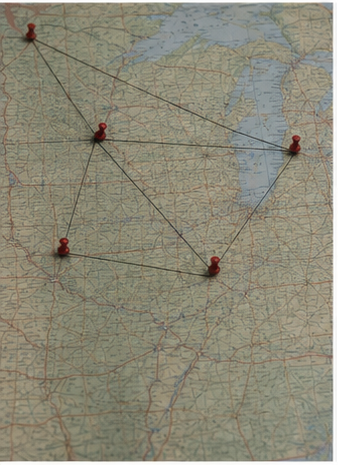
Editorial route board: five scene pins across Indiana, Missouri and Kansas. Lines show comparison paths, not a proven itinerary or home base.
Geographic profiling becomes unreliable if scene selection is driven by employment or personal travel. A salesperson may offend far from home but near assigned stops. A divorced parent may move between two family centers. A veteran or contractor may revisit installations. A driver may follow freight. A person without fixed work may simply select places along recreational travel. The same map can be generated by very different lives.
The best geographic question is therefore not “What point is in the middle?” It is “What recurring obligation makes all five dates and directions ordinary for one person?” Center-of-gravity calculations assume that crimes radiate from a stable anchor. A mobile offender may have several anchors or an anchor that is itself a route.
Even the store locations should be analyzed in layers: distance from an interchange, visibility from through-roads, parking-lot exits, surrounding businesses, closing hours, staffing patterns, and whether the offender could observe the shop before entering. The selected vulnerability may have been architectural rather than geographical.
8. Ballistics: the strongest thread and its boundary
Regional Crime Stoppers describes the six murders as linked through the murder weapon and ammunition, with recovered ammunition matched by the FBI laboratory. That statement deserves more evidentiary weight than later psychological descriptions. It is a physical association between scenes investigated by separate departments.
When a semiautomatic firearm cycles, components can receive marks from the firing pin, breech face, extractor, ejector and barrel. Examiners compare questioned items with one another or with test fires from a recovered gun. Shared class characteristics narrow the firearm type; corresponding microscopic marks may support a same-firearm conclusion under the laboratory’s standards.
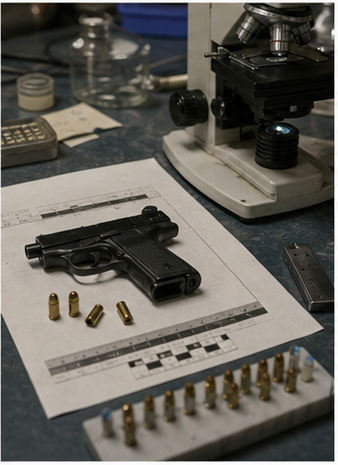
Editorial forensic scene: a small-caliber pistol, cartridges and microscope illustrate firearm comparison. The gun is generic and not claimed to be the murder weapon.
Three cautions follow. First, a match is only as useful for identification as the custody history of the gun. Second, old evidence must be preserved and re-examined under validated methods; database imaging cannot manufacture missing marks. Third, reporting language matters. A computerized NIBIN lead is a candidate association that trained examiners must confirm. A laboratory conclusion should be described in the exact terms used by the laboratory, not inflated into mathematical certainty by a writer.
If the murder weapon is ever recovered from an unrelated seizure, modern ballistic databases could connect it to stored evidence. But a gun found decades later might have passed through several owners. The investigation would still need records, fingerprints, DNA, statements or possession evidence tying it to the correct person in spring 1992.
9. Victim pattern or store pattern?
Five of the six victims were women, and summaries often emphasize age, build or hair color. Those observations may matter, but the sample is small and heavily shaped by retail staffing. The relevant question is whether the offender selected individuals before selecting stores, or selected stores likely to contain a particular kind of employee.
McCown’s murder is the stress test. If the same gun and method connect his homicide, a theory requiring a female victim must explain why the offender proceeded. The store name may have suggested a woman, or the offender may have seen only a silhouette. Yet the simpler possibility is that gender preference was secondary to control, privacy and low resistance.
The double homicide in Wichita is another stress test. If solitude was required, the second person should have caused withdrawal. Instead, two people were killed. This suggests a method capable of adapting once the offender entered. It also means the public should avoid building a portrait from only the most visually similar victims while treating the exceptions as accidents.
I therefore rank the common factors this way: first, a small and relatively quiet retail environment; second, a clerk or small staff that could be moved away from public view; third, rapid access to a parking lot and road network; fourth, a low-value commercial setting where a visitor would not look memorable. Victim appearance may have influenced selection, but the public evidence does not establish it as the controlling rule.
10. Robbery, compulsion and staging
Small amounts of money were available at the scenes, and early reporting naturally described robbery. But robbery as an event is not necessarily robbery as motive. An offender who wants money can leave after receiving it. Killing compliant clerks increases risk without improving the take. Repeated execution-style violence points to an additional purpose: eliminating witnesses, exercising control, satisfying a compulsion, or creating a consistent scene.
Those possibilities cannot be diagnosed from distance. The correct method is to compare the sequence of actions. Did the offender ask about merchandise? Was the register opened before or after the victims were moved? Were valuable personal items left? Did he bring a bag or concealment? Did he spend time in the store after the shots? Details withheld by police may distinguish a practiced robber from someone using theft as cover.
The ordinary appearance of the businesses may itself have been strategic. A violent offender entering a bank or jewelry store expects alarms, cameras and resistance. A bridal, ceramics, boot or gift shop can provide access with little suspicion. The cash return is poor; the control environment is better.
11. The witness face is a lead, not an identity
Multiple accounts produced a description of a white man with reddish or light-brown hair and a lean build, though details vary. St. Charles Police released age-progressed composite images in 2021. Such images are valuable for prompting a memory, especially when combined with the unusual travel dates or a known small-caliber firearm. They are dangerous when treated as a facial-recognition result.
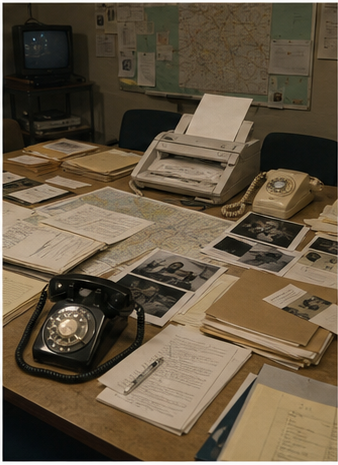
Editorial reconstruction: a 1992 multi-agency task-force table with fax pages, telephones, maps and folders. Cross-state coordination depended on people and paper.
Composite resemblance has an enormous false-positive field. Thousands of men can resemble a generalized drawing. Age progression adds another layer of estimation. A responsible tip should include verifiable context: the person travelled to the relevant cities, possessed a similar weapon, abruptly changed appearance, made a protected-detail statement, or had a work route matching the dates. “He looks like the sketch” is a starting observation, not a case.
Witnesses should also be re-interviewed with care. Repeated exposure to published sketches and documentaries can blend source memory. Investigators need to preserve the earliest descriptions and measure later recollections against them. A detail recorded before it became public is far more valuable than one remembered after decades of media coverage.
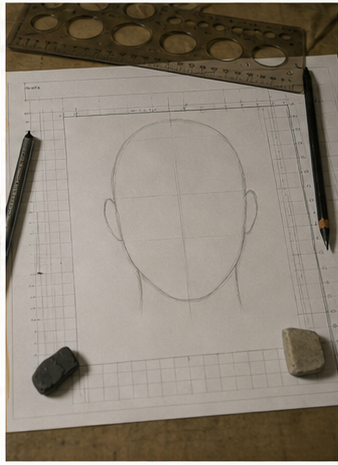
Editorial sketch desk: a deliberately generic unfinished face. A composite records recollection and should never be mistaken for a photograph.
12. Five departments, one offender, many seams
In 1992, a homicide file was primarily local. Detectives knew their city, witnesses and evidence room. Long-distance telephone calls, mailed photographs and faxed reports connected agencies, but there was no single shared cloud workspace. A name cleared in one jurisdiction might appear under a spelling variation in another. Vehicle descriptions could be coded differently. A tip might look unimportant until compared with a scene hundreds of miles away.
The FBI laboratory’s ballistic comparison helped cross those seams. Later task-force meetings brought Indiana, Kansas and Missouri investigators together. St. Charles Police reported a renewed initiative and review of evidence, while Wichita continues to list the bridal-shop homicides in its cold-case material. The collaboration is important because the offender’s advantage was jurisdictional movement.
A modern review should normalize every record into one chronology while retaining its source. Times need uncertainty ranges. Witness descriptions need their first-recorded wording. Vehicles should be compared by make, model, color, damage and direction. Tips should be deduplicated so that ten retellings of one rumor are not counted as ten independent reports.
Most of all, exclusions should be audited. A person dismissed because his car color seemed wrong may deserve reconsideration if the original witness expressed low confidence. A person excluded by alibi should remain excluded if the alibi is documented. Cold-case work is not about reopening every door; it is about checking whether each door was closed for a durable reason.
13. Later cases: test them, do not inherit them
Murders and an attempted murder in Texas in 1993 and 1994, along with a 2001 Terre Haute store homicide, have been discussed as possible extensions of the series. Similar retail settings, victim control or witness descriptions can justify comparison. They do not justify automatic inclusion. Reports indicate that the firearm in the Texas cases was not the same weapon used in the confirmed 1992 murders.
A changed gun does not exclude the same offender, but it removes the strongest physical link. The question must then be rebuilt from independent evidence: distinctive behavior not widely publicized, consistent travel opportunity, trace evidence, a matching vehicle, or a credible witness association. Broad facts such as “small store,” “clerk,” and “shot” occur in many unrelated crimes.
Series inflation is a real investigative hazard. Adding weak cases can distort the offender model, expand the geography beyond usefulness and import another killer’s evidence into the suspect pool. The confirmed six should remain the core. Later cases belong in a comparison file with explicit confidence levels.
14. What evidence could still break the case
A preserved biological trace with scene context
A usable DNA profile on an item handled by the offender could enable a direct database match or, where lawful and appropriate, forensic genetic genealogy. Context is critical. DNA on a public store surface may belong to an innocent customer. DNA on a protected item placed during the attack would be more discriminating. A 2021 St. Charles departmental report stated that evidence possibly containing suspect DNA would be sent to a forensic laboratory; no public result should be assumed from that submission.
Recovery of the firearm
A weapon linked by confirmed examination could generate a possession history. Serial-number restoration, sales records, prior owners, theft reports and later seizures might lead back toward 1992. Even an incomplete chain could identify a social circle or region that intersects the travel calendar.
A work or travel archive
Expense reports, hotel ledgers, delivery manifests, military records, union assignments, toll receipts and family calendars may place a person in all five cities. Individually such records look mundane. Together they could explain why the offender crossed states without appearing to disappear from his ordinary life.
A statement containing protected details
A confession or intimate remark becomes powerful when it includes facts never published and consistent across scenes. The detail must be protected, specific and independently verified. General boasts about being “the highway killer” after widespread publicity carry little weight.

Editorial modern review room: sealed evidence, a digital route map and an empty chair. The case remains unresolved, but preserved evidence can acquire new value.
15. My ranked reconstruction
I believe the offender selected commercial environments that gave him temporary control, then used regional travel to keep each local investigation from immediately revealing the full pattern. The road network was an enabling tool, not necessarily the source of his identity. He was comfortable entering ordinary stores, assessing occupancy, moving people away from view and leaving before the scene attracted attention.
The return to Indiana after Wichita and the later sweep across Missouri make a simple westbound drifter story unlikely. The movement looks more like repeated access to several anchors or a route imposed by work or relationships. The weekday distribution supports someone with flexible hours, travel-based employment, unemployment, leave, shift work or a job that itself placed him on the road.
I do not find the public evidence strong enough to declare that appearance drove victim selection. Five women and one man in retail jobs may reflect a preference, staffing demographics or both. The robust target was the store situation. The robust cross-scene evidence was the firearm linkage.
My conclusion
The confirmed I-70 series is best understood as five controlled retail scenes connected by ballistics and a 29-day travel calendar. The interstate nickname accurately conveys mobility but falsely suggests a simple line and a highway-based home.
The most promising suspect would not merely resemble the composite. He would have a documented reason to move between Indianapolis, Wichita, Terre Haute, St. Charles and Raytown on the exact dates; access to the linked .22-caliber firearm; and a personal history compatible with sudden availability in spring 1992. A contextual DNA result, a recovered weapon or a protected-detail statement could then convert that pattern into proof.
Until such evidence appears, named internet suspects should remain outside the conclusion. Six people lost their lives in ordinary workplaces. The case deserves a solution built from verifiable linkage, not a resemblance contest.
Sources and further reading
- Wichita Police Department — Cold Case Unit entry for Patricia Magers and Patricia Smith
- St. Charles County Regional Crime Stoppers — I-70 serial killer chronology and FBI laboratory linkage
- St. Charles Police Department — 2021 annual report describing the renewed investigation
- St. Charles Police Department — November 2021 report on evidence submitted for forensic testing
- KSHB 41 — Multi-agency search continues 32 years later
- KWCH 12 — Wichita Police participation in the renewed investigation
- A&E — Victim chronology and interviews concerning the continuing search
- The Kansas City Star — 2021 age-enhanced sketches released by St. Charles Police
- Bureau of Alcohol, Tobacco, Firearms and Explosives — How NIBIN links ballistic evidence
- ATF — NIBIN resources and distinction between leads and confirmed examination
- National Institute of Standards and Technology — Scientific foundation review of firearm examination
- NIST — Firearms and toolmark research and standards